














 The Constitutional Battle Over the Future of Prediction Markets
 Article Contributors


 Fact checked by
 Read Time: 1mins
 Published: 27/07/2026 | Updated: 03/08/2026


Dual Theories
The platforms base their legitimacy on federal licensing. Kalshi has operated as a designated contract market under the Commodity Futures Trading Commission (CFTC) since 2020, while Polymarket expanded its domestic reach by acquiring a regulated clearinghouse.
They argue that the Commodity Exchange Act grants the CFTC total authority over registered exchanges, effectively insulating their contracts from state interference under the Supremacy Clause.
Conversely, state gaming authorities argue that if a product operates like a sportsbook, it must follow local gambling laws. Regulators from New York to Nevada issued cease-and-desist orders throughout late 2025 and early 2026.
Tennessee demanded the cancellation of active trades, while Arizona pursued criminal charges against Kalshi under its election-wagering bans.
Divided Courts
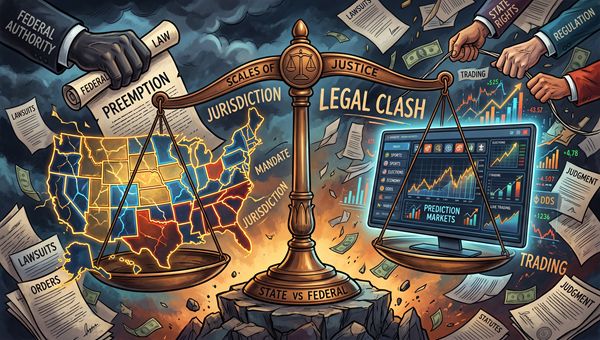
The legal battlefield remains deeply divided. Federal judges have favored the platforms in Tennessee, Ohio, Arizona, and Connecticut, ruling that state authorities cannot criminalize activities permitted by federal licenses.
However, states have secured significant victories elsewhere. Massachusetts and Nevada successfully obtained injunctions, Maryland affirmed that local betting laws apply to these markets, and a federal court in New York recently sided with the state’s gaming commission.
Meanwhile, three California tribes have escalated the conflict to the Ninth Circuit, arguing that these contracts violate the Indian Gaming Regulatory Act—setting two distinct federal frameworks against each other.
High Stakes
The financial motivations behind this legal fight are immense. Sports contracts account for nearly 90% of Kalshi’s trading volume and half of Polymarket’s business. While political markets gather seasonal interest, sports provide year-round engagement, highlighted by Kalshi processing over $1 billion on a single Super Bowl.
This rapid expansion threatens the traditional $150 billion licensed sports betting industry, which provides vital tax revenues to state budgets.
For federal regulators, the conflict has forced an unusual shift in strategy. The CFTC has taken the rare step of suing states like Connecticut, Arizona, and Illinois to protect its jurisdiction. Operating with a single confirmed commissioner, the agency is actively defending its registrants against local enforcement.
If the platforms successfully defend their position, the traditional framework of state-level gambling regulation could face permanent disruption. Activities reframed as exchange-traded assets would bypass local oversight, shifting consumer protection, taxation, and market boundaries entirely into the federal domain.


 eabungana@gmail.com

