














Top Blockchain Gambling Sites in October 2026
These platforms support deposits and withdrawals recorded on public chains. A public payment record does not automatically mean every game settles on-chain.
 Last Updated: 26/10/2026


-
 Trusted and known brand
-
Many cryptos available
-
Live Casino
Exclusive Bonus Offer of 200% Up To $3000




-
High welcome bonus
-
No signup KYC required
100% Match Deposit Bonus up to $100,000



-
No Fuss and No Fees
-
Anonymous Gambling
-
VPN friendly
100% Bonus Up To 1 BTC + 10% Weekly Cashback

-
Quick registration process
-
No maximum withdrawal
-
Many Crypto Payment Options
70% Rakeback & $75k Weekly Leaderboards



-
Popular cryptocurrencies accepted
-
Over 15,000 Casino Games
-
Large selection of slots
100% up to €500 OR a Wager-free €300 package



-
Fully licensed
-
Regular offers
-
Many cryptos accepted
500% Welcome Package


-
Provably Fair Games
-
Dice-focused
-
Instant withdrawal
🔥500% WELCOME BONUS up to 3BTC + 100 Free Spins

-
Native tokens
-
Large selection of games
-
Top Gambling Site
Bonus up to $500 + 100FS


-
Live Casino
-
Generous welcome bonus
-
Dice-focused

-
Provably Fair Games
-
Play with No KYC & Complete Privacy
-
Fast payouts
$50,000 Weekly Race

-
Instant Payout
-
Popular cryptocurrencies accepted
-
Easy, quick registration



-
Large selection of games
-
Anonymous Gambling
-
Licensed and secure operator


-
Live Casino
-
Top game developers
-
Fast payouts

-
Quick Registration
-
Extensive game selection
-
User-Friendly Design
What Is Blockchain Technology?
Blockchain technology is a system in which a network of computers shares, checks, and preserves an ordered digital record.
Records are shared between participants, added in an agreed sequence, and are extremely difficult to alter once the network accepts them.
Think of a bank ledger. A bank controls the master copy and can edit or reverse entries. On a public blockchain, many participants hold matching copies, and new entries are accepted only when the network’s rules are satisfied.
In practical terms, blockchain technology means that participants who may not know or trust one another can still agree on a single transaction history. Cryptographic links and network consensus make unauthorized changes detectable, removing the need for a single record keeper.

How Blockchain Technology Works
A blockchain works by broadcasting proposed transactions, checking them against shared rules, ordering valid transactions into blocks, and using consensus to make one history authoritative. The mechanism becomes clearer when its main components are separated.
Blocks, Hashes, and Nodes
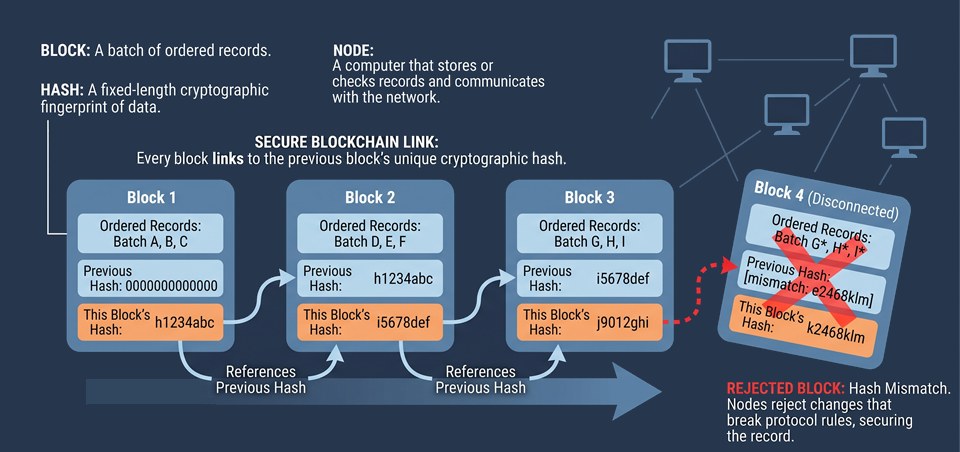
A block is a batch of ordered records. A hash is a fixed-length cryptographic fingerprint of data, while a blockchain node is a computer that stores or checks records and communicates with the network.
Each block references the previous block’s hash. If an old record changes, its hash changes too, breaking the link with the blocks that follow. This is how a hash helps secure blockchain technology.
Nodes reject transactions and blocks that break protocol rules. A larger, more distributed network makes it harder for one participant to influence the shared record, although node count alone does not determine decentralization.
What Happens When You Send a Transaction?
- You sign it. Your wallet uses a private key to authorize the amount and destination without revealing the key itself.
- Nodes receive it. The wallet broadcasts the signed transaction, and nodes check its format, signature, balance, and other protocol rules.
- Validators order it. A miner or validator selects the valid transaction and includes it in a proposed block.
- The network confirms. The accepted block becomes part of the shared history, and later blocks or validator votes strengthen finality.
A confirmation means the transaction has entered the accepted chain. Some platforms wait for additional confirmations depending on the chain, transaction value, and double-spend risk.
A transaction can still fail or remain pending because of low fees or rejected instructions. A wallet showing “sent” does not necessarily mean the recipient has a final balance, so the transaction hash remains the best way to verify its status.
Consensus Mechanisms
Consensus mechanisms solve a difficult problem: how can strangers agree on one valid record when messages arrive at different times, and some participants may lie? The rules determine who may propose the next block, how others verify it, and what makes the result final.
1. Proof of Work
Proof of work makes miners spend computing power and electricity to compete for the right to add a block. Bitcoin rewards the winning miner with newly issued BTC and transaction fees. Rewriting history requires reproducing the work and overtaking the honest chain, which is expensive. The trade-off is substantial energy use and an average ten-minute block interval.
2. Proof of Stake
Proof of stake makes validators lock native assets as collateral. Ethereum validators stake ETH, propose blocks in 12-second slots, and vote on the accepted chain. Provably dishonest behavior can cause some or all of the validator’s stake to be destroyed. It uses far less energy than mining and supports faster settlement, although stake concentration creates its own governance risks.
3. Other Consensus Models
Delegated proof of stake lets token holders elect a smaller validator group; TRON uses 27 elected Super Representatives. Proof of authority gives block-production rights to approved, identifiable validators and is common on permissioned networks. Both increase speed by restricting participation, but they trade away some decentralization.
Where to Trade Cryptocurrencies Hosted on These Chains?
Our crypto exchanges hub compares platforms for buying, selling, and converting assets hosted on the chains discussed here. It covers custody, fees, supported markets, payment methods, and security without turning this technology guide into a buying tutorial.

Crypto.com
4.4/5A reputable cryptocurrency platform that offers a wide range of services, including trading, investin…

Binance
4.2/5Binance is one of the biggest names in the crypto exchange world. It’s undoubtedly become more than j…

Coinbase
3.4/5Along with Binance, Coinbase is perhaps the most well-known crypto exchange on the market. It’s no sh…
Types of Blockchain: Public, Private, and Permissioned
Blockchain is not one fixed architecture. The main distinction is who can join the network and who can validate changes. Public chains are open to anyone, while private and consortium networks restrict access or validation to selected participants.
Public crypto payments and verifiable gambling settlement rely on public chains because users can independently check transactions and results. A private chain controlled by the operator would remove that independent verification.
| Type | Who Can Join | Who Validates | Typical Use |
|---|---|---|---|
| Public | Anyone | Anyone meeting the consensus rules | Cryptocurrencies, open payments and public settlement |
| Private | Invited members only | Operator-appointed nodes | Internal company records |
| Permissioned or consortium | Approved organizations | A known member group | Shared industry records between firms |
| Hybrid | Mixed access, often open to read but closed to write | A restricted validator set | Public proof linked to private data |
Keys, Addresses, and Who Really Holds Your Crypto
A wallet does not contain coins. It stores or controls the private keys that authorize movement from addresses recorded on the chain. The public address tells the network where an asset is assigned; the private key proves who can spend it.
Custody therefore belongs to whoever controls the key, whether that is you, an exchange, or a gambling platform. Our crypto wallets hub covers the available custody options.


Blockchain Mining Explained
Miners are paid to order transactions, propose valid blocks, and help secure proof-of-work networks. On Bitcoin, the successful miner receives newly issued BTC through the block subsidy plus transaction fees.
Mining applies only to proof-of-work chains. Proof-of-stake networks use validators and staked assets instead, avoiding competitive computation.
Proof of work uses electricity and specialized hardware to make attacks costly, which also creates environmental costs. Proof of stake uses far less energy but relies on capital at risk. Our environment and sustainability guide covers these trade-offs in more detail.
Blockchain Security and Where It Ends
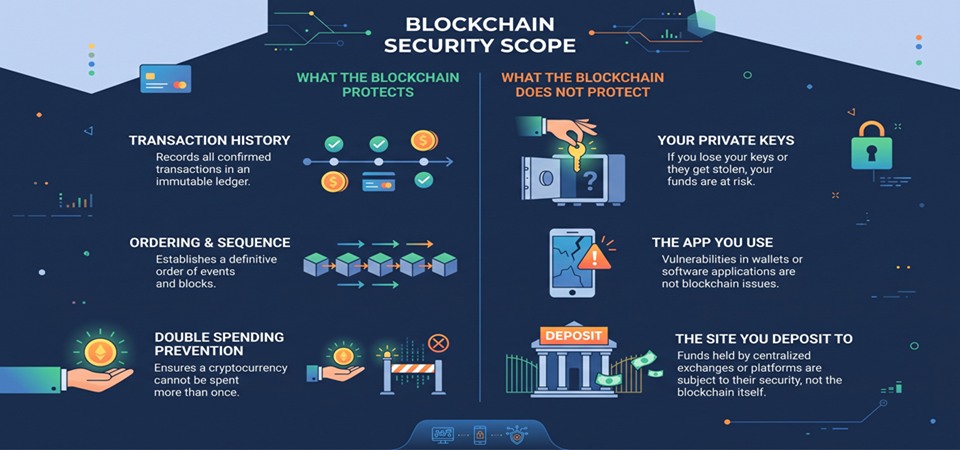
Blockchain security protects the transaction record through hashing, signatures, validation rules, and consensus. A 51% attack occurs when one party controls enough mining power or validator influence to reorganize recent history or censor transactions. It is economically and operationally expensive on a large network, but not mathematically impossible.
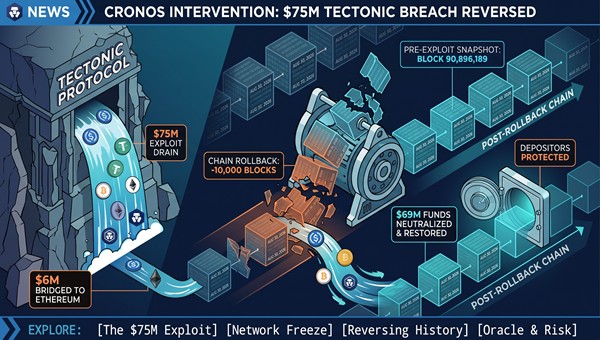
The chain’s security does not automatically protect anything built on top of it. A phishing page can steal a seed phrase, a malicious signature can grant token access, a smart contract can contain a bug, and an exchange can be hacked. In each case, the network may accurately record the theft or mistake.
Confirmed means final on most payment chains. Before sending, verify the asset, network, full destination address, and any required memo. Use a small test transfer for a new address and consider hardware wallets for keys controlling material long-term holdings.
The Blockchain Trilemma: Speed, Cost and Security
The blockchain trilemma describes the trade-off between decentralization, security, and scalability. Improving one area can weaken another: more validators may slow coordination, while fewer validators can increase speed but concentrate control.
This is why some transactions settle in seconds at low cost while others take longer and cost more. The difference comes from how each network balances speed, security, and decentralization.
Layer 2 networks improve blockchain scalability by processing transactions above the base chain and settling results back to it. Bitcoin Lightning and Ethereum rollups can reduce costs and improve speed, although they introduce additional risks around bridges, operators, and withdrawals.
| Chain | Typical Confirmation | Typical Transfer Fee | Consensus | Best Suited To |
|---|---|---|---|---|
| Bitcoin (BTC) | About 10 minutes for one confirmation; 30-60 mins where 3 to 6 are required | About 141 sats for a 141-vB transfer at the checked 1 sat/vB rate; variable with demand and transaction size | Proof of work | Larger transfers where settlement certainty matters most |
| Ethereum (ETH) | About 12 seconds for block inclusion; roughly 13 minutes for protocol finality | About 0.0000009 ETH for a simple 21,000-gas transfer at the checked 0.043 gwei rate; variable | Proof of stake | Smart-contract activity and token transfers |
| Solana (SOL) | Usually under one second for confirmation; finality takes longer | About $0.001 to $0.05 for a simple payment in normal or congested conditions | Proof of stake with proof of history | Frequent small transfers |
| Litecoin (LTC) | About 2.5 minutes for one block; around 15 minutes for six | About 0.000049 LTC average in the checked network snapshot; transaction size still matters | Proof of work | Everyday transfers at low cost |
| TRON (TRX) | About 3 seconds for block inclusion | 0 TRX with sufficient Bandwidth and Energy; otherwise TRX is burned according to resource use | Delegated proof of stake | Stablecoin transfers |
These figures describe protocol timing and ordinary transfers, not a casino’s internal approval time. Fees and congestion change continuously. As a rule, match the confirmation time and fee to the value and urgency of the transfer rather than choosing a chain only because it is popular.
Blockchain Use Cases in the Real World
Blockchain is already used where multiple parties need a shared record or programmable transfer, although many announced projects remain pilots. The clearest current blockchain use cases are:
- Payments and remittances: stablecoins and native assets move across borders continuously without correspondent-bank opening hours.
- Prediction markets: contracts hold stakes, record positions, and pay outcomes under published rules.
- Digital ownership: tokens represent transferable access rights, collectibles, or claims on other assets.
- Supply-chain records: approved firms add time-stamped events to a ledger shared across organizations.
- Identity proofs: a holder can prove a signed credential without making one database responsible for every verification.
The Bank for International Settlements’ work on tokenisation shows that distributed ledger technology does not remove issues such as legal ownership, custody, data quality, or governance.
Blockchain is most useful when several parties need a shared record and independent verification; where one trusted organization controls everything, a conventional database is often simpler and cheaper.
The Future of Blockchain: Where It Is Heading
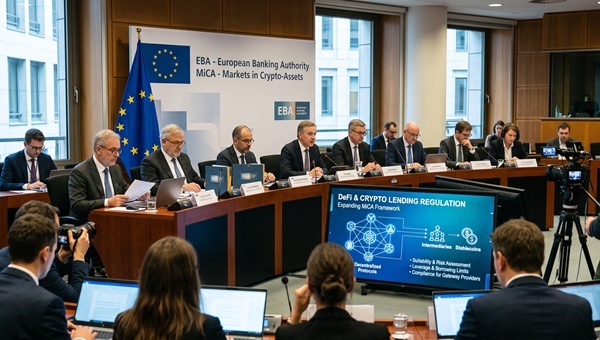
Three developments are already underway. Financial institutions are testing and using tokenized real-world assets; layer 2 systems are moving more low-cost activity away from congested base chains; and regulators are defining how token issuers, custodians, and service providers fit existing rules.
The direction is toward integration with ordinary finance and payments, not a separate system replacing everything.
Crypto Casinos and Provably Fair Games
A provably fair game uses a hidden server seed, a client seed, and a nonce to generate the result. Before the round, the operator publishes a hash of the server seed, then reveals the seed afterward so the player can reproduce and verify the outcome.
This shows that the committed input was not changed after the bet. It does not prove that the odds are favorable or that the operator can pay withdrawals. On-chain deposits and withdrawals add a public payment record, while fully on-chain games can also settle wagers through smart contracts.
Our Bitcoin gambling hub compares the brands, licensing, games, limits, and payment performance rather than repeating those rankings here.

Crypto Sports Betting and On-Chain Settlement
For bettors, payment timing matters. Crypto deposits can clear faster than bank or card payments, while a slow chain can still mean missing the odds or market price you wanted. Crypto withdrawals can also avoid some bank processing and card restrictions.
Smart-contract betting and prediction markets can settle stakes fully on-chain, but most sportsbooks still run accounts and markets on centralized systems even when crypto is used for payments. Compare options through our crypto sports betting hub.
Go Deeper on Crypto
Understanding the ledger makes wallets, payments, mining, and smart contracts easier to evaluate. Our crypto guides turn those concepts into practical instructions for storing assets, moving funds, checking terms, and avoiding common mistakes.
Latest Blockchain and Crypto News
Our crypto news hub covers network upgrades, regulation, security events, tokenized finance, and market developments. It is updated as material stories emerge.















Why You Can Trust Bitedge on Blockchain?
Bitedge began in 2009 and has focused on crypto betting since 2013. Our database contains more than 1,500 casino brands, while our published reviews use direct platform research rather than promotional claims alone. We test deposits, withdrawals, support, mobile access, and terms with real accounts and real funds.
Each page has a named author and fact-checker. We update or remove poorly rated operators when licensing, payment evidence, or complaint patterns no longer support inclusion. Our how we rate and review page explains the evidence and scoring criteria used across the site.
Frequently Asked Questions
What Exactly Is Blockchain Technology?
In simple terms, blockchain technology is a shared digital record that independent computers check and keep in the same order. Once the network accepts an entry, changing it without detection becomes extremely difficult.
What Is the Purpose of Blockchain Technology?
The purpose of blockchain technology is to let separate parties agree on a record without appointing one middleman to control it. It is useful when participants need a common transaction history, programmable settlement, and independent verification.
How Do You Explain Blockchain to Dummies?
Imagine a notebook copied to thousands of computers, where every accepted new line appears in every copy. If someone secretly changes an old line, their copy no longer matches the rest, and the network rejects it.
Where Is Blockchain Used in Real Life?
Blockchain is used for crypto payments, stablecoin transfers, tokenized assets, prediction markets, digital ownership, and shared records between organizations.
Is Blockchain 100% Safe?
No. Blockchain records can be very difficult to alter, but wallets, exchanges, smart contracts, and private keys can still be compromised.
How Does a Hash Help Secure Blockchain Technology?
A hash gives each block a cryptographic fingerprint, and the next block stores a reference to it. Altering an older block changes its hash, invalidating the links in every later block and exposing the attempted change.
Can I Withdraw My Money From Blockchain?
A blockchain is a record, not an account. You move crypto through a wallet or platform and sell it through an exchange if you want cash or bank funds.