














 Robinhood Chain Overtakes Solana in Daily Revenue as Gas Subsidies Near Expiration
 Article Contributors


 Fact checked by
 Read Time: 2mins
 Published: 07/09/2026 | Updated: 22/09/2026


Subsidies Drive Rapid L2 Growth
In just two months following its mainnet debut on July 1, 2026, Robinhood Chain has caused a significant shift across decentralized finance. Built using Arbitrum Orbit as an Ethereum Layer-2 ecosystem, the network recorded a massive surge in network activity, briefly outpacing heavyweight protocols like Solana, Base, and Ethereum in daily fee collection.
By late August, daily gas intake on Robinhood Chain hit $1.07 million, propelled by over 5.5 million daily transactions and $1.49 billion in decentralized exchange volume. The explosive metric growth stemmed largely from speculative token activity on specialized platforms such as Pons and GMGN, which facilitated thousands of new asset launches every day.
Combined with integrated liquidity from Uniswap, cumulative trading volumes on the platform surpassed $47 billion shortly after launch.
A core catalyst behind this initial user uptake was Robinhood’s temporary 90-day transaction fee subsidy. By absorbing initial gas expenses for users interacting through Robinhood Wallet, the platform eliminated onboarding friction, drawing massive liquidity and driving total value locked past $735 million alongside $2.4 billion in bridged assets.
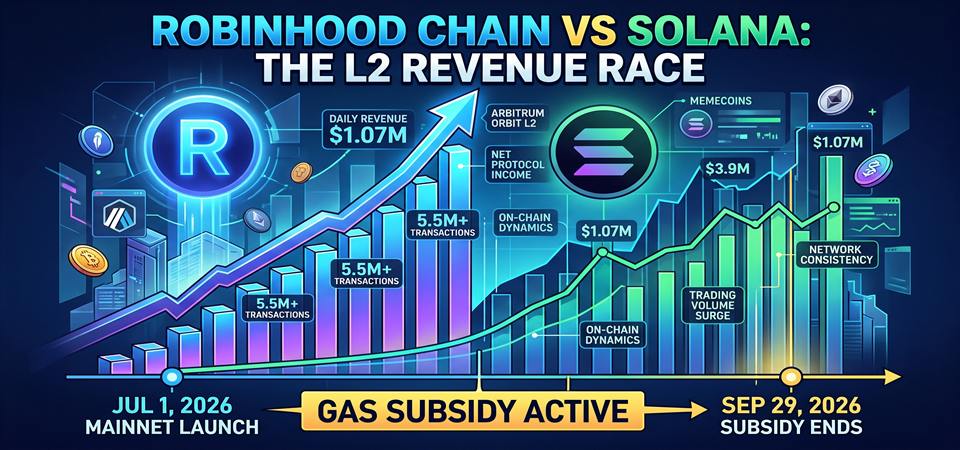
Robinhood Chain vs Solana Monetization
The rapid rise of Robinhood Chain sparked an industry-wide debate between blockchain founders regarding economic capture. Unlike Layer-1 architectures like Solana, where transaction fees reward independent validators and stakers, Layer-2 rollups enable operators to capture network sequencers directly.
Under Robinhood’s framework, the company retains roughly 89% to 90% of net protocol revenues. The remaining share covers Ethereum data availability costs and an approximate 10% allocation to the Arbitrum ecosystem under its expansion agreement.
On peak fee days, this mechanism funneled around $950,000 directly to Robinhood’s balance sheet in a single 24-hour period.
Solana proponents argue that building on an established Layer-1 provides greater organic network effects and lower infrastructure upkeep. However, supporters of the Layer-2 model stress that controlling the execution environment grants financial institutions total fee autonomy, ensuring revenue flows to the brokerage rather than external network operators.
The Post-Subsidy Outlook
As the 90-day subsidy program approaches its scheduled end on September 29, 2026, market observers are watching closely to see if current activity levels can be sustained.
On-chain analysis indicates that gas prices previously spiked nearly 25-fold during peak trading windows, with a substantial portion of activity driven by high-frequency wallets and automated bots.
The central question now facing the network is whether retail participants and third-party developers will remain active once required to cover their own gas fees.
While Solana has since reclaimed its lead in daily app revenues—topping $6.5 million in single-day generation—Robinhood Chain’s initial operational stretch has proven that dedicated enterprise Layer-2 solutions can compete with established public networks in overall revenue capture.


 eabungana@gmail.com

