














 Sui Outlines Multi-Stage Strategy for Post-Quantum Account Security
 Article Contributors


 Fact checked by
 Read Time: 3mins
 Published: 10/08/2026 | Updated: 25/08/2026


Navigating the Emerging Threat of Quantum Decryption
The cryptographic foundations underpinning decentralized networks face an inevitable long-term challenge: the arrival of fault-tolerant quantum hardware capable of running Shor’s algorithm. Because public-key cryptography reveals public keys onchain as soon as account transactions occur, blockchains are uniquely susceptible to “harvest-now-forge-later” strategy attacks.
Malicious actors can passively harvest onchain public keys today and simply await sufficiently powerful quantum machinery to reverse-engineer private keys in the future.
Recent studies from Google Quantum AI highlight that a quantum system operating with fewer than half a million physical qubits could potentially extract private keys within minutes once operational.
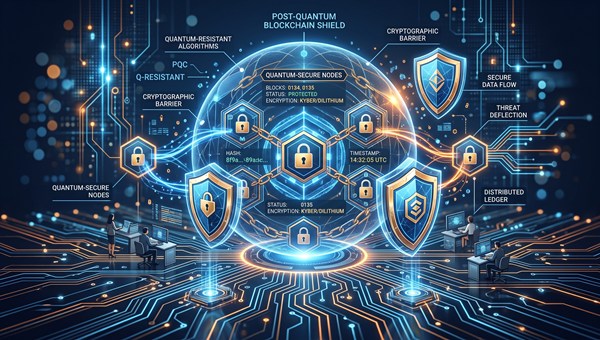
Government authorities and regulatory standards are shifting rapidly in response to these projected capabilities. Under recent federal mandates like Executive Order 14412, federal infrastructure deadlines have accelerated, requiring post-quantum digital signature adoption for sensitive systems by late 2031.
To stay ahead of these regulatory timelines and hardware breakthroughs, Sui has structured a comprehensive protocol-level transition to ensure its state remains resilient against advanced decryption attempts.
A Dual-Scheme Architecture Combining Lattice-Based and Hash-Based Post-Quantum Signatures
Rather than relying on a single cryptographic mechanism, Sui is integrating two distinct, NIST-approved signature standards built on fundamentally different mathematical paradigms.
By diversifying its cryptographic primitives, the network minimizes single-point vulnerabilities—ensuring that a theoretical breakthrough in cracking one mathematical model will leave the alternative shield intact.
Preserving User Experience and Seed Phrase Continuity Through Advanced Derivation
A critical aspect of Sui’s post-quantum framework is maintaining a smooth user experience. Upgrading to quantum-resistant authentication will not force users to generate brand-new seed phrases, discard existing recovery phrases, or migrate funds to entirely new wallet addresses.
Sui achieves this continuity through its deterministic key architecture combined with native address aliases. The protocol derives new ML-DSA-65 post-quantum keys directly from existing master seed phrases. Through address aliasing, an existing account can simply bind a new post-quantum authorization key to its current address without initiating token transfers or altering wallet balances.
While post-quantum public keys and signatures require larger payloads than traditional Ed25519 schemes—increasing raw transaction payload sizes—onchain verification costs remain manageable, and programmable transaction blocks help cushion the extra data overhead.
Multi-Phase Mainnet Rollout Schedule and Industry-Wide Security Benchmarks
The rollout follows an incremental, non-disruptive schedule similar to Sui’s past integrations of passkeys and zkLogin:
- Phase 1 (Late 2026): Smart contract vaults utilizing SLH-DSA-SHA2-128s land on Mainnet, while native ML-DSA-65 account authentication enters Testnet testing alongside ongoing third-party audits.
- Phase 2 (Q1 2027): Full Mainnet activation of native quantum-safe account authentication, accompanied by comprehensive SDK, CLI, and wallet integration support.
- Multisig Compatibility: Support will also extend to Sui’s native multisig framework, allowing accounts to require a hybrid signature pairing both classical Ed25519 and post-quantum ML-DSA-65.
Sui’s efforts reflect a broader industry transition toward post-quantum readiness. While BNB Chain has tested ML-DSA-44 and Starknet continues to push STARK-based proofs, Sui’s dual-engine deployment offers a clear, structured pathway toward preserving onchain assets well before quantum threats materialize.


 eabungana@gmail.com

