














 TRON Solidifies Global Stablecoin Dominance in Q2 USDT Transfers
 Article Contributors


 Fact checked by
 Read Time: 2mins
 Published: 13/08/2026 | Updated: 25/08/2026


Record-Breaking Transfer Volumes and Market-Leading Stablecoin Supply
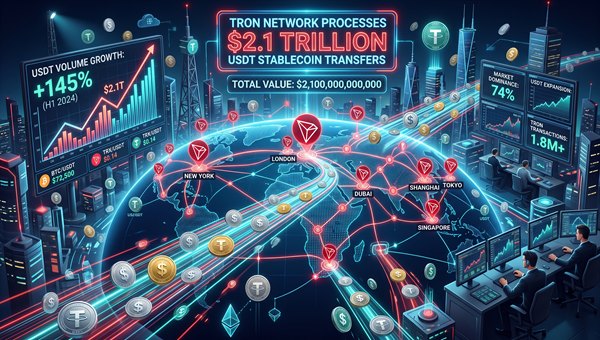
The second quarter of 2026 marked a major operational milestone for TRON, the Layer-1 protocol established by Justin Sun. Data published in Messari’s latest network performance report shows the ecosystem facilitated $2.1 trillion in Tether (USDT) transfers over the three months.
Driven by continuous demand for low-cost settlement, average daily USDT movement bounced back from early-year lulls, climbing 4.3% quarter-over-quarter to reach $22.8 billion per day.
TRON’s total stablecoin valuation expanded by 4.1% during the quarter, touching a record high of $89.2 billion. USDT remains the absolute cornerstone of this asset class on the network, representing 98.5% of its total stablecoin capitalization.
By the end of June, TRON held 47.6% of all circulating USDT across the crypto ecosystem, securing an $87.9 billion balance that surpassed Ethereum’s $78.7 billion total. Growth maintained its momentum into July, with on-chain records confirming that circulating USDT on TRON broke past the $90 billion threshold shortly after the quarter closed.
Network engagement remained equally robust, averaging around 11.8 million to 12.07 million daily transactions while total lifetime operations topped 15 billion.
Rebound in Network Fees and Changing TRX Token Economics
Increased transaction density noticeably strengthened protocol revenue. TRON produced $699.4 million in total fee revenue throughout Q2, reflecting a 15.9% increase in dollar valuation. When denominated in native TRX, fee generation rose 2.1% to 2.10 billion TRX.
This upturn represents the network’s first quarterly revenue expansion since governance participants voted to reduce the energy unit price in August 2025. Meanwhile, the average cost per transaction experienced a modest 5.4% uptick, bringing the typical execution fee to $0.65.
Despite heightened transactional throughput, the network did not achieve net token deflation over the quarter. Token creation outpaced burning mechanisms, increasing circulating TRX by roughly 87 million tokens to end Q2 at 94.85 billion TRX.
By mid-August, total circulating supply nudged slightly higher to 94.898 billion TRX, driven by daily issuance of approximately 3.92 million TRX against 3.32 million burned. Concurrently, total staked TRX dipped 0.9% to 45.7 billion, nudging the overall network staking participation rate down to 48.2%.
Expanding Institutional Bridges and Regulated Access in the U.S. Market
Alongside transaction growth, TRON deepened its connectivity with institutional capital in the United States. Binance.US re-enabled spot trading for TRX in mid-April, reintroducing spot pairs against USD and USDT along with native blockchain deposits and withdrawals.
Furthering institutional involvement, CFTC-regulated exchange Bitnomial launched spot TRX trading in Q2 before introducing exchange-traded TRX futures contracts in late July. Industry observers point out that establishing a regulated futures track record fulfills a key structural prerequisite for any future spot exchange-traded fund (ETF) applications.
Institutional staking frameworks also gained momentum. Anchorage Digital enabled client staking directly from its regulated custody environment in mid-July. Meanwhile, asset manager Canary Capital pushed forward with its proposed exchange-traded trust, filing an updated registration statement detailing plans to list a staked TRX fund under the ticker TRXS on the Cboe BZX exchange.
As TRON’s global payment role broadens, regulatory oversight remains sharp. On July 1, the U.S. Treasury’s Office of Foreign Assets Control (OFAC) added 131 TRON addresses linked to terrorist financing networks to its sanctions list, prompting Tether to freeze all associated wallet balances.
On the technical side, TRON successfully deployed its GreatVoyage v4.8.2 Pyrrho protocol upgrade in July, followed by maintenance releases aimed at maintaining performance as settlement volumes hit record territory.


 eabungana@gmail.com

