AI16Z launched one of the most ambitious ideas during the 2024 AI agent boom: a venture fund operated entirely by autonomous AI rather than human managers.
While the story captured market attention, it spawned something much larger—the Eliza framework, which has grown into the open-source backbone powering more than half of all new crypto-focused AI agent projects.
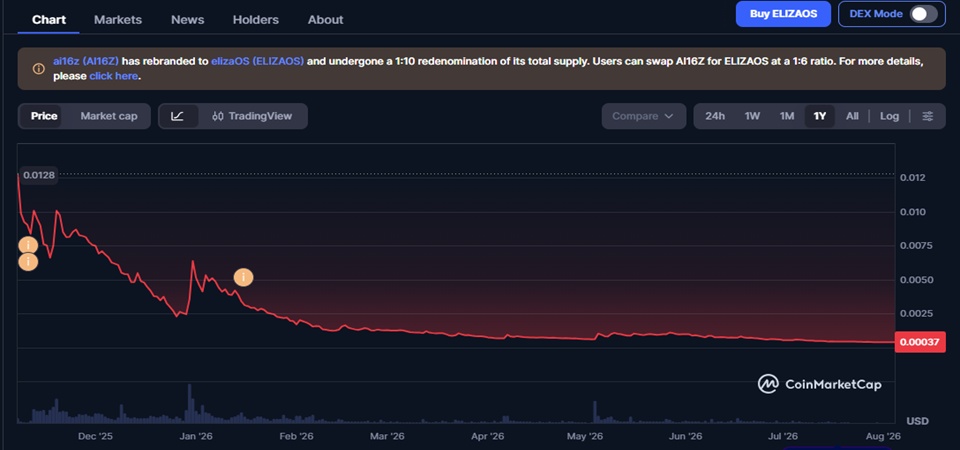
However, framework adoption and token economics soon diverged. AI16Z peaked at an all-time high of $2.45 in January 2025 before suffering a severe collapse. The project subsequently rebranded to elizaOS, migrated its tokens, and redenominated its supply.
Today, AI16Z brings its market capitalization to approximately $7.5 million. Any serious AI16Z price prediction hinges on a single question: can the industry’s most widely used AI agent framework translate tech adoption into sustainable token value?
AI16Z is currently holding a market cap of approximately $7.5 million and ranking roughly #1,078 across crypto data tracking platforms. Following its token migration and a 1:10 redenomination, circulating supply sits at approximately 9.3 billion tokens out of an 11 billion maximum supply cap.
This represents a drawdown exceeding 99% from its peak. The decline highlights a market that has shifted focus away from developer adoption of the Eliza framework and toward token-level value capture—where mechanisms remain weak.
While the token swap wrapped up in February 2026—expanding AI16Z multichain across Solana, Ethereum, Base, and BNB Chain while establishing a Generative Treasury—the project still faces resistance. The overhang from an April 2026 investor lawsuit continues to cast a cloud of legal uncertainty over its long-term credibility.
AI16Z continues to trade as a high-beta narrative token carrying reputational risk. Major framework updates or renewed AI agent enthusiasm can spark violent rallies, while lawsuit news and thin order books drag prices down just as quickly. A recent 170% surge over a 48-hour window highlighted how rapidly market sentiment can pivot in both directions.
Key Support: The $0.0006–$0.0007 range has reliably absorbed sell pressure in recent months. Reclaiming $0.0010 is required to re-establish a constructive short-term trend.
Key Resistance: The $0.0015–$0.0020 area serves as the primary barrier. Breaking above this zone would signal a true structural recovery rather than a short-lived relief bounce.
Volatility Profile: High-beta token with elevated risk. Protocol milestones, legal updates, and broader crypto AI sentiment will trigger significant price swings.
The targets below reflect pessimistic (bear), realistic (base), and optimistic (bull) cases. These projections are evaluated against framework monetization, AI agent adoption cycles, treasury performance, and legal resolution. Note: These ranges reflect current post-redenomination token units and are scenario estimates, not financial advice.
Year
Pessimistic Case (Bear)
Realistic Case (Base)
Optimistic Case (Bull)
2026
$0.0004
$0.0020
$0.0050
2027
$0.0005
$0.0045
$0.0120
2028
$0.0004
$0.0080
$0.0250
2030
$0.0008
$0.0180
$0.0600
2040
$0.0020
$0.0700
$0.2500
Yearly Breakdowns
AI16Z Price Prediction 2026
The decisive factor for 2026 is whether the multichain token swap can put historical turmoil to rest. With the migration complete and tokens trading across multiple chains, focus has shifted to value capture: can Eliza’s dominance as a framework drive direct treasury performance and sustained token demand?
Base Case ($0.0020): Assumes a stabilizing market for AI tokens and early proof-of-concept performance from the Generative Treasury, supporting a price near $0.0018–$0.0022.
Bull Case ($0.0050): Requires a broader AI narrative surge alongside fading attention on the project’s legal issues.
Bear Case ($0.0004): Reflects persistent legal pressure and ongoing market indifference to token value despite developer usage of the underlying code.
elizaOS Price Prediction 2027
By 2027, crypto markets typically enter post-cycle recovery phases where protocols with verified usage undergo re-evaluations. If Eliza remains the leading framework for autonomous agents and its treasury delivers visible yield, AI16Z could start trading as utility infrastructure rather than a speculative asset.
Downstream demand from platforms using autonomous agents for verification—such as analytics engines or automated fraud-detection systems—helps validate the model.
Base Case ($0.0045): Attainable if baseline utility translates into modest protocol revenue.
Bull Case ($0.0120): Requires a full-scale AI agent cycle to position AI16Z as the sector’s flagship standard.
Bear Case ($0.0005): Stagnant token growth where open-source adoption fails to flow back to token holders.
elizaOS Price Forecast 2028
2028 serves as a long-term accountability check. By this period, legal disputes will have been resolved, and the protocol will have demonstrated whether open-source adoption can meaningfully accrue value to its token holders.
Base Case ($0.0080): Assumes functional value-capture mechanisms and a restored market reputation.
Bull Case ($0.0250): Reflects a scenario where AI16Z serves as the accepted index and standard for the decentralized AI agent economy.
Bear Case ($0.0004): Represents lost market trust and gradual token obsolescence.
elizaOS Valuation 2030
By 2030, the AI agent thesis will have either evolved into critical Web3 infrastructure or faded as an early-stage trend.
Base Case ($0.0180): Represents a market cap of approximately $170 million—a realistic mid-cap recovery assuming Eliza retains developer share and operates an active treasury.
Bull Case ($0.0600): Translates to roughly a $550 million valuation. This assumes widespread adoption across fintech, automated compliance, and privacy-focused platforms utilizing AI agents for trust verification.
Bear Case ($0.0008): Reflects a scenario where the framework prospers independently while the token trades at low valuation levels.
elizaOS Macro Vision 2040
The 2040 perspective tests the maximum potential of a full long-term recovery.
Base Case ($0.0700): Implies a market capitalization around $650 million based on steady integration into Web3 infrastructure.
Bull Case ($0.2500): Pushes AI16Z to a $2.3 billion market cap—matching its previous historic peak valuation, but backed by real utility rather than speculative hype. This requires autonomous agents to become a primary software category.
Bear Case ($0.0020): The framework outlives the token completely, leaving the market unwilling to price long-term value into AI16Z.
What Makes AI16Z Different From Other AI Tokens
Most AI cryptocurrencies operate primarily as governance tokens over off-chain products that do not strictly require blockchain integration. AI16Z presents the inverse situation: it generated genuine, widely adopted open-source software, but continues to tackle the challenge of linking that technology directly to token value.
The Eliza Framework and Open-Source Moat
Eliza is a multi-agent framework designed to build and deploy autonomous AI agents with persistent cross-platform personalities. It is utilized by a significant share of new AI crypto projects, establishing a strong developer moat that few competitors can match.
The AI-Agent DAO and Generative Treasury
Originally launched as an AI-driven venture DAO, AI16Z has shifted toward a Generative Treasury model following its token migration. This treasury seeds autonomous multichain agents designed to yield-farm, deepen liquidity, and reinvest in ecosystem growth—creating a functional bridge between code usage and token accrual.
Core Catalysts That Could Drive AI16Z Higher
1️⃣ Framework Monetization:
Directing protocol fees, treasury yields, or staking requirements from Eliza-based applications straight to AI16Z token holders.
2️⃣ AI Agent Market Cycles:
As a recognized ticker in the space, AI16Z stands to capture disproportionate speculative inflows whenever the broader AI agent narrative trends upward.
3️⃣ Generative Treasury Growth:
Demonstrable on-chain balance sheet growth offers verifiable fundamentals that appeal to value-oriented crypto investors.
How High Can AI16Z Go? Price Targets Explained
Can AI16Z Reclaim Its Old Peak Valuation?
AI16Z reached a peak market cap exceeding $2 billion in January 2025. Reaching this milestone again aligns with our 2040 bull case target ($0.2500), requiring structural value capture and deep integration across the broader AI economy rather than temporary hype cycles.
Can AI16Z Reach $0.01?
A price target of $0.01 represents a market cap of approximately $93 million (based on a 9.3 billion circulating supply). This target is achievable during a strong 2027–2028 market cycle, provided framework monetization takes effect and legal overhangs clear.
Will AI16Z Hit $0.05?
Hitting $0.05 implies a market cap near $465 million, fitting into our 2030 bull case scenario ($0.0600). This requires AI16Z to establish itself as an industry standard for autonomous AI infrastructure with an actively performing treasury.
Investment Risks
1. Reputational and Legal Overhang:
The class-action lawsuit filed in April 2026 alleging fraud creates ongoing uncertainty that discourages conservative capital.
2. Value Disconnect:
The primary structural risk remains value accrual—the Eliza framework can remain a dominant open-source tool without driving financial demand to the AI16Z token.
3. Token Redenomination Confusion:
Historical migrations, ticker rebranding to ElizaOS, and supply adjustments have created market confusion that takes time to smooth out.
Investment Tools
1. Crypto Exchanges
Crypto exchanges are key platforms for buying, selling, and trading digital tokens. It’s important to select a reliable exchange with deep liquidity, low fees, and strong security for safe asset management.
2. Crypto Wallets
Crypto wallets provide secure storage and complete self-custody over your private keys and digital assets. Choosing the right solution ensures your holdings remain protected from exchange failures and unauthorized access.
3. Crypto Guides
Make sure to do your own research to get familiar with the world of cryptocurrencies and complex blockchain concepts. Visit our crypto guides to help you understand digital assets objectively.
AI16Z presents a high-risk, high-upside profile in the crypto AI sector. On one hand, its underlying Eliza framework boasts unrivaled developer adoption across the agent ecosystem. On the other hand, legacy legal issues and weak value-capture mechanisms keep the token heavily discounted.
For high-risk investors, long-term performance will depend on whether the Generative Treasury and future tokenomics successfully turn framework dominance into sustainable token demand.
Frequently Asked Questions
What will the AI16Z price be in 2026?
Our realistic base case estimates AI16Z trading between $0.0018 and $0.0022 in 2026. A strong AI sector rally could drive prices toward $0.0050, while persistent legal headwinds could keep the token anchored near its bear target of $0.0004.
What is the AI16Z price outlook for 2030?
If the Eliza framework maintains market share and the Generative Treasury yields consistent results, the base case projects a value of $0.0180 by 2030. An optimistic scenario envisions targets up to $0.0600.
What happened to my AI16Z tokens?
AI16Z rebranded its umbrella project to ElizaOS, initiating a token swap that concluded in February 2026. This process included a 1:10 redenomination and multichain expansion. Most primary exchanges handled conversion parameters automatically.
Is AI16Z a good investment?
AI16Z pairs unmatched open-source framework distribution with token-level reputational and legal risks. It is suited primarily for investors with a high risk tolerance who believe developer activity will eventually translate into token value.
Can you use AI16Z at crypto casinos?
AI16Z is an ecosystem governance and utility token and is not widely accepted as a direct deposit method on gaming or gambling platforms, though traders can convert it via major exchanges.
In 2016, he worked on his first client to help write a white paper for a crypto and blockchain project they were building, and started delving deeper into blockchain and distributed ledger technology.
















 Article Contributors


 Fact checked by
 Read Time: 6mins
 Published: 04/08/2026 | Updated: 04/08/2026





 shahnakul23@gmail.com