














 Akash Network (AKT) Price Prediction


Reading the AKT Market Right Now
Akash Network trades at approximately $0.90 as of this writing, giving it a market cap of around $250 to $265 million and a fully diluted valuation of approximately $175 million. With a circulating supply of roughly 271 million tokens against a max supply of 388 million, inflation is a factor, but it’s now controlled by the new BME mechanism.
This is a fundamental difference from purely speculative tokens; every new AKT minted is part of a system designed to be net-deflationary as network usage grows.
The narrative has matured significantly. Akash has cemented itself as a leading project in the DePIN (Decentralized Physical Infrastructure Networks) sector, with a specific focus on the exploding demand for AI compute. The launch of the BME model and the expansion of its GPU marketplace have opened up new avenues for growth.
For investors, the critical question is whether this tangible network growth and utility can finally translate into sustained, long-term demand for the AKT token.
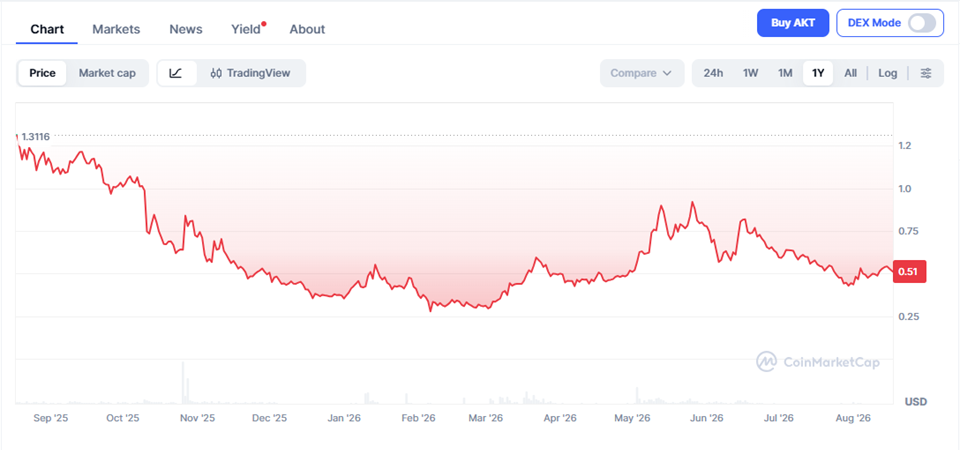
Image Source: https://coinmarketcap.com/currencies/akash-network/
Short-Term AKT Price Dynamics
AKT’s price action is a balancing act between its strong fundamental narrative and the often-turbulent crypto market. While it’s less erratic than a memecoin, it is still sensitive to the broader market trends and network-specific developments.
A major enterprise partnership, a significant uptick in compute spend, or a successful BME implementation milestone can send ripples through its valuation.
The retail crowd paying attention here often overlaps with tech-savvy investors who frequent platforms like provably fair platforms; they value the underlying tech and its long-term viability as much as the immediate price chart.
- Key support: The $0.65 to $0.75 range has proven to be a resilient level. A decisive break below this could see AKT testing lower regions.
- Key resistance: The $1.50 to $2.00 zone, particularly the 200-day SMA, is a major psychological and technical barrier. A clean breakout above would be a significant signal of a trend reversal.
- Volatility profile: Expect moderate to high volatility. The token reacts strongly to network updates, burn data, and the overall sentiment towards the DePIN and AI narrative. In May 2026, AKT spiked to $3.90 before correcting sharply, illustrating its capacity for rapid moves in both directions.
AKT Price Prediction Table (2026–2040)
The following projections consider a range of outcomes based on network growth, the success of the BME model, adoption rates, and the overall health of the DePIN and AI markets. These price forecasts are scenario-based estimates, not financial advice.
| Year | Bearish Case | Realistic Case | Bullish Case |
|---|---|---|---|
| 2026 | $0.35 | $0.75 | $1.60 |
| 2027 | $0.40 | $1.35 | $3.20 |
| 2028 | $0.45 | $2.20 | $5.50 |
| 2030 | $0.60 | $3.80 | $12.50 |
| 2040 | $1.00 | $8.50 | $22.00 |
Year-by-Year Price Forecast
Key Differentiators and Tokenomics
1. Real-World Utility & Network Mechanics
Unlike assets that rely solely on speculative momentum, AKT functions as payment settlement, staking security, and governance for a physical marketplace. Providers offer hardware resources, while clients lease CPU, storage, and GPU capacity.
The focus on GPU compute directly aligns Akash with the high demand for machine learning and AI inference. By offering capacity at a fraction of centralized cloud costs, the platform presents a practical value proposition.
2. Tokenomics and the BME Model
AKT features a hard supply cap of 388.5 million tokens. The transition to a Burn-Mint Equilibrium (BME) alters its economic trajectory:
- Users purchase compute capacity using AKT or stable settlement options.
- The paid AKT is burned to mint compute credits (ACT).
- Compute providers are compensated in newly minted AKT or fixed rewards based on net usage.
- When network usage is high, the total volume of AKT burned exceeds total emissions, creating net-deflationary pressure on the token supply.
Core Growth Catalysts
1️⃣ AI & DePIN Expansion:
Growing institutional and developer demand for decentralized compute resources could drive capital toward established DePIN leaders.
2️⃣ On-Chain Deflation Metrics:
Clear data showing that monthly AKT burns consistently surpass emissions could act as a strong fundamental catalyst.
3️⃣ Integrations & Ecosystem Partnerships:
Expanding access via API aggregators (such as OpenRouter) and AI deployment frameworks lowers onboarding friction for non-crypto developers.
How High Can AKT Go? Price Targets Explained
Realistic Price Targets:
Hard-to-Achieve (Extreme Bull / “Moonshot”) Price Targets
Investment Risks
Despite its strong technological foundation, investing in Akash Network involves distinct risks:
1️⃣ Execution & Scale Challenges: Building, maintaining, and scaling a high-availability global compute marketplace presents complex engineering hurdles.
2️⃣ Centralized & Decentralized Competition: Giant hyperscalers (AWS, Google Cloud, Azure) possess vast capital resources, while competing DePIN projects also vie for hardware providers.
3️⃣ Novel Economic Design: The BME model, while sound in theory, must demonstrate long-term stability across varying crypto market conditions.
4️⃣ Market Volatility: As an altcoin, AKT remains susceptible to broad market downturns regardless of underlying protocol progress.
Crypto Investment Guides
Our crypto guides break down intricate blockchain topics—such as tokenomics, staking models, and decentralized infrastructure—into clear, actionable steps that help investors evaluate emerging assets.



Final Thoughts
Akash Network stands out in the crypto ecosystem by offering real utility in a rapidly growing market: decentralized GPU compute for AI and cloud workloads. Its economic model directly connects token value to actual network utilization rather than speculative narrative alone.
While short-term price movements remain subject to market trends, AKT presents a compelling long-term profile for investors seeking exposure to decentralized infrastructure and AI compute. As always, allocations should be managed within a diversified portfolio framework.
Frequently Asked Questions
What will the AKT price be in 2026?
Our realistic forecast places AKT between $0.50 and $0.75 for 2026, building from its current level of ~$0.51. Strong network usage spikes or bull market momentum could push prices toward $1.60, while market corrections could see tests down to $0.35.
What is the AKT price prediction for 2030?
By 2030, our base scenario targets $3.80 as network adoption matures. In a bullish market cycle where decentralized AI compute becomes industry standard, targets up to $12.50 are achievable.
Is Akash Network (AKT) a good long-term investment?
AKT offers high long-term potential for investors seeking exposure to DePIN and AI infrastructure. However, as an emerging technology asset, it carries notable operational and market risks and should be approached with appropriate risk management.
Why is AKT trading below its all-time high?
AKT reached its all-time high of $8.07 in April 2021 during broader bull market liquidity. Subsequent macro corrections across the crypto sector led to a prolonged period of re-accumulation. Today’s price reflects organic fundamentals and ongoing network growth.
How can I store and hold AKT tokens securely?
AKT can be stored using Cosmos-compatible self-custody wallets (such as Keplr or Leap Wallet) or hardware wallets like Ledger, allowing users to safely manage keys and participate in network staking.