














 Aave Plans $98M Cleanup Across Six Blockchains to Optimize Efficiency
 Article Contributors


 Fact checked by
 Read Time: 2mins
 Published: 06/08/2026 | Updated: 14/08/2026


Protocol Streamlines Operations
Decentralized lending heavyweight Aave has proposed an extensive operational overhaul designed to eliminate low-performing liquidity pools and completely retreat from six blockchain networks.
The governance initiative targets roughly $98.1 million in deposited capital alongside $15.6 million in active borrowing debts across 71 distinct markets, signaling a clear departure from the multi-chain expansion playbook that defined previous DeFi growth cycles.
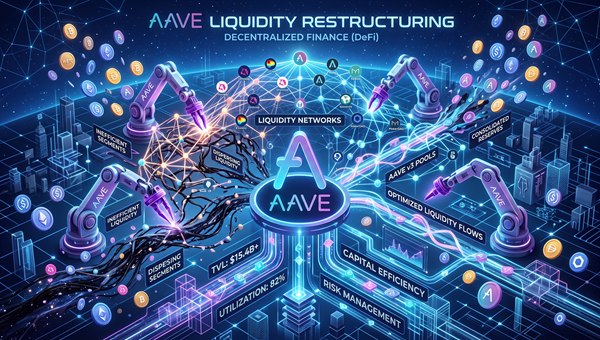
Exiting Six Underperforming Chains
The most drastic phase of the proposal involves shutting down entire protocol deployments on Sonic, Scroll, Metis, Soneium, Aptos, and zkSync. Together, these six networks manage approximately $12.8 million in user deposits and $4.1 million in debt obligations across 25 individual asset pools.
Liquidity metrics across these environments have dropped sharply over recent months:
- Sonic: Holds $7.6 million in deposits and $2.7 million in open loans, despite experiencing a 74% decline in total value over half a year.
- Scroll: Deposits plummeted 86% down to $2.2 million.
- Aptos: Experienced a 94% liquidity drop, retaining $1.7 million supplied and $719,000 borrowed.
- zkSync, Metis, and Soneium: Hold remaining balances of $844,000, $297,000, and $173,000 respectively.
Analysis from risk management firm LlamaRisk highlighted that transactional yields generated by these smaller instances fail to offset the mandatory expenses of running price oracles, active risk monitors, and liquidation support pipelines.
Pruning 50 Secondary Asset Pools
Beyond full network withdrawals, the plan targets 50 individual asset reserves and 21 matured Pendle principal token markets spread over 11 primary deployments. These standalone targets represent $85.3 million in supplied liquidity and $11.5 million in user debt.
The purge focuses primarily on outdated bridged token variants, redundant collateral listings, and assets superseded by native issuances—such as legacy bridged USDC tokens.
Notable high-value positions marked for deactivation include Ethereum-based FBTC and eBTC wrappers, which collectively maintain about $16.3 million in deposits against a tiny $63,000 in outstanding loans due to stagnant demand.
Orderly Phase-Out Mechanism
To prevent market friction or forced liquidations, the implementation relies on a phased wind-down process:
- Initial steps freeze affected markets and cap new deposits and minting allowances to a single unit.
- Existing positions remain intact, but active interest rates and reserve factors will rise—climbing up to a 99% reserve factor and a 5% baseline borrow rate on retiring markets—redirecting revenue to the treasury and incentivizing borrowers to settle balances.
- If positions linger, risk parameters like liquidation thresholds will tighten gradually, followed by replacing live price feeds with fixed-value oracles before ultimate pool retirement.
Long-Term Vision and Aave V4
Aave founder Stani Kulechov emphasized that retreating from low-volume networks reflects a routine risk audit rather than a systemic critique of Layer-1 or Layer-2 scaling solutions.
Instead of stretching infrastructure across emerging venues, the protocol is consolidating focus around high-turnover markets, real-world asset tokenization, institutional financial products, and the upcoming rollout of Aave V4.
While the proposal progresses through the standard governance process toward a binding vote, Aave continues to maintain its dominant position as the largest lending protocol in crypto, holding roughly $14.5 billion in total value locked across 23 active chains.


 eabungana@gmail.com

