ZKsync might be the widest gap in crypto between engineering respect and token performance. The Matter Labs-built Layer 2 shipped the Atlas upgrade in late 2025, delivering one-second finality and throughput beyond 15,000 TPS, and earned rare public praise from Vitalik Buterin, who called its work in the Ethereum ecosystem underrated and valuable.
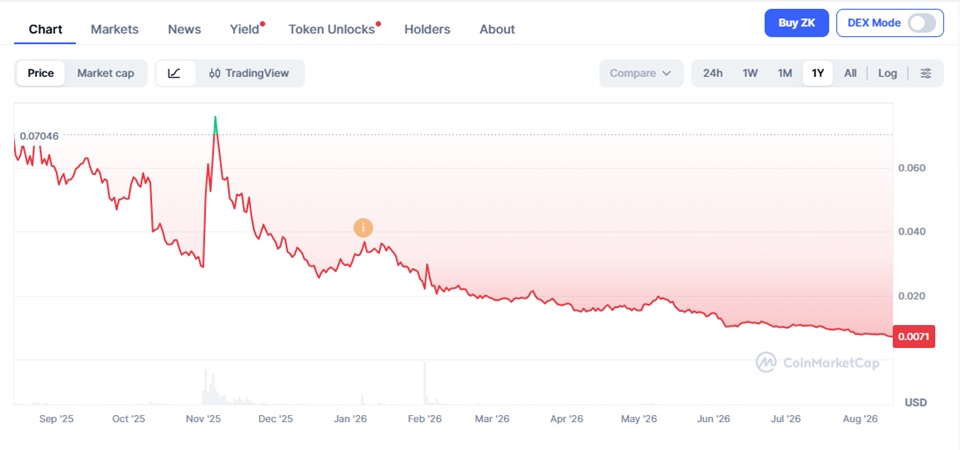
The ZK token never got the memo. It trades around $0.010, roughly 97% below its all-time high near $0.32, weighed down by relentless unlocks from a 21 billion max supply and an L2 sector the market stopped paying for. Every serious ZKsync price prediction now revolves around two bets: the proposed shift to revenue-backed tokenomics, and the bank-grade Prividium push that could make ZKsync institutional settlement infrastructure.
ZK has a market cap near $100 million and a circulating supply of roughly 9.6 billion against a 21 billion hard cap. That supply structure is the chart’s defining feature: more than half the tokens remain locked, and scheduled unlocks have consistently outpaced organic demand since the June 2024 airdrop, which itself distributed 17.5% of supply to users.
The forward-looking story is stronger than the chart. A governance proposal from co-founder Alex Gluchowski would route all network revenue, on-chain fees plus off-chain enterprise licensing, into ZK buybacks, burns, and staking rewards.
Meanwhile, the 2026 roadmap centers on Prividium, private-but-verifiable infrastructure that already has UBS testing tokenized gold, Deutsche Bank building on the stack, and a network of US regional banks with $600 billion in combined deposits targeting a pilot.
ZK’s deep listings across major crypto exchanges make it simple to trade for anyone managing exposure.
ZK trades like a token caught between narrative and dilution. Atlas and the Buterin endorsement produced a 120% spike in late 2025 that unwound within days, the textbook pattern of a market that buys headlines and sells unlocks. Setbacks like Sophon decommissioning its ZK Stack chain in June 2026 add reputational noise.
Key support: $0.008–$0.010 is the historic low zone. It has absorbed selling through mid-2026, but there is little structure beneath it.
Key resistance: $0.015–$0.020 is the first hurdle. Reclaiming $0.030 would signal the tokenomics story is finally being priced rather than faded.
Volatility profile: High. ZK reacts to unlock dates, governance votes on the revenue model, enterprise pilot news, and overall Layer 2 sentiment.
ZK Price Prediction Table (2026–2040)
The price forecasts below reflect bear, base, and bull cases built around the tokenomics overhaul, Prividium enterprise adoption, unlock absorption, and competition across the L2 landscape. Scenario estimates only, not financial advice.
Year
Pessimistic Case (Bear)
Realistic Case (Base)
Optimistic Case (Bull)
2026
$0.006
$0.022
$0.050
2027
$0.005
$0.040
$0.100
2028
$0.004
$0.055
$0.160
2030
$0.008
$0.100
$0.350
2040
$0.010
$0.220
$0.900
Yearly Breakdowns
ZKsync (ZK) Price Prediction 2026
The rest of 2026 hinges on whether the revenue-to-token proposal passes and begins to work. Protocol version 31 already introduces a fixed fee of 10 ZK per cross-chain interop call, the first direct utility sink the token has had. A base of $0.020–$0.025 assumes the governance model activates and the Q3 bank pilots stay on schedule.
The bull case toward $0.050 needs a visible buyback-and-burn flywheel plus an L2 sentiment recovery. The bear case at $0.006 is what happens if unlocks keep grinding, enterprise deals stay in pilot purgatory, and the market keeps treating ZK as exit liquidity for early allocations.
ZKsync (ZK) Price Prediction 2027
By 2027, the Prividium thesis will be measurable: either regulated institutions are settling meaningful volume through ZKsync’s private chains, or the enterprise pivot joins crypto’s long list of pilot programs that never scaled. The technology argument is strong; zero-knowledge proofs solve the exact privacy-versus-verifiability dilemma banks have complained about for a decade.
Verification infrastructure has downstream users well beyond banks, from fintechs to platforms like no-KYC sports betting sites that lean on cryptographic proofs instead of intrusive checks. A base of $0.040 assumes early enterprise revenue is real; the bull case of $0.100 requires ZKsync to be the default institutional settlement layer narrative of the cycle.
ZK Price Forecast 2028
2028 is the accountability year for the elastic chain vision. A base of $0.055 reflects a working revenue model, several production bank deployments, and unlock pressure fading as supply matures. The bull case of $0.160 is the scenario where tokenized deposits scale and every interop call, license, and fee route value to ZK holders, supporting a valuation in the low billions. The bear case of $0.004 is where rivals like Linea and Base absorb the activity, and ZKsync’s tech excellence never monetizes.
ZK Valuation 2030
By 2030, the question is whether ZKsync became infrastructure for regulated on-chain finance. A base of $0.100 would imply roughly $2 billion on full supply, a rational outcome for a protocol processing institutional settlement at scale.
The bull case at $0.350 implies around $7 billion, the scenario where Prividium is to bank-chain infrastructure what AWS became to cloud computing. Liquidity in crypto migrates across sectors constantly, and some of the capital rotating through venues like VPN online casinos ends up chasing infrastructure plays in risk-on phases, though ZK’s case rests on enterprise revenue rather than retail speculation.
ZK Macro Vision 2040
The 2040 view is the full ZK-endgame bet: zero-knowledge proofs as the trust layer for global finance. A base of $0.220 implies a valuation near $4.6 billion, a mature infrastructure outcome. The bull case at $0.900 puts ZK near $19 billion, requiring ZKsync to own a meaningful share of a world where banks, sovereigns, and enterprises settle on proof-based rails. The bear case at $0.010 is the familiar tragedy: the technology wins, but this particular token does not.
Treat any investment as a long-horizon infrastructure bet with substantial downside, and find crypto wallets that would safely store investment funds.
What Makes ZK Different From Other Layer 2 Tokens
Most L2 tokens are governance wrappers on sequencer businesses competing for the same DeFi users. ZKsync bets its future on cryptographic finality and regulated institutions instead.
Atlas, Airbender, and the Performance Stack
The Atlas upgrade delivered one-second ZK finality with throughput benchmarks between 15,000 and 43,000 TPS, backed by the open-source Airbender RISC-V proof system. Validity proofs, not optimistic assumptions, secure the network, which is precisely the property institutions require before touching public-chain settlement.
Prividium and the Enterprise Pivot
Prividium lets institutions run private, compliant chains that anchor correctness to Ethereum through zero-knowledge proofs, keeping data confidential while remaining verifiable. With UBS, Deutsche Bank-linked projects, and a $600 billion regional-bank consortium in the pipeline, ZKsync has the deepest enterprise funnel of any L2 stack.
Core Catalysts That Could Drive ZK Higher
1️⃣ The Tokenomics Flywheel:
If governance finalizes the model routing network revenue into buybacks, burns, and staking, ZK becomes one of the few L2 tokens with direct value accrual. Against a $100 million cap, even modest revenue creates real per-token impact.
2️⃣ Bank Pilots Going to Production:
The tokenized-deposit pilots are the make-or-break catalyst. A single major bank moving from pilot to production would validate the entire Prividium thesis and force a repricing of everything built on the ZK Stack.
3️⃣ Interop Fees and the Elastic Network:
Version 31’s fixed 10 ZK fee per interop call ties token consumption directly to network activity across ZKsync chains. If the elastic network of connected chains grows, so does structural demand for the token.
How High Can ZK Go? Price Targets Explained
Can ZK Reach $0.05?
Plausible in a strong 2027 window. At $0.05, the fully diluted valuation sits near $1 billion, modest for a leading ZK-rollup with enterprise revenue. It requires the tokenomics vote to pass and pilots to progress.
Will ZK Hit $0.30?
That is a return to all-time-high territory, implying roughly $6 billion fully diluted. It needs institutional settlement to become ZKsync’s proven business at scale, most realistic as a 2030 bull case. A moonshot with an unusually concrete roadmap.
Investment Risks and Final Notes
Dilution remains the headline risk. With over 11 billion tokens still locked, every rally competes with scheduled supply, and the market has faded ZK’s best headlines for two years running. Until the revenue model is live and measurable, the token’s relationship to protocol success is aspirational.
Execution risk is equally real. Enterprise sales cycles are slow, pilots die quietly, and the Sophon departure shows ecosystem chains can leave. Competition from Linea, Base, Starknet, and Scroll is unrelenting, and reputational incidents like the fake-token scams trading on the ZKsync name add noise.
Base case: $0.020–$0.025, assuming the tokenomics proposal activates and enterprise pilots stay on track. A full narrative cycle could push ZK toward $0.050. Persistent unlock pressure keeps $0.006 possible.
What is the ZK price outlook for 2030?
If Prividium converts its bank pipeline into production settlement volume, a base near $0.100 by 2030 is defensible. The bull case at $0.350 prices ZKsync as core infrastructure for regulated on-chain finance.
Why is ZK so far below its ATH?
The token launched into a massive airdrop in June 2024, and continuous unlocks from the 21 billion supply have outweighed demand ever since. Even the Atlas upgrade and Buterin’s endorsement produced rallies that unwound within days.
Is ZK a good investment?
ZK combines elite technology and the strongest enterprise pipeline in the L2 sector with punishing token dilution. It suits patient investors with high risk tolerance who believe revenue-backed tokenomics will eventually close the gap.
Can you use ZK at crypto casinos?
ZK is primarily a network and governance token and is not widely supported as a direct casino deposit method.
Before We Part Ways…
Check the following crypto guides we prepared for you
In 2016, he worked on his first client to help write a white paper for a crypto and blockchain project they were building, and started delving deeper into blockchain and distributed ledger technology.
















 Article Contributors


 Fact checked by
 Read Time: 5mins
 Published: 11/08/2026 | Updated: 14/08/2026







 shahnakul23@gmail.com