












 Astar (ASTR) Price Prediction
 Article Contributors


 Fact checked by
 Read Time: 6mins
 Published: 27/04/2026 | Updated: 27/04/2026


Astar Price Prediction Analysis (Today → Long-Term)
The Astars circulating footprint is around $800 million. Developers engineered a cross-virtual machine environment, allowing Ethereum Virtual Machine (EVM) and WebAssembly (WASM) smart contracts to coexist seamlessly.
This bypasses the developer friction that strangles older blockchains.
That frictionless interoperability acts as a magnet for institutional builders. Investors hunting for an Astar crypto price prediction take a calculated stance that this innovation hub, backed by Sony’s Soneium network and SBI Holdings, will siphon market share away from legacy networks.
Tokenomics 3.0 dictates the endgame. With roughly 8.6 billion ASTR circulating, the foundation implemented a cap of 10 billion tokens and a dynamic burning mechanism tied to developer activity, mitigating the threat of unchecked dilution.
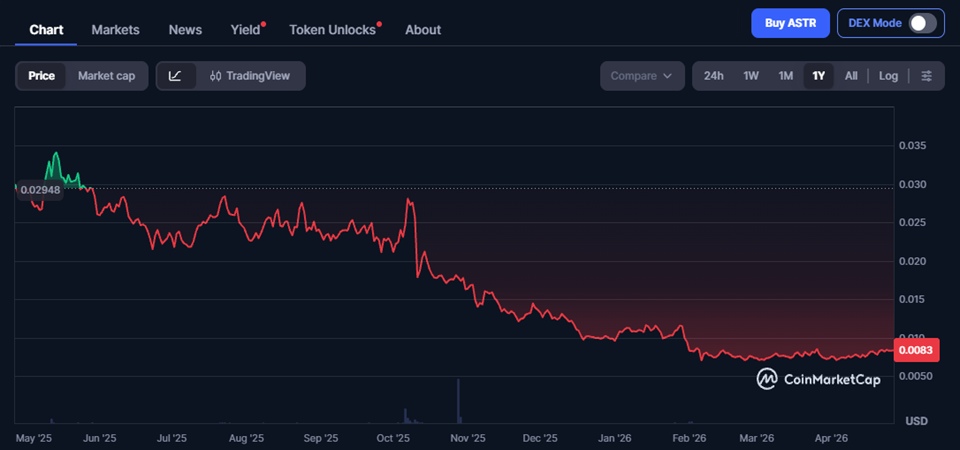
Short-Term Astar Forecast
Predicting immediate action means tracking the mood swings of the broader Ethereum ecosystem. Chart technicians are heavily focused on defending the critical $0.006 to $0.007 psychological support floor.
Holding that trench indicates the multi-month bleeding has ended. Violent intraday volatility is a standard feature here. Looking beneath chaotic red candles uncovers deliberate accumulation by sophisticated capital ahead of the Astar Fi rollout in Q2 this year.
Support & Resistance: Buyers routinely step up when ASTR dips below $0.007, but the token must crush the heavy $0.015 overhead resistance to trigger a legitimate reversal.
Volatility: Prepare for structural whiplash. With the RSI nearing 45, the asset is coiled to explode the second an enterprise partnership campaign hits the wire.
Astar Price Prediction Table (2026-2040)
Note: Calculated based on the 10-billion-token supply cap introduced in Tokenomics 3.0.
| Year | Pessimistic Case | Realistic Case | Optimistic Case |
|---|---|---|---|
| 2026 | $0.006 | $0.015 | $0.035 |
| 2027 | $0.009 | $0.028 | $0.060 |
| 2028 | $0.015 | $0.055 | $0.120 |
| 2030 | $0.030 | $0.150 | $0.450 |
| 2040 | $0.100 | $0.850 | $1.500 |
Astar Price Prediction 2026
For 2026, we project Astar to establish a baseline around $0.015. If the treasury pulls the trigger on Astar Fi (Web3 Personal Finance Hub), optimistic projections see the asset running toward $0.035, while a pessimistic bear case sits near $0.006.
This forecast relies on the network absorbing decentralized liquidity leaking out of slower, fragmented relay chains. The maturation of the Astar zkEVM ties Ethereum’s liquidity directly to Japan’s premier blockchain.
Delivering an environment where legacy businesses ignore high gas fees alters the valuation math entirely. Achieving that technical superiority provides an undeniable hook for venture funds.
ASTR Price Prediction 2027
Entering 2027, conservative models suggest a trading band between a $0.009 floor and a realistic base of $0.028. Deliver on corporate adoption promises, and the resulting institutional wave could push the asset toward an optimistic $0.060.
The reasoning hinges on post-halving capital rotation favoring networks that generate intrinsic organizational yield. The era of launching a scaling solution with zero enterprise backing is officially dead.
Ecosystems surviving this far will offer hyper-regulated, compliant environments. Integrating deep smart contract logic allows external assets to migrate across the bridge without friction.
Astar Forecast 2028
Pushing toward the late 2020s, a viable Astar forecast expects a solid base of $0.055. Winning brutal liquidity battles paves a clear highway toward $0.120. Should Web3 studios sunset Polkadot integrations, the floor could collapse to $0.015.
This phase hinges on establishing absolute ecosystem dominance over rival parachains. Being just another fast background engine is no longer optional; participants demand sticky, high-quality consumer applications.
The real war will be fought against legacy Layer-2 cartels protecting fading market share in Asia. We expect heavy adoption in sectors demanding cryptographic fairness, pushing users toward platforms utilizing provably fair gambling mechanics.
ASTR Valuation 2030
Turning into 2030, holding a firm $0.150 baseline dictates that the network maintains a total stranglehold on the Japanese Web3 narrative. Flawless execution could push limits toward a premium $0.450 valuation.
This premium valuation demands that the chain act as the invisible clearinghouse for multinational enterprises worldwide. By then, grueling debates over institutional blockchain integration will finally be resolved.
Executing complex smart contracts will feel like clicking a button on a mobile app. Everyday users will secure digital identities and corporate loyalty points via DeFi wallets natively linked directly to the ecosystem.
Astar Macro Vision 2040
Looking to the distant 2040 horizon, calculated mathematical models suggest an ambitious trading band settling between $0.85 and $1.50. A pessimistic bear case still places the token around $0.10 due to stabilized foundational inflation.
Visualizing these specific prices might seem absurd given today’s charts, but it prices in a massive generational cultural shift. Fast forward fourteen years, and the network will be governed entirely by community voting metrics.
It is the ultimate wager on a completely frictionless decentralized financial system rooted in Eastern technology hubs, where cross-chain architecture easily handles billions in daily global revenue.
What Drives Astar Price? (Fundamentals)
1️⃣ The Build2Earn Economy
Most networks dilute token supply to fund developers, punishing retail holders. Astar bypassed that death spiral through dApp Staking. Token holders stake capital directly into applications, letting developers earn a sustainable basic income. That financial firepower creates an economic baseline that marketing hype alone could never build.
2️⃣ Corporate Enterprise Incubation
A fast network is useless if traditional finance refuses to touch it. By partnering with Sony Network Communications to incubate Web3 startups, it effectively bridged the gap between traditional Web2 conglomerates and blockchain. Corporate validation is a powerful gravitational pull for serious decentralized builders.
3️⃣ Navigating Global Exchange Liquidity
A scaling solution hidden on obscure platforms is fundamentally flawed. Shifting from localized Asian crypto exchanges toward massive Western platforms dramatically increases global visibility. Institutional capital demands regulatory compliance. Investors often utilize Coinbase to ensure the platform’s offering, ASTR, adheres to the strictest security standards.
Risks & Disclaimer
Putting cash into scaling tokens is a dangerous game. Navigating this sector requires cold logic; investors must hedge downside risk carefully to insulate their capital against unexpected volatility.
Always do your own research (DYOR) before making important decisions or financial commitments. Ensure your choices match your risk tolerance and financial goals. For guidance in the digital asset market, visit our crypto hub.
Find Other Crypto Price Forecasts Pages




Frequently Asked Questions
What is the Astar price prediction for 2026?
Analysts project a realistic year-end target of $0.015, supported by the rollout of Astar Fi and the integration of the Sony-backed Soneium network. In a high-growth scenario where the Burndrop mechanism significantly reduces circulating supply, the price could reach a ceiling of $0.035.
What is the ASTR price prediction for 2030?
The transition to Tokenomics 3.0—which establishes a 10-billion-token supply cap—creates a path toward a $0.15 baseline by 2030. If Astar successfully captures the majority of Japanese enterprise transaction volume through its Astar Stack architecture, optimistic models suggest a peak of $0.45.
What is the Astar price prediction for 2040?
By 2040, the network’s value will be driven by its maturity as a foundational settlement layer. Mathematical models factoring in emission decay and protocol-level fee burns project a trading range between $0.85 and $1.50. This assumes Astar survives as a primary clearinghouse for digital assets in the Eastern Hemisphere.
How much will ASTR be worth in 5 years?
By 2031, ASTR is expected to fluctuate between $0.20 and $0.60. The primary driver for this valuation will be the mass adoption of regulated Japanese Yen-stablecoins (JPYSC) and the consistent routing of DeFi revenue back to token holders through the Astar Collective treasury.
Can Astar reach $1 / $5 / $10?
A $1 is considered a viable long-term target by 2040, requiring a market capitalization of roughly $10 billion.
$5 & $10 levels are viewed as economically improbable, as a $10 price would require a $100 billion market cap, which exceeds the valuation of most established global financial institutions.
Is Astar a good investment?
Astar is best viewed as a utility-driven infrastructure play. It offers a unique value proposition with $63 million in Series A funding from Sony and SBI Holdings, reducing inflation to 3%. It suits patient investors looking for exposure to the regulated Japanese Web3 sector.
Why is ASTR rising/falling?
Price action is currently dictated by on-chain value capture. Increases are typically linked to successful Burndrop events, where ASTR is permanently removed from the supply, or positive developments within the Soneium ecosystem. Downward pressure generally stems from broader liquidity shifts within the Polkadot and Ethereum Layer-2 markets.

 shahnakul23@gmail.com