














 Poland Backs Pre-Court Crypto Asset Freezes
 Article Contributors


 Fact checked by
 Read Time: 2mins
 Published: 16/11/2026 | Updated: 25/11/2026


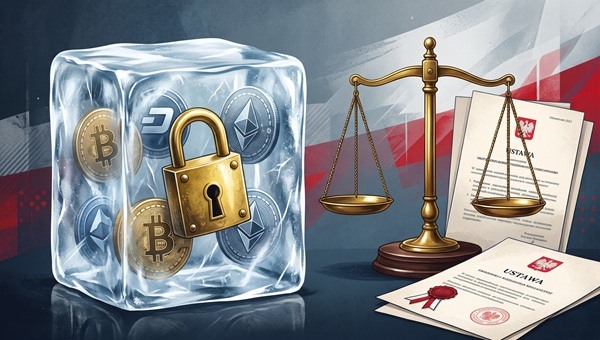
How Pre-Court Freezes Work
Under the approved text, digital tokens qualify as financial funds using the definition set out in Article 3 of the European Union’s Markets in Crypto-Assets Regulation (MiCA).
Once the interior minister adds an individual or company to Poland’s public sanctions register—either independently or at the request of the central bank, the Polish Financial Supervision Authority (KNF), the financial intelligence unit, or internal security agencies—the restrictions take effect the very next day.
Targeted parties retain the right to challenge their designation in an administrative court, yet filing an appeal will not pause the freeze. Restrictions remain active until a final court ruling is issued.
To prevent undue hardship, Article 10 permits authorities to grant separate exemptions covering essential expenses such as food, housing, medical care, taxes, utilities, and legal defense costs.
Impact on Exchanges and Wallets
Rather than targeting everyday retail investors, the framework focuses strictly on assets owned or controlled by sanctioned actors. Because the legislation grants officials no technical mechanism to extract private keys from self-custodied hardware wallets, practical enforcement relies on regulated intermediaries.
Exchanges, banks, and custodians operating under Polish oversight must block transactions and bar listed clients from accessing their funds, facing steep administrative penalties if they fail to comply. In specific scenarios, the economy minister can even appoint a temporary administrator to liquidate frozen holdings or transfer them to the State Treasury.
Broader National Security Scope
The legislation aligns domestic enforcement with EU Directive 2024/1226 regarding sanctions violations while expanding Warsaw’s existing April 2022 sanctions regime.
During a September 3 parliamentary debate, Deputy Interior Minister Czesław Mroczek noted that the current registry contained 554 entries—435 individuals and 119 businesses, predominantly tied to Russian and Belarusian capital.
The updated law widens listing criteria beyond conflicts in Eastern Europe to cover severe human rights abuses, backing for EU-sanctioned states, and financing foreign interference or disinformation campaigns that threaten Polish elections or borders, while explicitly carving out protections for legitimate journalism and political speech.
Senate Review and Presidential Hurdles
The bill reached the Senate on November 9, triggering a 30-day constitutional window under Article 121 for the upper chamber to approve, amend, or reject the measure by roughly December 9, 2026. Its final fate rests with President Karol Nawrocki, whose stance on digital asset regulation remains a major wildcard.
Nawrocki has repeatedly clashed with the government over crypto oversight, vetoing a separate MiCA licensing and supervision bill three times—most recently on June 11, 2026—before lawmakers fell short of the 266 votes needed to override him in a 241–198 vote this September.
Whether the president views national security sanctions differently from general market licensing will decide if Warsaw gains these sweeping new enforcement powers.


 eabungana@gmail.com

