














 Stellar’s Real-World Asset Ecosystem Hits $3 Billion
 Article Contributors


 Fact checked by
 Read Time: 2mins
 Published: 31/08/2026 | Updated: 08/09/2026


Institutional Capital Drives Tokenized Assets Beyond the $3 Billion Threshold
Data compiled in an industry study by oracle provider RedStone reveals that this rapid growth stems from a handful of heavy-hitting offerings. Leading the charge is Spiko’s tokenized U.S. Treasury bill instrument, which reached roughly $536 million.
Ondo Finance’s USDY, a yield-bearing alternative backed by short-term government debt and bank deposits, expanded from just above $1 million early in the year to exceed $533 million on Stellar.
Corporate credit structures have provided additional momentum.
Luxembourg-regulated VuMe Bond 2030 reached approximately $500 million after its February debut. European institutional presence also broadened through the French-regulated Amundi and Spiko Overnight Swap Fund, which amassed hundreds of millions in onchain value following its March launch.
Meanwhile, Franklin Templeton maintained its established presence, with the Franklin OnChain U.S. Government Money Fund (represented by the BENJI token) holding near $460 million on the network.
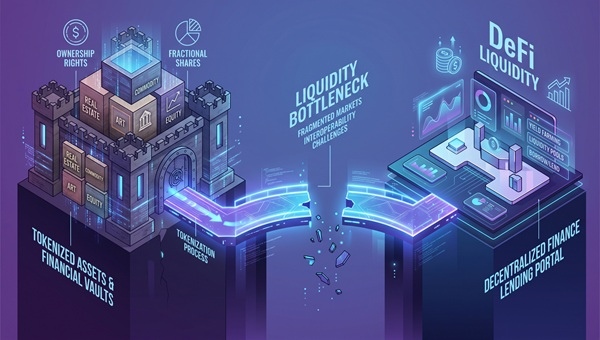
Onchain Lending Protocols Face a $2 Million Real-World Asset Liquidity Bottleneck
While total issuance reflects strong institutional interest, active utilization in decentralized credit protocols tells a different story. Stellar’s entire decentralized finance sector accounts for around $259 million in total value locked.
Blend, the premier money market venue on the network with $127 million in deposits, holds just over $2 million inside pools enabled for real-world assets. Similarly, Templar Protocol—which supports borrowing against sovereign debt, short-term Treasuries, and collateralized loan obligations like deJAAA, deJTRSY, CETES, and USTRY—maintains a modest $8.4 million total value locked.
Continuous Oracle Pricing Infrastructure Unlocks 24/7 Collateral Valuation
Industry experts emphasize that the primary roadblock to wider adoption is continuous valuation. According to Royal Fool, co-founder and chief executive of Templar Protocol, lending protocols require round-the-clock price feeds to calculate loan-to-value figures and execute liquidations safely.
Because traditional equities, government bonds, and fund net asset values update on traditional market schedules or through off-chain administrators, smart contracts struggle to evaluate them outside regular business hours.
To bridge this valuation divide, oracle providers are standardizing integrations. RedStone joined the network in March, utilizing Stellar’s SEP-40 framework to deliver 55 dedicated price feeds covering tokenized gold, corporate credit, and sovereign instruments. This comes alongside Chainlink’s earlier integration of data streams and cross-chain capabilities.
Traditional Financial Pipelines Prepare for Broader Blockchain Integration
Looking forward, traditional financial connectivity could expand further. The Depository Trust & Clearing Corporation intends to deploy tokenized versions of DTC-custodied securities on Stellar during the first half of 2027 following a successful multibank trial.
As continuous pricing infrastructure matures, these institutional assets may finally achieve the liquid, round-the-clock utility promised by decentralized finance.
Bridging Institutional RWA Bottlenecks via Advanced Execution Layers and Infrastructure Upgrades
Looking forward, traditional financial connectivity could expand further as the Depository Trust & Clearing Corporation prepares to deploy tokenized securities on Stellar in 2027, while parallel execution innovations—such as Ondo Finance’s recently launched Trusted Execution Environment (TEE) network—work to solve the underlying latency and collateral bottleneck.
By combining continuous oracle valuation with high-speed, off-chain risk calculations for products like USDY, these joint developments offer a technical blueprint to transform static institutional holdings into liquid, round-the-clock DeFi collateral.


 eabungana@gmail.com

