














 Misconceptions Surrounding Uniswap v4 Protocol Fee Switch Dismantled
 Article Contributors


 Fact checked by
 Read Time: 2mins
 Published: 05/08/2026 | Updated: 14/08/2026


Additive Fee Structure vs. Revenue Deductions
At the heart of the controversy was an assumption that Uniswap Labs intended to shave off a percentage of existing LP rewards to fund protocol operations. Critics argued that claiming 10% to 25% of pool revenue would squeeze capital providers, potentially driving liquidity toward rival automated market makers (AMMs).
Panoptic founder Guillaume Lambert aired similar concerns during governance debates, suggesting that taking a cut from non-guaranteed LP returns could undermine competitiveness unless charges were tied directly to position profitability.

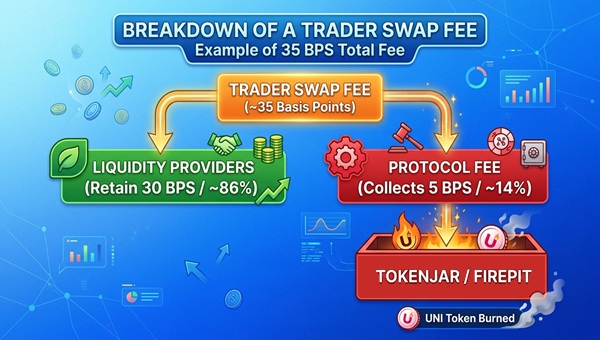
Adams countered this logic by detailing the actual mechanics encoded in the v4 architecture. The system utilizes an additive model rather than a subtractive one. In a standard pool where LPs set a 30-basis-point (0.30%) fee, market makers continue to earn that full 30-basis-point yield.
The protocol fee controller overlays an extra 5 basis points (0.05%), bringing the total swap cost paid by traders to roughly 35 basis points.
Under this framework, the 5-basis-point protocol take represents roughly 14% of the combined trading fee—not a 25% deduction from the LP’s pocket.
Adams further noted that even with this slight addition, trading costs on Uniswap remain drastically lower than those on traditional centralized exchanges, which routinely charge takers between 100 and 200 basis points per transaction.
Technical Contracts, Governance, and Ecosystem Expansion
The v4 infrastructure handles these distribution paths via specialized smart contracts. The V4FeePolicy contract evaluates pool classifications to determine exact percentages, while the V4FeeAdapter routes gathered funds into designated TokenJar storage contracts.
From there, external arbitrageurs can burn UNI through the Firepit mechanism to claim accumulated assets, creating a deflationary feedback loop linked to network usage.
Uniswap Labs pointed to historical data from prior v2 and v3 fee implementations on Ethereum mainnet, noting that the top 25 fee-enabled pools retained 98.5% of their liquidity post-activation. These protocol charges have successfully backed over 7.5 million UNI in token burns since late 2025 as part of the broader UNIfication initiative.
While additional chain deployments for Celo, Soneium, World Chain, X Layer, and Zora await future proposal batches due to execution limits per vote, the initial rollout establishes a clear baseline. As v4 dynamic pools and custom hooks mature, market behavior will ultimately show whether capital remains stationary, but the foundational math behind LP yields remains untouched.


 eabungana@gmail.com

