














 Zano Triggers Emergency Blockchain Reset After Gateway Hack
 Article Contributors


 Fact checked by
 Read Time: 2mins
 Published: 01/10/2026 | Updated: 03/11/2026


A Drastic Reversal to Defend Monetary Scarcity
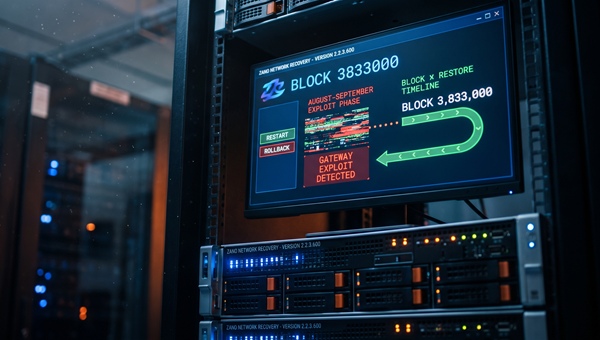
In a high-stakes decision that underscores the fragile balance between immutable ledgers and existential protocol survival, the privacy layer-1 network Zano has reset its blockchain back to block 3,833,000. The intervention effectively discards roughly four weeks of chain records, targeting a window that began with the activation of Hard Fork 6 on August 26, 2026.
The emergency maneuver arose after engineers discovered bad actors exploiting an undocumented vulnerability to conjure substantial sums of unauthorized native ZANO and collateralized Freedom Dollar (fUSD) out of thin air.
Left unchecked, the counterfeit flood threatened to dilute the token supply into obsolescence and shatter user trust in the project’s hard monetary caps. Confronted with boundless inflationary damage, developers chose to sacrifice thirty days of ledger history rather than let rogue assets permanently circulate.
Where the Architecture Cracked: The Gateway Mechanism
Since debuting in May 2019, Zano built its reputation on stealth: a hybrid proof-of-work and proof-of-stake foundation concealing transaction participants, asset categories, and transfer totals behind cryptographic shielding.
However, standard unspent transaction output (UTXO) accounting proved notoriously cumbersome for custodial exchanges, centralized liquidity rails, and automated bridges, which strongly favor traditional account-style balances.
Hard Fork 6 was engineered to solve that friction. By launching Gateway Addresses—an opt-in framework costing 100 burned ZANO to register—the network provided institutional services with consolidated single-balance accounting. Yet within that translation layer between UTXO privacy and uniform balances, an unmapped flaw emerged.
Exploiting this loophole, the attacker bypassed minting guardrails without compromising seed phrases, cryptographic keys, or user transaction privacy.
Coordinating the Shift: Exchange Freezes and Staker Realignment
Because decentralized networks cannot be rewound by fiat, the core team issued emergency client patch version 2.2.3.600, requesting that mining pools, stakers, validators, and exchange custodians coordinate around the revived block height.
Centralized platforms quickly restricted access; MEXC paused both deposit and withdrawal gateways for ZANO and fUSD while syncing with the corrected sequence. Market reactions proved swift, with the native asset sliding over 12% to trade around $6.32, lowering the network’s market valuation to roughly $97.6 million amid thin liquidity.
Because transfers executed across bridges into external stables like USDT and DAI remain irreversible on foreign ledgers, the rollback inevitably creates discrepancies for third-party liquidity providers.
The Restitution Framework and the Path Ahead
Wiping a month of valid activity presents severe logistical friction for regular participants whose legitimate transfers were caught in the reset window. Leadership has ruled out inflating the token cap to bail out impacted participants.
Instead, reimbursements will draw entirely from foundation balances, team allocations, and volunteered reserves from major stakeholders.
Gateway Addresses remain completely deactivated on mainnet while the codebase undergoes external auditing and security overhauls. As developers prepare a comprehensive technical post-mortem, the focus shifts toward rebuilding institutional confidence and safely reintroducing exchange connectivity.


 eabungana@gmail.com

