












 Berachain (BERA) Price Prediction
 Article Contributors


 Fact checked by
 Read Time: 6mins
 Published: 14/08/2026 | Updated: 17/08/2026


Reading the BERA Market Right Now
BERA has a market cap of roughly $60 million and about 280 million tokens circulating out of a 540 million and growing total supply. That ratio explains most of the chart: investor and team allocations vest continuously, daily unlocks drip supply into thin liquidity, and demand has not kept pace since the airdrop generation took profits.
The ecosystem is more alive than the price implies. The tri-token model, BERA for gas, BGT for governance emissions, HONEY as the native stablecoin, keeps liquidity sticky inside native apps, and the chain weathered real adversity: the November 2025 Balancer V2 exploit touched its DeFi stack, yet the foundation recovered the full $12.8 million, a rare outcome in this industry.
Wall Street even showed up, with Nasdaq-listed Greenlane raising $110 million to build a BERA treasury in late 2025.
To safely navigate this tri-token architecture and manage non-transferable BGT emissions alongside BERA and HONEY, users need EVM-compatible crypto wallets that support custom network RPCs and direct smart contract interaction.
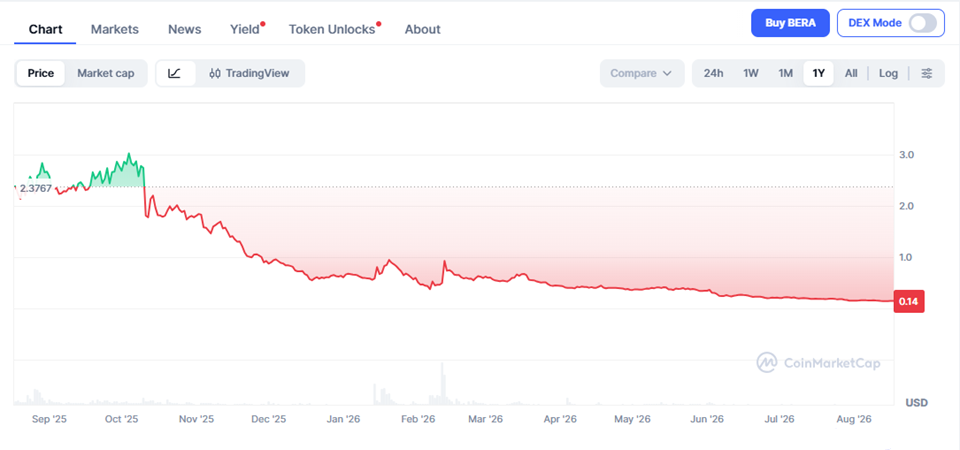
Image Source: https://coinmarketcap.com/currencies/berachain/
BERA Price Prediction Table (2026–2040)
The ranges below use bear, base, and bull cases built around Proof of Liquidity adoption, unlock absorption, ecosystem TVL, and Layer 1 market cycles. Scenario estimates only, not financial advice.
| Year | Pessimistic Case (Bear) | Realistic Case (Base) | Optimistic Case (Bull) |
|---|---|---|---|
2026 | $0.12 | $0.45 | $0.95 |
2027 | $0.10 | $0.80 | $2.00 |
2028 | $0.09 | $1.10 | $3.20 |
2030 | $0.15 | $1.80 | $6.00 |
2040 | $0.20 | $3.50 | $12.00 |
Yearly Breakdowns
What Makes BERA Different From Other Layer 1 Tokens
Most Layer 1s bolt DeFi onto generic proof-of-stake. Berachain rebuilt consensus itself around liquidity, which remains its genuinely original contribution.
Because Proof of Liquidity completely reimagines traditional proof-of-stake dynamics, comprehensive crypto guides are essential for helping investors understand how validator delegation, BGT emissions, and yield strategies work in practice.
Core Catalysts That Could Drive BERA Higher
1️⃣ Unlock Exhaustion:
The dominant seller in BERA’s market is the vesting calendar. As allocations complete toward 2027–2028, that structural pressure fades, and even flat demand starts moving price against a sub-$70 million cap.
While centralized crypto exchanges provided the initial order book depth for BERA’s launch-day peak, much of the continuous selling pressure now flows through both spot platforms and native Proof of Liquidity pools.
2️⃣ A Flagship App Breakout:
Every successful L1 rode one killer app to relevance. Berachain’s PoL design means a breakout native protocol would recycle its success directly into chain-level security and BERA demand, a tighter loop than any competitor offers.
3️⃣ Institutional Treasury Adoption:
Greenlane’s $110 million BERA treasury raise proved public-market appetite exists. Additional treasury vehicles or fund products would introduce the patient, price-insensitive buyers this chart has never had.
How High Can BERA Go? Price Targets Explained
Investment Risks and Final Notes
Supply is the first and largest risk. BERA’s chart is a live demonstration of what continuous unlocks do to a thin market, and the schedule has years left to run. Until vesting matures, every rally will be sold into by someone whose cost basis is effectively zero.
Beyond that, Proof of Liquidity remains unproven at scale; the ecosystem’s exploit exposure is real even when recoveries succeed, and competition for DeFi liquidity is the fiercest arena in crypto. A launch-day ATH also means nearly every buyer in the token’s history is underwater, a psychological overhang that takes cycles to clear.
Any investment should be treated as deeply speculative, sized for the possibility of further lows.
Other Crypto Price Prediction Pages
FAQ – BERA Price Prediction
What will the BERA price be in 2026?
Base case: $0.40–$0.50, assuming stabilization at the lows and recovering ecosystem activity. A genuine catalyst could push BERA toward $0.95. Continued unlock pressure keeps $0.12 in play.
What is the BERA price outlook for 2030?
If Proof of Liquidity proves itself and supply matures, a base near $1.80 by 2030 is defensible. The bull case at $6.00 requires Berachain to rank among the leading DeFi settlement layers.
Why is BERA so far below its ATH?
The $14.83 print came on launch day in February 2025, on tiny float and maximal hype. Continuous vesting unlocks then expanded supply into fading demand, grinding the token down more than 98% to fresh lows by mid-2026.
Is BERA a good investment?
BERA offers an original consensus design, serious backers, and a washed-out entry price, against heavy ongoing dilution. It suits only investors with very high risk tolerance betting on a multi-year ecosystem recovery.
Can you use BERA at crypto casinos?
BERA is primarily a gas and staking token for the Berachain network and is not widely supported as a direct casino deposit method. It can be held in self-custody using popular Bitcoin wallets with multi-chain support or any EVM-compatible wallet.

 shahnakul23@gmail.com