












 Compound (COMP) Price Prediction
 Article Contributors


 Fact checked by
 Read Time: 5mins
 Published: 24/08/2026 | Updated: 24/08/2026


Reading the COMP Market Right Now
COMP is priced well below the value once assigned to its brand. That discount reflects more than a weak market. Aave captured broader mindshare, newer lenders compete on specific collateral types, and Compound’s conservative design can look slow during incentive-driven expansions.
The protocol remains technically credible. Compound III uses supply caps, separate borrow and liquidation collateral factors, base-asset reserves, and governance-controlled parameters. Markets can deploy on EVM networks while Ethereum governance communicates changes across bridges. The architecture contains risk, but multi-chain governance creates dependencies of its own.
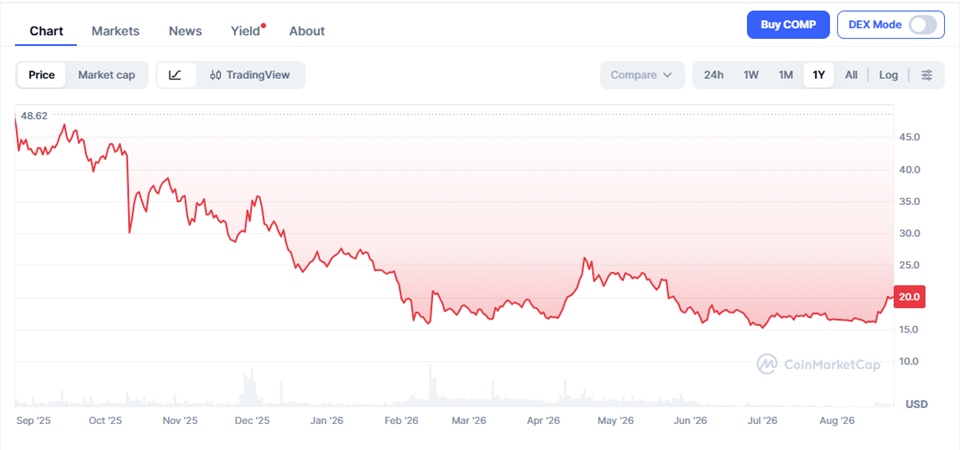
Image Source: https://coinmarketcap.com/currencies/compound/
COMP Price Prediction Table (2026–2040)
These price predictions scenarios consider lending activity, reserves, chain expansion, protocol competition, governance, and token value capture. They are estimates, not financial advice.
| Year | Pessimistic Case (Bear) | Realistic Case (Base) | Optimistic Case (Bull) |
|---|---|---|---|
2026 | $10 | $24 | $45 |
2027 | $8 | $35 | $70 |
2028 | $7 | $50 | $110 |
2030 | $10 | $75 | $180 |
2040 | $16 | $160 | $500 |
Yearly Breakdowns
What Makes COMP Different From Other Lending Tokens
Compound’s advantage is restraint. Compound III isolates base assets, limits supported collateral, and separates borrowing thresholds from liquidation thresholds. That reduces contagion compared with a broad pool where every asset can interact with every other one.
The Comet Market Model
Each Comet market centers on a single base asset such as USDC. Users supply that asset to earn interest or borrow it against approved collateral. Collateral does not automatically earn interest, which makes the accounting and risk boundary easier to understand.
Governance and Reserves
COMP holders delegate votes and control parameters, deployments, reserve withdrawals, and upgrades through a timelock. Reserves absorb debt during liquidations and grow from the difference between borrower and supplier rates. This is valuable protocol capital, though access to it is governed rather than automatically distributed.
Compound v2 and Compound III
The original v2 markets still matter because they hold long-lived positions and use the familiar cToken model. Compound III is a separate architecture rather than a transparent upgrade of every account. That coexistence preserves user choice but fragments liquidity, interfaces, and risk monitoring. A successful transition should move activity toward Comet without forcing borrowers through unsafe migrations or abandoning functioning v2 markets.
The distinction also affects valuation. Growth reported across “Compound” may include markets with different reserve structures and incentives. Investors should separate supplied collateral from borrow balances, check utilization, and identify which deployment actually produces reserves. Gross deposits are not revenue, and rewards can temporarily make an unproductive market look active.
Core Catalysts That Could Drive COMP Higher
How High Can Compound Go? Price Targets Explained
Investment Risks and Final Notes
Lending protocols fail through bad collateral, broken oracles, bridge problems, governance mistakes, and liquidations that outrun available reserves. Compound reduces some of those risks with isolated markets and supply caps, but it cannot eliminate them. Multi-chain deployments also widen the operational surface.
Competition and value capture are equally important. Aave, Morpho, and specialized lenders can offer more markets or different economics. Some users recycle trading and gaming balances through online casinos with crypto, but borrowed funds magnify losses regardless of where they are spent. Strategies resembling arbitrage betting with cryptos still carry execution and liquidation risk. COMP is a speculative governance asset, not a deposit claim.
Other Crypto Price Prediction Pages
FAQ – COMP Price Prediction
What will the COMP price be in 2026?
The base case is $24. A stronger DeFi market could push COMP toward $45, while stagnant borrowing or a risk event keeps $10 possible.
What is the COMP price outlook for 2030?
A base near $75 assumes Compound III grows across several important markets. The $180 bull case requires top-tier lending share and stronger tokenholder alignment.
Why is COMP far below its ATH?
The 2021 peak reflected liquidity-mining enthusiasm, limited float and DeFi-wide speculation. As incentives fell and competition grew, the market discounted governance rights that did not guarantee cash flow.
What is Compound III?
Compound III, also called Comet, is a lending architecture where each market has one borrowable base asset and a controlled list of collateral assets with separate risk parameters.
Is COMP a good investment?
COMP offers fixed supply, a respected protocol and meaningful governance authority, but token value capture is uncertain. It remains a high-risk bet on lending growth and governance decisions.
Can you use COMP at crypto casinos?
Direct support is uncommon. Most holders would swap COMP into a widely accepted coin or stablecoin before depositing. Check current platform rules and do not borrow to gamble.




 shahnakul23@gmail.com