Kaito invented a market category and then had to survive it. The AI-powered platform founded by Yu Hu turned crypto’s scattered information, posts, podcasts, research, governance forums, into a searchable, rankable attention layer, coining the term InfoFi in the process.
Its Mindshare dashboards and Yapper leaderboards became the industry’s default scoreboard for narrative momentum, and projects now pay to run token-distribution campaigns through it.
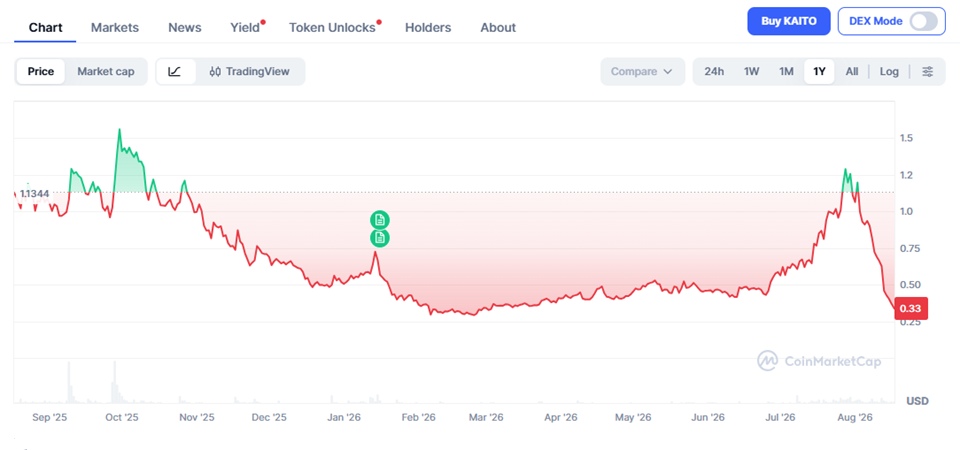
The token had a rougher education. KAITO launched in February 2025, spiked to $2.92 within weeks, then ground down to an all-time low near $0.27 in February 2026 as unlocks and airdrop churn did their usual work.
It has since recovered, and every Kaito price prediction now rests on whether attention markets are a durable business or a single cycle’s fashion.
KAITO has a market cap near $145 million on a circulating supply of roughly 241 million tokens out of a 1 billion max, and that ratio is the tension at the heart of the chart: less than a quarter of supply circulates, and scheduled unlocks, including a 17.6 million token tranche in July 2026, keep testing demand every month.
The business side has real signal. Kaito’s leaderboards shape how projects allocate marketing budgets, its AI agents scan the entire crypto information landscape, and the network monetizes through campaign fees and enterprise access rather than pure token emissions. Its listings across major exchanges keep it accessible for traders managing positions.
Doubling from February’s lows while the sector chopped sideways suggests the market is starting to separate Kaito from the average AI-token basket.
KAITO trades on a blend of altcoin beta and unlock mechanics. Rallies tend to stall into distribution events, then rebuild once the supply clears, a rhythm that will persist as long as three-quarters of the tokens remain locked.
Key support: $0.45–$0.50 is the zone buyers defended through spring 2026. Below that, the $0.27 all-time low is the final backstop.
Key resistance: $0.75–$0.85 capped the recovery so far. A clean break above $1.00 would confirm the trend change and put the launch range back in play.
Volatility profile: High. KAITO reacts to unlock dates, campaign launches on the platform, the AI narrative, and broader altcoin rotation.
KAITO Price Prediction Table (2026–2040)
The ranges below use bear, base, and bull cases built around InfoFi adoption, platform revenue, unlock absorption, and AI-sector narrative cycles. Price predictions below are scenario estimates only, not financial advice.
Year
Pessimistic Case (Bear)
Realistic Case (Base)
Optimistic Case (Bull)
2026
$0.35
$1.10
$2.20
2027
$0.30
$1.80
$4.00
2028
$0.25
$2.20
$6.00
2030
$0.40
$3.50
$10.00
2040
$0.50
$6.00
$20.00
Yearly Breakdowns
Kaito (KAITO) Price Prediction 2026
The rest of 2026 is a fight between recovering fundamentals and a heavy unlock calendar. A base of $1.00–$1.20 assumes the platform keeps winning campaign business, the AI narrative stays warm, and monthly unlocks get absorbed without breaking the uptrend from February’s lows.
The bull case toward $2.20 needs an AI-sector rally with Kaito as its information hub, plus visible revenue growth from enterprise products. The bear case at $0.35 is what happens if altcoin liquidity dries up and unlock supply overwhelms a thin order book, sending price back toward its lows.
Kaito (KAITO) Price Prediction 2027
2027 should reveal whether InfoFi is infrastructure or fad. If projects still budget for mindshare campaigns and traders still price narratives off Kaito dashboards two years in, the platform has crossed from novelty to utility.
Attention markets and gambling markets are cousins; the same crowd that handicaps narrative momentum on leaderboards often plays at provably fair online casinos, where transparent odds scratch the same itch. A base of $1.80 assumes durable platform revenue in a decent cycle; the bull case of $4.00 requires KAITO to reclaim its all-time high on the back of a full AI-and-attention narrative wave.
KAITO Price Forecast 2028
By 2028, most of the supply overhang will have vested, shifting the story from dilution to demand. A base of $2.20 reflects a platform that owns its niche with steady fee flows and a market cap in the low billions on near-full supply. The bull case of $6.00 is the scenario where attention data becomes standard market infrastructure, licensed by funds and exchanges the way price feeds are licensed today. The bear case of $0.25 is where a competitor or an AI-native successor eats the dashboard business and the token loses its reason to exist entirely.
KAITO Valuation 2030
By 2030, the attention economy thesis will be settled one way or the other. A base of $3.50 puts KAITO’s valuation near $3.5 billion on full supply, a plausible outcome for the category-defining platform in a world where information flow is openly financialized.
The bull case at $10.00 implies roughly $10 billion, the scenario where Kaito’s data layer underpins how capital allocates across crypto and beyond. Speculative liquidity is famously promiscuous, and some of the flow that cycles through VPN casino websites chases the same high-beta narratives Kaito itself measures, a loop the platform monetizes better than anyone.
KAITO Macro Vision 2040
The 2040 case is a bet that attention becomes a formally traded asset class. A base of $6.00 implies a valuation around $6 billion, a mature data-infrastructure outcome. The bull case at $20.00 puts KAITO near $20 billion, requiring the platform to be the Bloomberg of attention markets across an AI-saturated internet. The bear case at $0.50 is the quieter ending: the idea proves right, but value accrues to whoever executes it next.
What Makes KAITO Different From Other AI Tokens
Most AI tokens attach a ticker to a model wrapper. Kaito built a working data business first and tokenized its distribution second.
The InfoFi Category and Mindshare Data
Kaito’s engine ingests the entire crypto information sphere and converts it into mindshare metrics that traders, funds, and projects actually use daily. That daily utility is rare in the AI-token sector, where most products are demos, and it gives the platform pricing power over anyone who needs to be seen.
Yapper Leaderboards and Campaign Revenue
The leaderboard system turned content creation into a measurable, rewardable market, and projects pay Kaito to run distribution campaigns through it. The token sits inside that loop as the network’s currency and governance layer, meaning platform growth translates into structural token demand rather than pure speculation.
Core Catalysts That Could Drive KAITO Higher
1️⃣ An AI Narrative Supercycle:
Kaito is the reflexive AI trade: when AI tokens run, attention on Kaito spikes, which markets Kaito itself. Any sustained AI rally makes it a first-rotation destination against a modest $145 million cap.
2️⃣ Enterprise and Data Licensing Growth:
Funds, exchanges, and market makers all want structured attention data. Expanding paid access and API licensing would give KAITO the recurring-revenue story that separates surviving platforms from cycle toys.
3️⃣ Unlock Digestion:
Every vesting tranche absorbed without breaking support removes a future seller. As circulating supply climbs toward the cap through 2027–2028, the structural headwind that defined KAITO’s first years steadily disappears.
How High Can KAITO Go? Price Targets Explained
Can KAITO Reach $3?
Achievable in a strong 2027–2028 window, implying roughly $3 billion on near-full supply. It requires the platform to keep its category lead while the AI narrative runs. A new all-time high, but not an outrageous one.
Will KAITO Hit $10?
That is the 2030 bull case at around $10 billion, requiring attention markets to become standard financial infrastructure with Kaito as the incumbent. Ambitious, but the platform already owns the category it needs to grow into.
Investment Risks and Final Notes
Supply is the loudest risk. With roughly three-quarters of tokens still locked at the time of writing, KAITO faces years of scheduled distribution, and each unlock is a live test of real demand. The February 2026 collapse to $0.27 showed how quickly that test can fail in a weak tape.
The business risks are subtler. Attention platforms live and die by credibility; any perception that leaderboards can be gamed or campaigns bought erodes the core asset, and InfoFi’s critics already make that argument loudly.
Competition from AI-native analytics tools and the general fragility of narrative-driven sectors add further downside pressure. Treat any allocation as a high-risk growth bet on a young category and keep your funds safe in crypto wallets.
Base case: $1.00–$1.20, assuming continued platform growth and orderly unlock absorption. An AI-led rally could push KAITO toward $2.20. A liquidity drought keeps $0.35 in play.
What is the KAITO price outlook for 2030?
If InfoFi matures into standard market infrastructure, a base near $3.50 by 2030 is defensible. The bull case at $10.00 requires Kaito to dominate attention data the way incumbents dominate price data.
Why is KAITO so far below its ATH?
The $2.92 peak came weeks after the February 2025 launch, when float was tiny and hype was maximal. Airdrop selling and monthly unlocks then expanded supply faster than demand, bottoming the token near $0.27 a year later.
Is KAITO a good investment?
KAITO pairs a genuinely used product and category leadership with heavy future dilution. It suits investors with high risk tolerance who believe attention markets outlast the hype cycle that named them.
Can you use KAITO at crypto casinos?
KAITO is primarily an ecosystem and governance token for the InfoFi network and is not widely supported as a direct casino deposit method.
Before we part ways…
Check the following beginner guides we provided to all crypto enthusiasts
He has worked with several companies in the past including Economy Watch, and Milkroad. Finds writing for BitEdge highly satisfying as he gets an opportunity to share his knowledge with a broad community of gamblers.
















 Article Contributors


 Fact checked by
 Read Time: 5mins
 Published: 12/08/2026 | Updated: 17/08/2026







 eabungana@gmail.com

