Maple Finance is what happens when former bankers build DeFi. The protocol runs an on-chain institutional lending marketplace, issuing fixed-rate, overcollateralized loans to professional borrowers while its permissionless Syrup product lets anyone access that institutional yield. In a sector full of circular token games, Maple generates the rarest commodity in crypto: actual interest income.
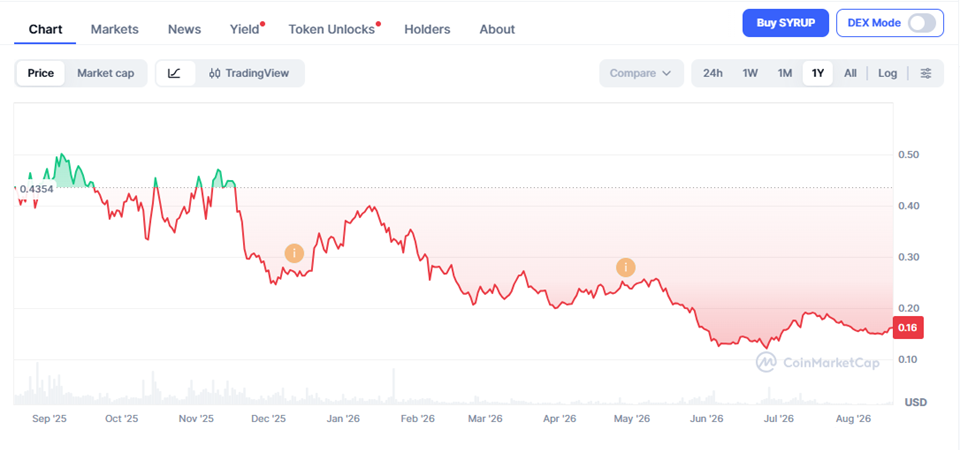
The SYRUP token has ridden that story unevenly. It peaked at $0.6557 in mid-2025 as the real-world-asset narrative surged, then retraced hard with the broader market to trade around $0.15 today, roughly 77% below the top, with a market cap near $180 million. Every serious Maple Finance price prediction now comes down to whether growing loan books and a 25% revenue buyback can outrun a risk-off tape.
SYRUP has a market cap of roughly $180 million and about 1.19 billion tokens circulating out of a 1.24 billion total, so dilution risk is nearly exhausted. The protocol’s fundamentals kept improving even as price fell: assets under management scaled into the billions, and 25% of protocol revenue is allocated to systematic SYRUP buybacks, a direct pipe between lending activity and token demand.
Before interacting with permissionless DeFi products like Syrup, users need to secure their funds using reliable crypto wallets that support cross-chain asset management and dApp connectivity.
2026 has delivered concrete catalysts. The legal dispute with Core Foundation that blocked Maple’s Bitcoin yield product was fully settled in May, clearing the runway for syrupBTC, a product aimed at the largest idle asset base in crypto.
A Revolut listing in April broadened retail access across the UK and EU, putting the token in front of millions of users who never touch DeFi front-ends. The token’s problem has never been the business; it has been a market that, for the past year, simply stopped paying for fundamentals of any kind.
SYRUP trades like a high-beta proxy on DeFi sentiment with a fundamental floor forming underneath. It tracks Bitcoin closely on macro days, but buyback flow and AUM growth give dips a bid that pure narrative tokens lack.
Key support: $0.11–$0.13 is the 2026 base that absorbed the worst of the drawdown. Losing it would signal the market pricing recession-level credit stress.
Key resistance: $0.20–$0.22 capped every recovery attempt this year. Clearing $0.28 would put the trend firmly back toward the highs.
Volatility profile: Moderate to high. SYRUP reacts to AUM and loan-book data, quarterly revenue, syrupBTC traction, RWA sector sentiment, and Bitcoin’s macro swings.
SYRUP Price Prediction Table (2026–2040)
The projections below reflect bear, base, and bull cases built around lending AUM growth, buyback impact, syrupBTC adoption, credit performance, and RWA cycles.
Note: These are scenario estimates only, not financial advice.
Maple Finance (SYRUP) Price Prediction 2026
The rest of 2026 belongs to syrupBTC. With the legal overhang settled, launching a Bitcoin yield product into a market of trillions in idle BTC is the single biggest addressable-market expansion in Maple’s history. A base of $0.25–$0.30 assumes a successful rollout, steady AUM growth, and buybacks compounding quietly.
The bull case toward $0.55, essentially a retest of the all-time high, needs syrupBTC to attract serious capital while the RWA narrative reheats. The bear case at $0.09 is the macro path, where credit appetite shrinks, AUM stalls, and revenue-linked buybacks thin out with it.
Maple Finance (SYRUP) Price Prediction 2027
2027 is when the flywheel either shows its teeth or doesn’t. More AUM means more revenue, which means larger buybacks on a supply that has essentially stopped growing, a structure closer to equity mechanics than typical DeFi tokenomics.
Yield-seeking crypto capital is broad church; the same users comparing lending APYs often frequent provably fair casinos, where transparent on-chain math is the shared appeal. A base of $0.45 assumes institutional lending keeps scaling in a friendlier rate environment; the bull case of $0.95 requires Maple to consolidate its position as the default on-chain credit desk.
SYRUP Price Forecast 2028
By 2028, on-chain credit will either be a standard institutional allocation or still a niche. A base of $0.60 reflects Maple compounding AUM through a full cycle with buybacks steadily retiring float. The bull case of $1.40 is the scenario where tokenized credit goes mainstream and Maple, as the incumbent with a real underwriting track record, captures the flow, supporting a valuation near $1.7 billion. The bear case of $0.07 requires a serious credit event, defaults that break the protocol’s reputation for disciplined underwriting.
SYRUP Valuation 2030
By 2030, a base price of $1.00 would put SYRUP’s market cap around $1.2 billion, reasonable for a profitable lending platform managing institutional-scale assets on-chain. The bull case at $2.50 implies roughly $3 billion, the outcome where Maple becomes crypto’s reference credit institution as traditional fixed income migrates on-chain.
Capital in this industry rotates constantly between yield and risk, and some of the liquidity flowing through VPN online casinos on the speculative end eventually parks in yield products on the conservative end, a spectrum Maple sits at the profitable middle of.
SYRUP Macro Vision 2040
The 2040 case treats Maple as a maturing financial institution rather than a token. A base of $2.00 implies a valuation near $2.5 billion, plausible for a two-decade-old on-chain lender with compounding buybacks. The bull case at $6.00 puts SYRUP around $7.5 billion, requiring on-chain credit markets to rival traditional private credit with Maple among the leaders. The bear case at $0.15 is a business that survives but never escapes niche status.
What Makes SYRUP Different From Other DeFi Tokens
Most DeFi lending tokens govern pool parameters. SYRUP is tied to an underwriting business with revenue, credit standards, and a management team from traditional finance.
Institutional Underwriting On-Chain
Maple’s loans are fixed-rate and overcollateralized, extended to vetted institutional borrowers under real credit processes rather than anonymous pool mechanics. That discipline produced a yield track record strong enough to attract allocators who would never touch typical DeFi, and it is the moat imitators struggle to copy.
The Buyback Engine and Capped Supply
With 25% of protocol revenue committed to SYRUP buybacks and supply nearly fully circulating, the token behaves like a claim on business growth. Every new loan feeds the buyback, which is the cleanest value-accrual design in the RWA sector.
Core Catalysts That Could Drive SYRUP Higher
1️⃣ syrupBTC Adoption:
Bitcoin holders sit on the largest pool of unproductive capital in crypto. If syrupBTC captures even a sliver of it, Maple’s AUM and revenue step-change, and the buyback scales with them.
2️⃣ The RWA Narrative Cycle:
Maple is a flagship of the real-world-asset theme. When institutional tokenization headlines run hot, capital rotates into the sector’s proven operators first, and Maple’s track record makes it a default allocation.
3️⃣ Distribution Expansion:
The Revolut listing opened millions of European retail accounts to SYRUP. Each new distribution channel, exchanges, fintechs, integrations with Pendle and Balancer, widens the holder base beyond DeFi natives.
How High Can SYRUP Go? Price Targets Explained
Can SYRUP Reclaim $0.65?
A return to the all-time high is a realistic 2026–2027 bull outcome, implying a market cap near $800 million. It requires syrupBTC traction and a cooperative macro backdrop, nothing structurally heroic.
Will SYRUP Hit $2?
That implies roughly $2.5 billion, priced for Maple as the dominant on-chain credit platform of a much larger RWA market. Most realistic as a 2030 scenario, ambitious but anchored to a real business.
Investment Risks and Final Notes
Credit risk is the one that matters. Maple’s history includes the 2022 default cycle that nearly broke the original protocol, and while underwriting has been rebuilt around overcollateralization, any major borrower failure would hit AUM, revenue, and reputation simultaneously.
Beyond credit, SYRUP carries macro sensitivity, since lending demand tracks risk appetite, plus competition from both DeFi rivals and TradFi entrants moving on-chain. Regulatory treatment of on-chain lending also remains unsettled across major jurisdictions, and a hostile ruling in a key market could constrain growth overnight.
The buyback is a strength, but it is revenue-linked: in a downturn, it shrinks precisely when the token needs support most.
Treat any investmentas a high-risk position in an early-stage financial institution, not a stable yield instrument. Beginners navigating these yield strategies or evaluating protocol tokenomics can consult our crypto guides to better understand risk management and on-chain mechanics.
Base case: $0.25–$0.30, assuming a successful syrupBTC launch and continued AUM growth. A strong RWA rotation could push SYRUP toward $0.55. A macro credit crunch keeps $0.09 possible.
What is the SYRUP price outlook for 2030?
If Maple compounds as crypto’s leading credit platform, a base near $1.00 by 2030 is defensible. The bull case at $2.50 requires on-chain credit to become a standard institutional allocation.
Why is SYRUP below its ATH?
The $0.6557 peak came in mid-2025 at the height of the RWA rally. The broader 2025–2026 drawdown dragged SYRUP down with the sector, even as the protocol’s loan book and revenue continued growing underneath.
Is SYRUP a good investment?
SYRUP offers rare fundamentals, real revenue, buybacks, capped supply, wrapped in credit and macro risk. It suits investors with high risk tolerance who want cash-flow-linked exposure to the RWA theme.
Can you use SYRUP at crypto casinos?
SYRUP is primarily a protocol and staking token for the Maple ecosystem and is not widely supported as a direct casino deposit method.