














 Cronos Reverses Blockchain History to Neutralize $75M Tectonic Lending Security Breach
 Article Contributors


 Fact checked by
 Read Time: 2mins
 Published: 04/09/2026 | Updated: 22/09/2026


How the $75M Exploit Unfolded
On August 30, 2026, the Cronos ecosystem faced its most severe security challenge when an exploiter targeted Tectonic, the primary money market operating on the network. Prior to the breach, Tectonic held more than $120 million in locked value and maintained over $82 million in active lending pools.
The attacker executed a pump-and-borrow scheme by deploying roughly $600,000 across thin liquidity pools to buy TONIC, the protocol’s native governance token. Within 20 minutes, the market price of TONIC soared nearly 100-fold.
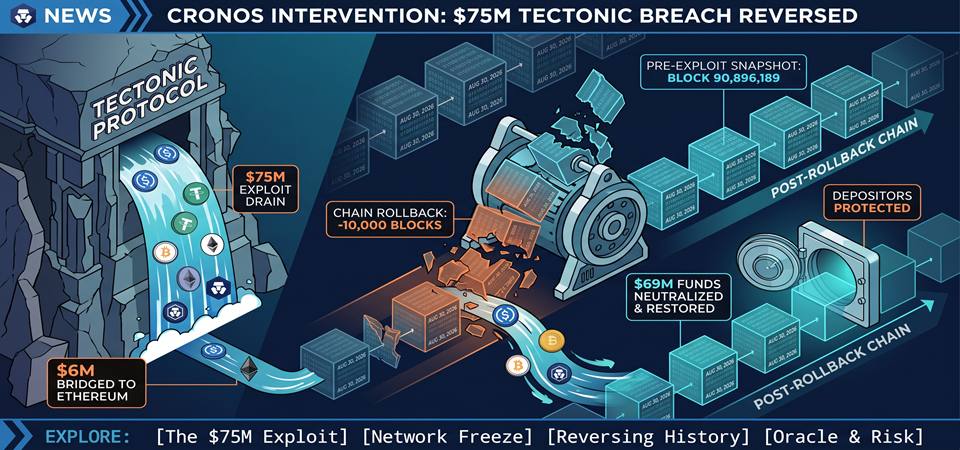
Capitalizing on the inflated valuation, the attacker deposited 364.6 trillion TONIC into Tectonic, establishing an artificial collateral position reported near $375 million. Against this phantom collateral, the individual borrowed roughly $75 million in liquid digital assets—including USDC, USDT, WBTC, WETH, and CRO—draining the protocol’s liquidity pools.
Validators Freeze the Network
Recognizing the scale of the drain, Cronos network operators took immediate action. Validators coordinated an emergency shutdown of the entire chain, halting block production to contain the incident.
By the time the network was paused, the attacker had bridged roughly $6 million onto the Ethereum network.
However, the remaining $69 million remained stranded across addresses on Cronos. The emergency pause temporarily suspended all network operations, leaving external RPC providers, cross-chain bridges, and un-involved users unable to process transactions while teams assessed the situation.
Meanwhile, Crypto.com clarified that its centralized exchange and mobile app remained completely unaffected and operational.
Erasing 10,000 Blocks of History
Faced with a devastating ecosystem loss, Cronos validators chose a drastic intervention rather than relying on standard address freezes. Node operators restored the network to a pre-exploit state, rolling back more than 10,000 blocks and resuming consensus from block 90,896,189.
| Metric | Details |
| Total Stolen Amount | ~$75 Million |
| Capital Escaped to Ethereum | ~$6 Million |
| Funds Neutralized via Rollback | ~$69 Million |
| Blocks Erased from History | 10,000 Blocks (~2 Hours) |
| Resumption Block Height | Block 90,896,189 |
By rewinding approximately two hours of transactional history, the attack transactions ceased to exist on the canonical chain, effectively recovering the $69 million marooned on Cronos.
While the rollback protected Tectonic depositors, it also erased all legitimate user transactions, swaps, and smart contract deployments executed within that two-hour window, requiring infrastructure providers to resynchronize their ledger databases.
Oracle Accuracy vs. Protocol Parameters
Security analysts emphasized that the underlying price oracles operated correctly by reflecting real-time decentralized exchange prices. Instead, the vulnerability lay within Tectonic’s risk controls, which allowed illiquid governance assets to serve as high-value collateral without imposing borrow caps based on executable market depth.
Without risk boundaries tied to actual market liquidity, thin token markets remain vulnerable to price manipulation. Identical exploits previously impacted protocols such as Moonwell on Base and Mango Markets on Solana.
The Cronos intervention highlights an ongoing industry discussion surrounding blockchain immutability, validator consensus speed, and decentralized risk management.


 eabungana@gmail.com

