THORChain solved one of crypto’s genuinely hard problems: swapping native Bitcoin for native Ethereum, Solana, or a dozen other assets without wrapped tokens, custodians, or centralized exchanges. Since 2021 it has been the decentralized routing engine quietly embedded in wallets and aggregators across the industry.
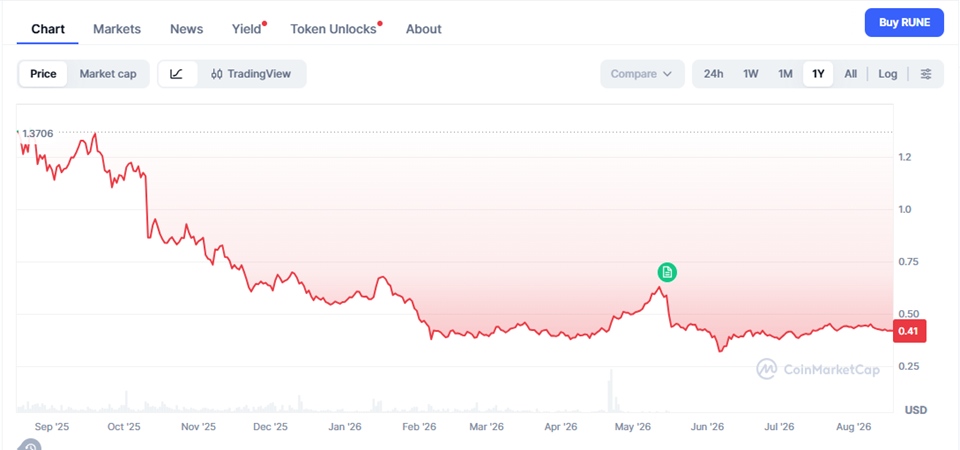
The RUNE token has lived a more violent life. It touched $21 in May 2021, survived exploits, a lending-program crisis, and multiple redesigns, and now trades around $0.41 with a market cap near $140 million, about 98% below its peak.
A June 2026 security incident that paused the network added fresh bruises. Any honest THORChain price prediction has to price both the protocol’s unmatched utility and its habit of scaring its own holders.
RUNE has a market cap of roughly $140 million and a circulating supply of nearly 340 million tokens against a 500 million cap. The token’s design still ties value to usage: every liquidity pool pairs with RUNE, nodes bond large RUNE stakes to secure the network, and all fees are paid in RUNE, with 5% of them burned and a share flowing to TCY holders under the post-restructuring model.
2026 has been eventful in both directions. The v3.16 upgrade restored native Solana swaps in March, reconnecting THORChain to one of crypto’s most active ecosystems, and the Rujira app layer opened smart contracts with direct access to native liquidity.
Then June brought a suspected $10 million exploit and a trading pause across several chains, a reminder that the protocol’s complexity is a permanent liability alongside its moat.
While centralized crypto exchanges still host the majority of RUNE’s fiat-to-crypto entry volume, THORChain’s decentralized model offers traders a non-custodial alternative for direct cross-chain settlement.
RUNE trades on a cycle of redemption and relapse. Upgrades and volume growth build rallies; security incidents and node dramas erase them. The June 2026 pause knocked the token down hard before recovery progress steadied sentiment, and that whiplash pattern is likely to remain the token’s signature until a long stretch of clean operation resets expectations.
Key support: $0.35–$0.39 held through the 2026 incident panic. Losing it would put the post-restructuring lows back in focus.
Key resistance: $0.55–$0.65 is the first serious zone. Reclaiming $0.90 would suggest the market is pricing the protocol’s utility again rather than its scar tissue.
Volatility profile: High. RUNE reacts to swap volume, security news, node bond metrics, burn data, and the broader appetite for DeFi infrastructure.
RUNE Price Prediction Table (2026–2040)
The projections below reflect bear, base, and bull cases built around cross-chain volume, the deterministic link between deposits and RUNE demand, security track record, and DeFi cycles.
Year
Pessimistic Case (Bear)
Realistic Case (Base)
Optimistic Case (Bull)
2026
$0.25
$0.80
$1.60
2027
$0.20
$1.40
$3.20
2028
$0.18
$1.80
$5.00
2030
$0.30
$3.00
$9.00
2040
$0.40
$6.00
$18.00
It can be held in self-custody alongside popular Bitcoin wallets or any THORChain-compatible wallet.
Yearly Breakdowns
THORChain (RUNE) Price Prediction 2026
The rest of 2026 is about rebuilding trust after the June incident while capitalizing on the Solana reconnection. A base of $0.70–$0.90 assumes full network recovery, swap volumes trending higher, and the burn mechanism steadily working on supply.
The bull case toward $1.60 needs a clean security record from here plus a DeFi rotation that rewards protocols with real fees. The bear case at $0.25 is the trust-erosion path, where every new incident compounds the last one and liquidity providers quietly exit.
THORChain (RUNE) Price Prediction 2027
2027 should be the payoff window for the Rujira app layer: lending, perps, and a Bitcoin-backed stablecoin built directly on native liquidity, with fees split back to the protocol. If those products gain traction, RUNE stops being just a swap token and becomes the base asset of a small economy.
The users drawn to trustless, non-custodial swaps overlap naturally with privacy-minded crypto crowds, including players at no KYC betting sites who prize the same permissionless rails. A base of $1.40 assumes app-layer fees compound in a decent cycle; the bull case of $3.20 requires THORChain to be the default cross-chain engine inside major wallets.
RUNE Price Forecast 2028
By 2028, the deterministic tokenomics either prove themselves or don’t. Because every dollar of pooled assets structurally requires roughly three dollars of bonded and paired RUNE, sustained deposit growth mechanically forces token demand. A base of $1.80 assumes deposits recover toward previous highs. The bull case of $5.00 is the scenario where native cross-chain settlement becomes standard wallet infrastructure and burns visibly tighten supply. The bear case of $0.18 is where another major exploit finally breaks liquidity-provider confidence for good.
RUNE Valuation 2030
By 2030, a base price of $3.00 would put RUNE’s market cap near $1 billion, sane for the leading native cross-chain protocol in a much larger on-chain economy. The bull case at $9.00 implies roughly $3 billion, a scenario where THORChain routes a meaningful share of all decentralized swap volume between major chains.
Crypto liquidity is one big interconnected pool, and some of the capital that rotates through VPN casinos is the same money chasing DeFi yields on protocols like this one, which is partly why RUNE’s beta to risk appetite is so high in both directions.
RUNE Macro Vision 2040
The 2040 case assumes wrapped assets and custodial bridges lose to native settlement. A base of $6.00 implies a valuation near $2 billion, a durable-infrastructure outcome for a protocol that would by then have survived two decades of adversarial conditions. The bull case at $18.00 puts RUNE near its historic peak, requiring THORChain to be the invisible engine behind most cross-chain movement. The bear case at $0.40 is stagnation: the protocol works, but newer designs route around it.
Scenario estimates only, not financial advice.
What Makes RUNE Different From Other DeFi Tokens
Most DeFi tokens are governance claims on fee streams. RUNE is structurally consumed by its own network’s growth, a design that remains unique at scale.
Native Swaps Without Wrapping
THORChain settles real BTC, ETH, SOL, and more from self-custody wallets, no wrapped assets, no custodians, no KYC gates. That was a first in DeFi history, and after years of bridge hacks elsewhere, native settlement looks less like a feature and more like the endgame.
Deterministic Tokenomics and the Burn
Every pool pairs against RUNE and nodes bond triple the pooled value, so deposits mathematically pull RUNE off the market. Add the 5% fee burn and the capped 500 million supply, and you get a token whose baseline demand is written into the protocol rather than promised in a roadmap.
Core Catalysts That Could Drive RUNE Higher
1️⃣ Wallet and Aggregator Integrations:
THORChain’s best growth channel is invisibility: powering swaps inside wallets people already use. Each new default integration adds volume without marketing, and volume is the whole ballgame for a fee-burning protocol.
2️⃣ The Rujira App Layer:
Smart contracts with direct native-liquidity access enable lending, perps, and stablecoins that pay fees back to the network. A breakout Rujira app would multiply fee flow and give RUNE a second demand engine beyond swaps.
3️⃣ Bitcoin DeFi Demand:
THORChain remains one of the few venues where native BTC earns yield or trades trustlessly. As Bitcoin’s dormant capital seeks productivity, the protocol is positioned to capture flows most DeFi platforms simply cannot touch.
How High Can RUNE Go? Price Targets Explained
Can RUNE Reach $2?
Very plausible in a strong 2027 cycle. At $2, market cap sits near $700 million, well within historical norms for the protocol during healthy DeFi periods. It mostly requires volume recovery and incident-free operation.
Will RUNE Hit $10?
That implies roughly $3.5 billion, still below the 2021 peak valuation. It needs cross-chain volume to scale dramatically with THORChain keeping its lead, most realistic as a 2030 bull case. Demanding, but consistent with the token’s own history.
Investment Risks and Final Notes
Security is the risk that never retires. THORChain’s design touches every major chain simultaneously, making it one of the most complex attack surfaces in crypto, and the June 2026 incident proved the danger remains current. Each exploit costs both funds and the liquidity-provider confidence the tokenomics depend on.
Beyond that, RUNE carries legacy debt from the lending and savers unwind, competition from intent-based bridges, and extreme sensitivity to DeFi sentiment. The protocol has survived everything so far, but survival came with 98% drawdowns. Treat any allocation as high-risk infrastructure exposure sized for violent volatility.
Base case: $0.70–$0.90, assuming full recovery from the June incident and growing swap volume. A clean run plus a DeFi rotation could push RUNE toward $1.60. Renewed security trouble keeps $0.25 in play.
What is the RUNE price outlook for 2030?
If THORChain remains the dominant native cross-chain venue, a base near $3.00 by 2030 is defensible. The bull case at $9.00 requires deposits and burns to compound across a full cycle.
Why is RUNE so far below its ATH?
The $21 peak came at the 2021 liquidity apex. Exploits in 2021, the harsh bear market, the lending-program crisis, and repeated trust shocks compounded into a 98% drawdown, leaving the token trading near its structural floor.
Is RUNE a good investment?
RUNE offers uniquely deterministic tokenomics on genuinely useful infrastructure, wrapped in above-average operational risk. It suits investors with very high risk tolerance who believe native cross-chain settlement wins the bridge wars.
Can you use RUNE at crypto casinos?
RUNE is primarily a settlement and bonding token for the THORChain network and is not widely supported as a direct casino deposit method.