Yearn Finance turned yield farming from a full-time job into a vault deposit. Its 2020 fair launch, no-founder-allocation mythology and microscopic token supply made YFI briefly trade above Bitcoin and peak near $90,800. The protocol survived long after DeFi summer, but survival came with a quieter brand, lower yields and a token whose connection to vault activity is still debated.
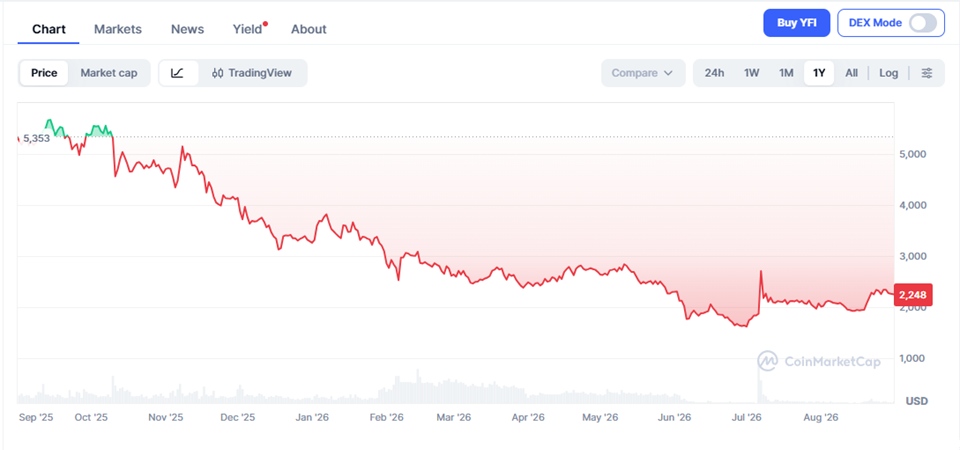
In 2026, YFI trades around $2,000 with a market capitalization close to $72 million. Yearn reports about $200 million in its vault ecosystem, while CoinGecko’s TVL feed sits in a similar low-hundreds-of-millions range. Nearly all 36,666 tokens exist. That makes a Yearn Finance price prediction less about dilution and more about whether a battle-tested yield marketplace can regain deposits, fees and a clear reason to own its governance asset.
YFI is unusual because the token price looks large while the network valuation is small. At roughly 36,000 circulating tokens, every $1,000 change represents only about $36 million in market capitalization. That low float creates sharp moves in both directions and makes per-token comparisons with Bitcoin meaningless.
Yearn’s product remains real. V3 vaults use the ERC-4626 standard, separate strategies from allocator vaults, and allow capital to move among independent yield sources. The open architecture improves composability and lets outside teams build on Yearn. It also increases curation risk: permissionless vault creation is useful only when depositors can distinguish robust strategies from fragile ones.
YFI can be illiquid relative to its reputation. A modest amount of capital rotating into or out of legacy DeFi can move the price quickly, especially when Ethereum fees or stablecoin yields change.
Key support: $1,800–$2,000 is the immediate demand zone. A break below $1,700 would reopen the 2026 lows and weaken the recovery structure.
Key resistance: $2,300–$2,600 is the first meaningful ceiling. Reclaiming $3,000 would suggest investors are pricing renewed vault growth.
Volatility profile: High. YFI reacts to TVL, strategy performance, security events, Ethereum DeFi sentiment and governance decisions.
YFI Price Prediction Table (2026–2040)
The ranges below are scenario estimates based on vault deposits, fee generation, strategy security, token value capture, and crypto market cycles. They are not financial advice.
Year
Pessimistic Case (Bear)
Realistic Case (Base)
Optimistic Case (Bull)
2026
$1,200
$2,800
$5,000
2027
$1,000
$4,000
$8,000
2028
$900
$5,500
$12,000
2030
$1,200
$8,500
$22,000
2040
$2,000
$18,000
$60,000
Research the best crypto exchanges and pick the right one to trade tokens efficiently and execute trades seamlessly.
Yearly Breakdowns
Yearn Finance (YFI) Price Prediction 2026
The rest of 2026 is a credibility-building period. Yearn needs steady deposits in allocator and single-asset vaults, competitive risk-adjusted returns, and no major strategy loss. A $2,800 base assumes TVL stabilizes above current levels and users rediscover automated yield as on-chain rates improve.
The $5,000 bull case requires stronger Ethereum DeFi activity and visible fee growth. The $1,200 bear case is not protocol death; it is the outcome where safe yields compress, depositors choose simpler products, and the governance token remains weakly connected to the business it oversees.
Yearn Finance (YFI) Price Prediction 2027
By 2027, V3’s open marketplace should show whether modularity creates distribution. If other applications route deposits into Yearn strategies and allocators, the protocol can grow without owning every user relationship. A $4,000 base price implies a network value around $145 million, still modest for a profitable yield layer.
Yearn’s audience is accustomed to moving capital across protocols, just as users compare crypto price predictions before taking risk. The advantage is automation; the risk is abstraction. When a vault hides strategy complexity, users may underestimate where losses can occur.
YFI Price Forecast 2028
A $5,500 base in 2028 assumes Yearn is again a standard backend for on-chain yield. ERC-4626 compatibility, independent strategies, and cross-protocol integrations could make vault shares useful building blocks instead of isolated deposits.
The $12,000 bull case would value YFI around $440 million at maximum supply, achievable if deposits and revenue multiply through a strong DeFi cycle. The $900 bear case reflects shrinking TVL, weak token demand or a security incident that permanently raises the risk premium.
YFI Valuation 2030
At $8,500, YFI’s implied market capitalization is roughly $312 million. That is a credible base for a mature protocol managing billions in deposits and earning consistent performance fees. It is difficult to defend if Yearn remains around a few hundred million dollars of TVL.
Self-custody is central to vault use. Depositors need compatible crypto wallets, and enough knowledge to approve contracts, evaluate chains, and understand withdrawal conditions. Better user interfaces can reduce friction, but they cannot remove smart-contract exposure.
YFI Macro Vision 2040
The 2040 case is about whether automated asset management becomes a permanent on-chain industry. A base of $18,000 values the fully diluted supply near $660 million, reasonable if Yearn is a durable, fee-producing allocator across several networks. The $60,000 bull case implies about $2.2 billion, still below the 2021 peak valuation but dependent on genuine institutional-scale deposits.
The $2,000 bear case says the protocol survives as useful open-source infrastructure while the token captures little of that usefulness. Code can endure without producing exceptional holder returns.
What Makes YFI Different From Other DeFi Tokens
Yearn does not compete primarily on a single lending rate or liquidity pool. It packages external opportunities into managed vaults, rebalances capital and compounds returns, turning fragmented DeFi into a higher-level product.
V3 Vaults and ERC-4626
V3 separates allocator vaults from tokenized strategies. Both follow a standard interface, which makes integrations easier and allows a strategy to serve several vaults. The design is flexible, gas-conscious, and more open than Yearn’s earlier architecture.
Scarce Supply and Governance
YFI’s maximum supply is only 36,666. veYFI and oYFI mechanisms connect locking and governance participation to protocol incentives, while historical buyback policy gives the treasury discretion over purchased YFI. Scarcity creates reflexivity, but governance must still deliver a credible economic link to fees.
Core Catalysts That Could Drive YFI Higher
1️⃣ TVL and Fee Recovery:
Deposits are the clearest input. Rising TVL across diverse, profitable vaults would show that Yearn is gaining market share rather than merely benefiting from asset-price inflation.
2️⃣ Strategy Distribution:
If wallets, protocols and fintech frontends embed Yearn vaults, the system can become invisible infrastructure. That is a stronger moat than asking retail users to visit a standalone yield dashboard.
3️⃣ Security as a Brand Asset:
Yearn has lived through exploits, rescues and difficult market cycles. Continued audits, transparent strategy reporting and rapid incident response can turn that experience into trust. Users of Provably Fair casinos understand the value of verifiable systems, but vault security is harder: the code may be visible while external protocols still fail.
How High Can YFI Go? Price Targets Explained
Can YFI Reach $5,000?
Yes. At maximum supply, $5,000 implies a valuation near $183 million. A broad DeFi recovery and improving fee data could support that without returning Yearn to its old scale.
Will YFI Hit $10,000?
$10,000 implies about $367 million fully diluted. That is plausible in a strong 2028–2030 cycle if TVL moves back into the billions and token holders receive clearer economic benefits.
Can YFI Reclaim Its $90,786 ATH?
The implied valuation would be roughly $3.3 billion. It is mathematically possible, but the old peak combined tiny float, DeFi mania, and extreme scarcity psychology. Reclaiming it requires Yearn to become a dominant global yield layer, not simply remain operational.
Investment Risks and Final Notes
Yearn stacks risks. A vault can be correctly written while an integrated lending market, oracle, bridge or liquidity pool fails. Strategy managers can make poor allocation decisions, and quoted APYs can disappear faster than users can exit. Smart contracts reduce discretion; they do not eliminate it.
The token has a second problem: value capture. Vault success does not guarantee automatic buying pressure for YFI. Governance can improve that relationship, but it can also change incentives. Yield seekers who value privacy may also use betting sites without KYC, yet avoiding identity checks introduces separate legal and counterparty risks. YFI should be treated as a scarce, high-volatility governance bet on a complex protocol.
The base case is $2,800. A stronger DeFi recovery could push YFI toward $5,000, while falling TVL or a security event keeps $1,200 in play.
What is the YFI price outlook for 2030?
A base near $8,500 assumes Yearn manages substantially more capital and produces consistent fees. The bull case reaches $22,000 if V3 becomes widely embedded.
Why is one YFI token so expensive?
The unit price reflects extremely low supply. Only about 36,000 tokens circulate, so YFI can have a high price per token while maintaining a relatively small market capitalization.
Does Yearn guarantee vault yield?
No. Vault returns vary with strategy performance and market conditions. Deposits face smart-contract, oracle, liquidity, governance and external-protocol risk.
Is YFI a good investment?
YFI combines scarce supply and a battle-tested product with uncertain value capture and layered technical risk. It is appropriate only for investors comfortable monitoring protocol data and accepting severe volatility.
Can you use YFI at crypto casinos?
Direct support is uncommon. YFI holders generally swap into a more widely accepted coin or stablecoin before depositing. Check the platform’s asset list and local rules first.
In 2016, he worked on his first client to help write a white paper for a crypto and blockchain project they were building, and started delving deeper into blockchain and distributed ledger technology.
















 Article Contributors


 Fact checked by
 Read Time: 5mins
 Published: 31/08/2026 | Updated: 31/08/2026



 shahnakul23@gmail.com