














 1inch (1INCH) Price Prediction
 Article Contributors


 Fact checked by
 Read Time: 5mins
 Published: 27/08/2026 | Updated: 31/08/2026


Reading the 1INCH Market Right Now
1INCH sits near historic lows and more than 99% below its 2021 peak around $8.65. The decline reflects token unlocks, intense aggregator competition, and a structural problem common to infrastructure tokens: the application can route billions in volume while value flows mainly to users and market makers.
The token does have a functional role. Holders can stake 1INCH to receive time-decaying Unicorn Power, participate in governance, or delegate power to Fusion resolvers. Longer locks create more power, and top resolvers compete for delegation by offering incentives.
That gives 1INCH a demand loop, but reward programs funded with tokens can become circular if resolver economics are weak.
Distribution is broader than the token chart suggests. The 1inch product spans Ethereum, BNB Chain, Polygon, Arbitrum, Avalanche, Base, Optimism, Solana, and other networks, and its APIs can sit inside third-party interfaces.
This reach lowers dependence on a single chain. It also makes the moat harder to see because users may receive a 1inch route without recognizing the network that produced it.
That invisible distribution is commercially powerful only if integrations remain sticky and resolver economics scale with the order flow they attract.
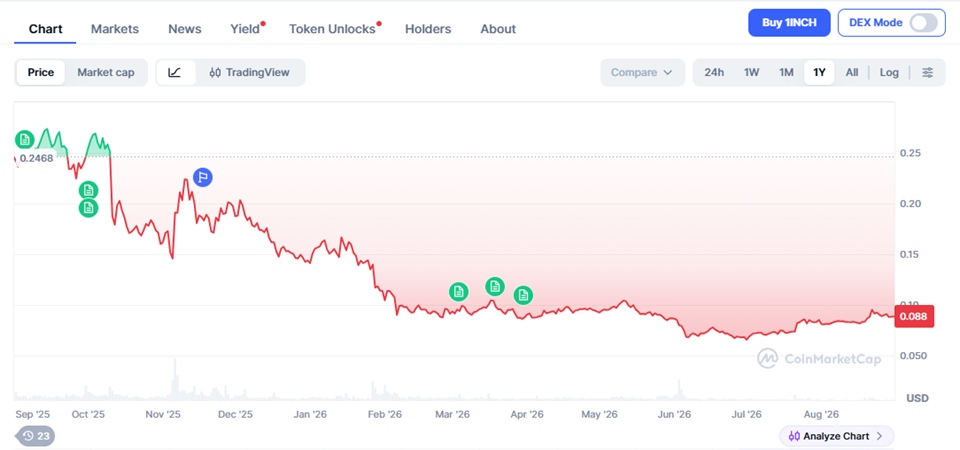
Image Source: https://coinmarketcap.com/currencies/1inch/
Short-Term 1INCH Price Dynamics
1INCH trades as a small-cap DeFi token with broad exchange distribution. Product announcements can trigger fast rallies, but supply around old unlock levels and weak governance participation can cap them.
Key support: $0.070–$0.080 is the immediate floor. Losing the July low near $0.065 would reopen price discovery.
Key resistance: $0.10–$0.12 is the first meaningful ceiling. A move above $0.18 would signal a larger change in DeFi appetite.
Volatility profile: Very high. 1INCH reacts to DEX volume, Fusion resolver demand, staking, token unlock completion, and Ethereum/Solana activity.
1INCH Price Prediction Table (2026–2040)
These ranges are scenario estimates based on aggregation volume, Fusion adoption, staking demand, competitive position, supply, and market cycles. These price forecasts are not financial advice.
| Year | Pessimistic Case (Bear) | Realistic Case (Base) | Optimistic Case (Bull) |
|---|---|---|---|
| 2026 | $0.05 | $0.12 | $0.22 |
| 2027 | $0.04 | $0.18 | $0.40 |
| 2028 | $0.035 | $0.26 | $0.65 |
| 2030 | $0.05 | $0.45 | $1.20 |
| 2040 | $0.08 | $1.00 | $3.50 |
Yearly Breakdowns
What Makes 1INCH Different From Other DEX Tokens
1inch is an aggregation network rather than a single liquidity venue. It searches routes across exchanges and can split a swap into several paths, optimizing execution instead of asking users to choose one pool.
Pathfinder and Aggregation
Pathfinder evaluates liquidity sources, gas costs, and route combinations. The Aggregation Protocol then executes the selected path atomically. That produces a consumer benefit even when users never notice which exchanges filled the order.
Fusion, Resolvers and Unicorn Power
Fusion matches signed user intents with resolvers that source liquidity and submit transactions. Staked 1INCH creates Unicorn Power, which can be delegated to resolvers or governance. The system ties token locks to execution rights and incentives.
Core Catalysts That Could Drive 1INCH Higher
How High Can 1INCH Go? Price Targets Explained
Investment Risks and Final Notes
Aggregation is brutally competitive. CoW Swap, Jupiter, wallet routers, and exchange-owned systems can compete on execution while giving users little reason to care about the underlying brand. Smart-contract, solver, API, and cross-chain risks also grow as routing becomes more complex.
Token economics remain the central uncertainty. Resolver staking is useful, but governance and rewards can be reflexive. Traders applying arbitrage crypto betting principles know that small execution differences matter; ordinary users may not. Some liquidity also circulates through crypto casinos, yet high transaction volume in adjacent sectors does not guarantee demand for 1INCH. Treat the token as a high-risk bet on execution infrastructure.
Other Crypto Price Prediction Pages
FAQ – 1INCH Price Prediction
What will the 1INCH price be in 2026?
The base case is $0.12. Strong Fusion growth could push the token toward $0.22, while weak value capture keeps $0.05 possible.
What is the 1INCH price outlook for 2030?
A base near $0.45 assumes 1inch remains a leading cross-chain execution layer. The $1.20 bull case requires deep integrations and strong resolver staking.
What is Unicorn Power?
Unicorn Power is time-decaying influence received by staking 1INCH for one month to two years. It can support governance or be delegated to Fusion resolvers.
Is the 1INCH supply fully unlocked?
About 1.41 billion of the 1.5 billion maximum was circulating in the 2026 market snapshot. Remaining dilution is much smaller than during earlier cycles.
Is 1INCH a good investment?
1inch has a widely used product and improving token utility, but aggregation margins and value capture are uncertain. It remains a speculative DeFi infrastructure token.
Can you use 1INCH at crypto casinos?
Direct support is uncommon. Users normally swap 1INCH into an accepted asset before depositing. The Aggregation Protocol can help find routes, but platform and jurisdiction rules still apply.
Before We Part Ways….
Navigating the crypto market effectively requires the right set of tools, so make sure to check the following crypto guides we prepared for you:




 eabungana@gmail.com

