Canton Network is built for a part of finance that public blockchains handle awkwardly: institutions need assets and cash to interoperate, but they cannot expose every position and counterparty to the world. Canton uses privacy-preserving applications connected through a Global Synchronizer, aiming to let regulated markets coordinate without forcing all data onto one public ledger.
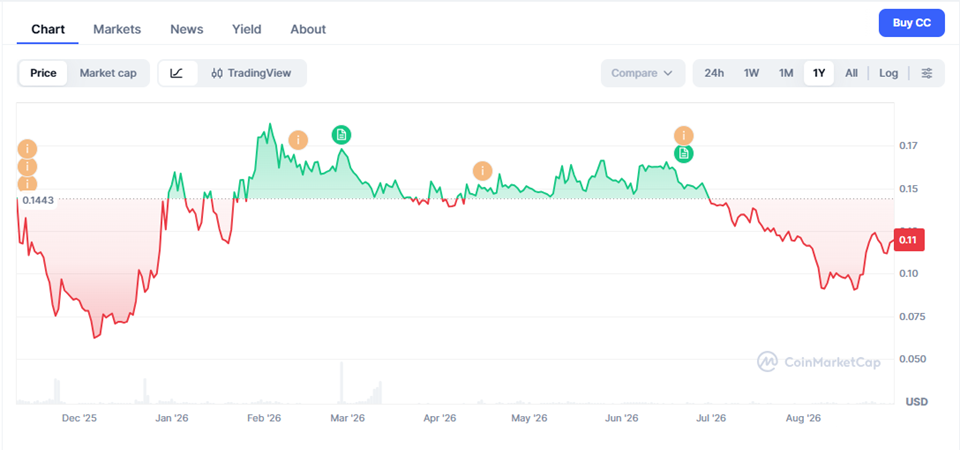
In 2026, Canton Coin (CC) trades around $0.12 with roughly 39 billion coins circulating and a market capitalization near $4.7 billion. That already places CC among the larger crypto assets despite its short public trading history. Its supply is earned through network contribution rather than a pre-mine or venture allocation, while transaction traffic burns coins and useful activity mints rewards. The Canton Network price prediction is therefore a test of burn-mint economics at institutional scale.
CC trades about 38% below its February 2026 high near $0.194. The decline is modest compared with most new tokens, but the valuation leaves little room for vague enterprise promises. At nearly $5 billion, the market already assumes Canton will become important financial infrastructure.
The supply system needs careful reading. Canton follows a predefined reward curve, but new coins enter circulation when validators, applications, users, and service providers earn them. Fees for Global Synchronizer traffic are burned. At burn-mint equilibrium, activity destroys as much value as rewards create. Before that point, emissions can expand circulating supply even when usage grows.
The reward split is designed to change as the network matures. Canton said featured applications could mint 62% of rewards after the January 2026 adjustment, shifting incentives toward assets and apps that generate traffic. That is a thoughtful distribution model, but it can produce selling pressure when builders convert earned CC into operating cash. Investors need both sides of the ledger.
CC is a new, high-value asset with limited price history. Unlock language is less useful than for venture-funded tokens because rewards are earned continuously; traders should watch net issuance, burns, and exchange liquidity.
Key support: $0.11–$0.12 is the immediate demand zone. Losing $0.10 would challenge the post-launch valuation and expose thinner support.
Key resistance: $0.14–$0.16 is the first ceiling. A move above the $0.194 high would require material usage or a strong market-wide bid.
Volatility profile: High. CC reacts to institutional announcements, reward emissions, fee burns, exchange access, and regulatory sentiment toward tokenized assets.
CC Price Prediction Table (2026–2040)
These crypto price forecasts use bear, base, and bull scenarios built around network traffic, burn-mint balance, application growth, institutional adoption, and future supply. They are not financial advice.
Year
Pessimistic Case (Bear)
Realistic Case (Base)
Optimistic Case (Bull)
2026
$0.07
$0.14
$0.22
2027
$0.05
$0.18
$0.32
2028
$0.04
$0.22
$0.45
2030
$0.05
$0.35
$0.75
2040
$0.08
$0.80
$1.25
Yearly Breakdowns
Canton Network (CC) Price Prediction 2026
The rest of 2026 should reveal whether the early valuation is supported by usage. Canton reported that the total mintable reward supply halved in January while featured applications received a larger share, pushing economics toward transaction-driven utility. A base near $0.14 assumes fees and application activity grow quickly enough to absorb ongoing issuance.
The $0.22 bull case requires CC to exceed its early high as institutions put tokenized assets into production. The $0.07 bear case reflects emissions outpacing burns, shallow retail liquidity or enterprise pilots that produce publicity without meaningful traffic.
Canton Network (CC) Price Prediction 2027
By 2027, investors should be able to compare coins minted for participation with coins burned for traffic. A $0.18 base assumes that ratio improves and that several high-value applications generate recurring settlement rather than one-off launches.
Institutions and market makers need robust custody, so distribution through crypto wallets and qualified custodians matters. Consumer wallet counts are less important than whether regulated participants can hold CC, pay fees and account for rewards within their compliance systems.
CC Price Forecast 2028
A $0.22 base in 2028 implies at least $8.6 billion using today’s circulating supply and more if supply expands. That is a serious infrastructure valuation. It requires Canton to become a standard interoperability layer for tokenized bonds, funds, collateral and cash.
The $0.45 bull case demands a network effect: every new asset should become more useful because it can transact privately with existing applications. The $0.04 bear case is the enterprise-blockchain graveyard, where strong members and clever technology fail to produce shared liquidity.
CC Valuation 2030
At $0.35, current circulating supply alone implies about $13.7 billion. Future reward issuance raises the real figure. This base case makes sense only if Global Synchronizer traffic is large, burns are visible and applications earn fees by delivering measurable utility.
Access through cryptocurrencies exchanges helps price discovery, but exchange turnover is not Canton’s core product. The relevant volume is private financial activity that consumes traffic and burns CC, not speculative spot volume between traders.
CC Macro Vision 2040
By 2040, Canton could be a neutral coordination layer for global capital markets. A base of $0.80 likely implies a valuation in the tens of billions once future supply is considered. That requires years of institutional adoption, reliable privacy and economics near burn-mint equilibrium.
The $1.25 bull case is already enormous. It assumes Canton becomes critical infrastructure across multiple asset classes and jurisdictions. The $0.08 bear case says the network remains used by a narrower consortium while rewards and selling pressure prevent token appreciation.
What Makes CC Different From Other Layer 1 Tokens
Canton does not put every application and transaction into a single shared state. Participants see only the data they are entitled to see, while the Global Synchronizer coordinates atomic transactions across applications.
Privacy With Composability
Traditional permissioned ledgers preserve confidentiality by becoming isolated databases. Public chains preserve composability by exposing state. Canton attempts to combine selective privacy with atomic interoperability, a design aimed directly at regulated finance.
Utility-Based Distribution
CC had no pre-mine, token sale or venture allocation. Coins are earned by network contributors under a scheduled reward curve. This improves distribution legitimacy, but it does not remove dilution; contributors can sell the tokens they earn.
Core Catalysts That Could Drive CC Higher
1️⃣ Tokenized Asset Settlement:
Large live bond, repo, fund or collateral workflows would validate the product. Announced memberships matter less than transaction traffic and applications that users repeatedly pay to access.
2️⃣ Burn-Mint Equilibrium:
The moment fee burns begin matching reward minting would change the supply narrative. A ratio moving consistently toward equilibrium is stronger evidence than raw transaction counts.
3️⃣ Application Revenue:
Canton allocates a large share of rewards to applications and assets that generate utility. If this attracts serious builders, token economics can become a distribution channel rather than a validator subsidy alone.
How High Can Canton Network Go? Price Targets Explained
Can CC Reach $0.25?
Yes, but it is not a small target. At today’s 39 billion circulating supply, $0.25 implies about $9.8 billion. Canton would need visible institutional traffic and improving burn economics.
Will CC Hit $1?
$1 implies at least $39 billion before future emissions. That requires Canton to become globally important market infrastructure. It is an optimistic 2040 scenario, not a near-term recovery trade.
Can CC Reach $5?
At current supply, $5 implies about $195 billion; future supply would make the valuation larger. That would place Canton among the world’s most valuable financial networks. The target is technically possible but economically extreme.
Investment Risks and Final Notes
CC’s first risk is valuation. The market already prices substantial success into a young network. Enterprise adoption cycles are slow, integrations are expensive, and member announcements can take years to become production volume. If burns lag rewards, even growing activity may coincide with dilution.
Technology and governance also matter. Privacy failures, synchronization outages or conflicting regulatory requirements could damage a network designed for sensitive finance. Consumer sectors such as sports betting with cryptos and VPN-friendly casinos may demonstrate demand for private digital transactions, but they are not Canton’s institutional use case. CC remains a high-risk bet on a new economic model.
The base case is $0.14, with a $0.07 bear case and $0.22 bull case. Net issuance and real Global Synchronizer traffic are the key variables.
What is the CC price outlook for 2030?
A base near $0.35 assumes strong tokenized-asset adoption and improving burn-mint balance. The $0.75 bull case requires Canton to become major financial infrastructure.
Does Canton Coin have a maximum supply?
Canton follows a predefined long-term supply and reward curve rather than a simple fixed cap. Coins are minted when participants earn rewards, while traffic fees burn CC.
Was CC allocated to venture investors?
The network states that CC had no pre-mine, venture allocation or token sale. Tokens enter circulation by rewarding measurable network contribution.
Is Canton Network a good investment?
Canton has credible institutional participants and differentiated privacy technology, but CC already carries a large valuation and ongoing emission risk. It is suitable only for high-risk investors.
Can you use CC at crypto casinos?
Direct support is rare. CC is designed for Global Synchronizer fees and network rewards, not consumer gambling payments. Holders would usually convert it first.
Before We Part Ways….
Navigating the crypto market effectively requires the right set of tools, so make sure to check the investment guides we prepared for you:
Crypto Guides—essential for understanding digital assets, market trends, and tokenomics.
Crypto Wallets—critical for keeping your assets safe and your private keys protected.
Crypto Exchanges—vital for trading tokens efficiently, accessing deep market liquidity, and executing trades seamlessly.
In 2016, he worked on his first client to help write a white paper for a crypto and blockchain project they were building, and started delving deeper into blockchain and distributed ledger technology.
















 Article Contributors


 Fact checked by
 Read Time: 5mins
 Published: 24/08/2026 | Updated: 31/08/2026






 shahnakul23@gmail.com