Terra Classic is the chain left behind by one of crypto’s defining failures. When UST lost its dollar peg in May 2022, the original mint-and-burn mechanism created trillions of LUNA, destroyed the token price and erased tens of billions in ecosystem value.
The surviving network was renamed Terra Classic, the token became LUNC, and control shifted toward a fragmented but persistent community.
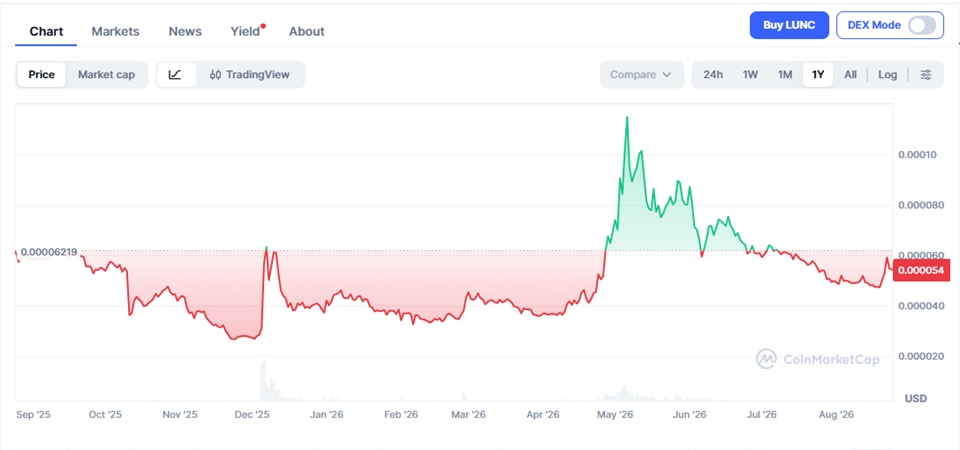
In 2026, LUNC trades around $0.000050 with a market capitalization near $280 million and roughly 5.5 trillion tokens circulating. The chain still supports staking, governance, Cosmos tooling and applications, while burns gradually reduce supply.
Any responsible Terra Classic price prediction must start with arithmetic: community enthusiasm can move a thin market, but turning trillions of units into scarce money requires enormous, sustained demand or an equally enormous supply reduction.
LUNC trades less like a conventional Layer 1 and more like a recovery speculation. The original market-swap mechanism is disabled, USTC remains far from $1, and there is no central operating company capable of imposing a unified roadmap. Proposals compete for community attention, but a forum post is not code, liquidity, or adoption.
The constructive case is that the chain continues to run. Validators secure it, developers maintain a Cosmos-based codebase, staking removes some float, and on-chain or exchange-supported burns permanently destroy tokens. The problem is scale. Even billions of LUNC burned can be statistically small against supply measured in trillions.
Staking should not be confused with burning. Delegated LUNC leaves the liquid market while bonded, which can tighten short-term float, but it returns when users undelegate. Only destruction at the burn address permanently reduces total supply. Price analysis that combines the two figures exaggerates deflation.
LUNC is highly sensitive to burn announcements, USTC proposals, Binance activity, and social-media momentum. The unit price makes percentage moves look easy, encouraging traders to ignore market capitalization.
Key support: $0.000045–$0.000050 is the immediate base. A breakdown below $0.000040 would reopen the 2026 lows.
Key resistance: $0.000060–$0.000070 is the first heavy ceiling. Reclaiming $0.00010 would require a significant change in volume and sentiment.
Volatility profile: Extreme. LUNC reacts to governance votes, burn data, exchange policies, USTC speculation, and broad meme-coin liquidity.
LUNC Price Prediction Table (2026–2040)
These ranges are scenario estimates based on future supply, burn rates, network activity, USTC outcomes, and market cycles. They are not guarantees or financial advice.
Year
Pessimistic Case (Bear)
Realistic Case (Base)
Optimistic Case (Bull)
2026
$0.000030
$0.000070
$0.000140
2027
$0.000025
$0.000100
$0.000250
2028
$0.000020
$0.000140
$0.000400
2030
$0.000030
$0.000250
$0.000800
2040
$0.000050
$0.001000
$0.005000
Yearly Breakdowns
Terra Classic (LUNC) Price Prediction 2026
The rest of 2026 depends on basic coordination. Core upgrades, stable validator performance, and applications that generate taxable transactions matter more than another ambitious repeg document. A base near $0.000070 assumes the chain remains stable, burns continue, and altcoin liquidity improves.
The $0.000140 bull case requires a speculative revival plus credible utility. The $0.000030 bear case reflects governance fatigue, falling exchange support, or a security problem. None of these outcomes meaningfully recreates the pre-collapse token economics.
Terra Classic (LUNC) Price Prediction 2027
By 2027, the burn thesis should be judged by percentages, not headline token counts. Supply must decline fast enough to change per-token value while the tax remains low enough for users and applications to transact. An aggressive tax that drives activity away can reduce the base it is supposed to burn.
A $0.00010 base gives LUNC a market capitalization around $550 million at today’s circulating supply. Traders comparing predictions of cryptocurrencies should update that calculation whenever supply changes. The $0.00025 bull case implies roughly $1.4 billion before future burns, achievable in a strong cycle but not proof of recovery.
LUNC Price Forecast 2028
The 2028 base of $0.00014 assumes Terra Classic maintains developers, IBC connectivity, and a modest application economy. If a community-owned exchange or stable asset generates repeat on-chain volume, burns can become an output of real use instead of voluntary destruction.
The $0.00040 bull case would imply about $2.2 billion at current supply. The $0.000020 bear case is the abandonment scenario, where validators and applications gradually leave while speculative rallies become shorter and less liquid.
LUNC Valuation 2030
A $0.00025 base in 2030 produces a $1.4 billion valuation if supply barely changes. With substantial burns, the same price requires less capital, but “substantial” must mean trillions rather than billions. The $0.00080 bull case requires both a smaller supply and a functioning economic reason to hold LUNC.
Access through major crypto exchanges keeps LUNC liquid, yet exchange volume does not automatically create on-chain value. If most activity is speculative trading between custodial accounts, it contributes little to application fees or burn mechanics on Terra Classic.
LUNC Macro Vision 2040
The 2040 base at $0.001 is a long-duration recovery case. At 5.5 trillion tokens, it implies $5.5 billion; at 3 trillion it implies $3 billion. Either valuation requires Terra Classic to remain culturally relevant and technically maintained for another fourteen years.
The $0.005 bull case assumes a far smaller supply and an application ecosystem that gives the chain an identity beyond the 2022 collapse. The $0.000050 bear case is nominal survival: the network persists, but burns and usage never overcome weak demand.
What Makes LUNC Different From Other Layer 1 Tokens
Terra Classic is a live post-collapse chain governed without its original sponsor. Its defining asset is not technical novelty but a large distributed holder base attempting to rebuild an abandoned economic system.
Community Governance and Staking
Staked LUNC can vote on parameter changes, software upgrades, and community spending. That creates real coordination power, but participation is uneven, and competing groups can push incompatible plans. Decentralization does not guarantee coherent strategy.
Burns and the USTC Overhang
On-chain tax mechanisms and exchange-supported burns reduce LUNC supply. USTC proposals attempt to restore utility or some form of reference value, but any new stable system must avoid repeating the reflexive unbacked design that caused the original collapse.
Core Catalysts That Could Drive LUNC Higher
1️⃣ Organic Transaction Volume:
Applications that users choose without burn incentives would be the strongest signal. More real transactions create fees, support validators and make deflation an economic by-product.
2️⃣ Measurable Supply Reduction:
The market needs a credible multi-year curve showing supply falling by meaningful percentages. Occasional burn events can boost sentiment but will not change the valuation equation on their own.
3️⃣ USTC Resolution:
A conservative, collateralized or otherwise credible resolution could remove a permanent psychological overhang. A poorly designed repeg attempt would introduce new risk and damage trust again.
How High Can Terra Classic Go? Price Targets Explained
Can LUNC Reach $0.001?
Yes, but it is demanding. At the current circulating supply, $0.001 implies roughly $5.5 billion. A smaller future supply and a strong market could make it plausible as a 2030–2040 scenario.
Will LUNC Hit $0.01?
At today’s supply, $0.01 means about $55 billion. Even if burns reduce supply to 3 trillion, the implied value is $30 billion. That requires major adoption, not community enthusiasm alone.
Can LUNC Reach $1?
Not under anything close to the current supply. At 5.5 trillion tokens, $1 implies a $5.5 trillion market capitalization. Supply would need to fall by several orders of magnitude while demand expanded dramatically. The math makes this an implausible target.
Investment Risks and Final Notes
LUNC carries technical, governance, and reputational risks that most large assets do not. The chain inherited code and economic damage from a collapse, lacks centralized product leadership, and relies on community coordination. Validator concentration, upgrade errors, and low application liquidity can create sudden problems.
Speculation adds another layer. LUNC’s tiny unit price encourages lottery-ticket thinking, similar to behavior seen at cryptocurrency casinos. Users seeking crypto betting without KYC also face legal and counterparty risks unrelated to token price. Treat LUNC as an extreme-risk recovery trade, and judge burns against total supply, not social-media headlines.
The base case is $0.000070. A speculative revival could reach $0.000140, while weak coordination or exchange support keeps $0.000030 possible.
What is the LUNC price outlook for 2030?
A base near $0.000250 assumes continuing burns, stable infrastructure and some application growth. The $0.000800 bull case needs substantial supply reduction and a strong cycle.
Why can’t LUNC simply return to its old price?
The 2022 collapse expanded supply from hundreds of millions into trillions. Comparing the old and current unit prices without adjusting for supply produces impossible market-cap assumptions.
Do LUNC burns guarantee a higher price?
No. Burns reduce supply, but price also depends on demand, liquidity and how quickly supply falls. Activity can decline faster than burns improve scarcity.
Is Terra Classic a good investment?
LUNC has an active community and functioning chain, but it faces exceptional governance, reputation and supply risks. It is suitable only for investors prepared for severe losses.
Can you use LUNC at crypto casinos?
Some platforms may support LUNC, but it is not a standard deposit option. Confirm the exact network, minimum deposit and withdrawal terms before transferring funds.
In 2016, he worked on his first client to help write a white paper for a crypto and blockchain project they were building, and started delving deeper into blockchain and distributed ledger technology.
















 Article Contributors


 Fact checked by
 Read Time: 5mins
 Published: 20/08/2026 | Updated: 24/08/2026






 shahnakul23@gmail.com