














 Ordinals (ORDI) Price Prediction
 Article Contributors


 Fact checked by
 Read Time: 5mins
 Published: 20/08/2026 | Updated: 24/08/2026


Reading the ORDI Market Right Now
ORDI is more than 95% below its 2024 high near $95. The drawdown tracks a brutal cooling in BRC-20 speculation and a market that increasingly distinguishes the Ordinals protocol from the ORDI token. Ordinal theory works with satoshis and Bitcoin; it does not require ORDI.
The bullish argument is symbolic. ORDI was first, uses a Bitcoin-mirroring 21 million supply, and remains the BRC-20 ticker most large traders recognize. In collectible markets, provenance can matter even when cash flow does not. The bearish argument is equally simple: new metaprotocols, Runes, and future Bitcoin-native assets can capture activity without creating demand for ORDI.
BRC-20 transfers are operationally awkward. A user first inscribes a transfer instruction and then spends the relevant inscription to the recipient, while indexers reconstruct balances from Bitcoin history. That two-step flow can be expensive when block space is crowded. It also explains why exchange and wallet support matters disproportionately: infrastructure hides complexity that the base chain does not understand as a native token balance.
When infrastructure providers disagree, markets must pause and reconcile state, a coordination risk that does not appear in ORDI’s fixed-supply headline.
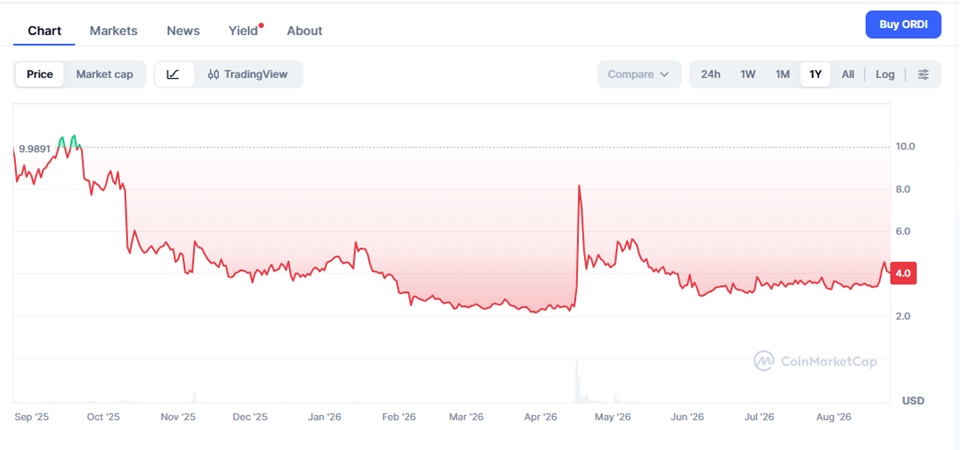
Image Source: https://coinmarketcap.com/currencies/ordi/
ORDI Price Prediction Table (2026–2040)
These ranges are scenario estimates based on BRC-20 activity, Bitcoin block-space demand, fixed supply, exchange liquidity and cultural relevance. They are not financial advice.
| Year | Pessimistic Case (Bear) | Realistic Case (Base) | Optimistic Case (Bull) |
|---|---|---|---|
2026 | $2.00 | $5.50 | $11.00 |
2027 | $1.50 | $8.00 | $20.00 |
2028 | $1.20 | $12.00 | $35.00 |
2030 | $1.50 | $20.00 | $60.00 |
2040 | $2.00 | $45.00 | $150.00 |
Yearly Breakdowns
What Makes ORDI Different From Other Bitcoin Tokens
ORDI’s strongest feature is its origin. Its deployment inscription appears in the definitive BRC-20 experiment documentation, with a 21 million maximum and 1,000-token mint limit. It was not allocated through a venture round or governed by a foundation.
BRC-20 Indexer-Based Balances
BRC-20 operations are JSON inscriptions interpreted by off-chain indexers. Bitcoin orders the inscriptions, but indexers determine whether deploy, mint, and transfer actions create valid balances under the standard. Consensus is therefore more social and application-layer-dependent than a native Bitcoin balance.
Fixed Supply Without Protocol Rights
All ORDI has been minted, removing future issuance. Holders do not receive block fees, govern Ordinals or own a claim on marketplaces. Scarcity can support price, but only demand gives that scarcity meaning.
Runes make the competitive risk concrete. Casey Rodarmor’s later fungible-token protocol uses native Bitcoin transaction semantics more directly than inscription-based BRC-20 accounting. Runes can expand Bitcoin token activity while shifting attention away from ORDI. The ecosystem is not a winner-take-all market, but standards can become obsolete faster than cultural artifacts.
Core Catalysts That Could Drive ORDI Higher
How High Can ORDI Go? Price Targets Explained
Investment Risks and Final Notes
ORDI has no conventional development team, roadmap, or protocol revenue. Its value is exposed to indexer consensus, marketplace support, Bitcoin fees, and collective attention. A bug or disagreement in infrastructure can interrupt deposits and withdrawals even when Bitcoin itself works correctly.
Narrative substitution is the central risk. Ordinals, inscriptions, BRC-20 and ORDI are related but not identical. Readers using crypto price predictions should not assume growth in one automatically benefits the others. ORDI’s speculative rhythm also resembles crypto dice games: fixed odds are absent, swings are severe, and short-term outcomes can dominate careful analysis. Size positions accordingly.
Other Crypto Price Prediction Pages
FAQ – ORDI Price Prediction
What will the ORDI price be in 2026?
The base case is $5.50. A strong inscription revival could push ORDI toward $11, while weak BRC-20 demand keeps the $2 low area in play.
What is the ORDI price outlook for 2030?
A base near $20 assumes ORDI remains the best-known BRC-20 asset. The $60 bull case requires a durable Bitcoin-token market and continued historical premium.
Is ORDI the token of the Ordinals protocol?
No. Ordinal theory and inscriptions use Bitcoin and satoshis. ORDI is a separate BRC-20 token created as the example deployment in Domo’s experimental standard.
Is all ORDI already circulating?
The 21 million maximum was fully minted. Market-data providers may differ slightly on tradable supply, but there is no scheduled venture or team unlock.
Is ORDI a good investment?
ORDI offers fixed supply and strong provenance but little direct utility or cash flow. It is a high-risk cultural asset dependent on BRC-20 relevance and exchange liquidity.
Can you use ORDI at crypto casinos?
Direct support is rare. Holders generally convert ORDI into Bitcoin or a supported stablecoin first. Use a wallet that handles inscriptions correctly when withdrawing.




 eabungana@gmail.com

