














 Stacks (STX) Price Prediction
 Article Contributors


 Read Time: 6mins
 Published: 06/07/2026 | Updated: 21/10/2026


Stacks Price Prediction Analysis (Today → Long-Term)
While the vast majority of traditional cryptocurrencies focus on processing simple peer-to-peer asset transfers, Stacks expands the utility of Bitcoin by introducing complex financial operations through smart contracts.
When it comes to its price action, STX is fundamentally tied to Bitcoin’s broader market performance. However, multiple asset-specific variables heavily impact its independent trajectory—most notably regulatory compliance frameworks and the real-world adoption rate of Bitcoin-based decentralized finance (DeFi).

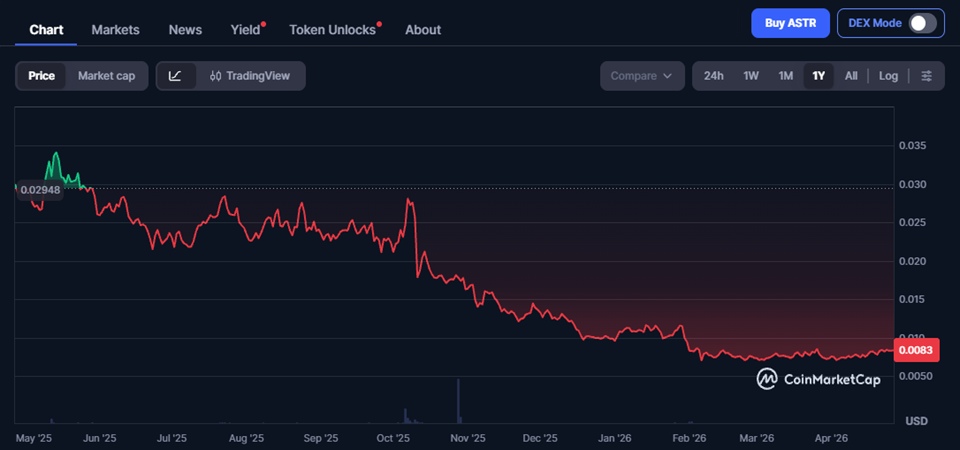
Image Source: https://coinmarketcap.com/currencies/stacks/
Short-Term Stacks Forecast
Whether you are searching for a Stacks price prediction for tomorrow, next week, or next month, keep in mind that these horizons are strictly short-term. Short-term forecasts usually depict noise and minor liquidations rather than macroeconomic trends.
To gain a clearer perspective, traders rely on macro support and resistance levels. A clean break above key overhead resistance indicates potential for structural expansion, while a sustained drop below major support levels typically signals a shift toward a bearish regime.
Ultimately, Stacks exhibits high historical volatility, meaning dramatic price swings can occur rapidly. Broader macroeconomic market shifts, aggregate BTC liquidity, and futures market open interest remain the primary catalysts driving this volatility.
| Year | Pessimistic Case | Realistic Case | Optimistic Case |
|---|---|---|---|
| 2026 | $0.12 | $0.18 | $0.35 |
| 2027 | $0.15 | $0.30 | $0.75 |
| 2028 | $0.25 | $0.60 | $1.50 |
| 2029 | $0.40 | $1.10 | $2.80 |
| 2030 | $0.60 | $1.80 | $4.50 |
| 2035 | $1.60 | $4.50 | $11.00 |
| 2040 | $2.50 | $7.50 | $20.00 |
Yearly Market Breakdown & Analysis
The Stacks Network Archetype
To properly understand the token’s value proposition, it helps to examine how the network functions under the hood. Stacks relies on a unique consensus engine known as Proof-of-Transfer (PoX). Under this mechanism, miners do not burn computational energy; instead, they compete by committing a Proof-of-Work cryptocurrency (Bitcoin) directly to the network.
Rather than destroying these funds, the PoX protocol dynamically routes the committed Bitcoin directly to network participants who choose to “Stack” their native STX tokens. Consequently, token holders who actively secure the ecosystem receive consistent stacking rewards paid directly in native BTC.
Because Stacks anchors its structural state directly to Bitcoin, native base-layer settlement times take roughly 10 minutes. However, thanks to the deployment of the Nakamoto upgrade, the network safely processes fast microblocks in just a few seconds.
Every completed Stacks transaction ultimately inherits the cryptographic finality of the Bitcoin blockchain while keeping average transaction fees to a small fraction of a cent.
Finally, developers can deploy specialized subnets to achieve high-performance transaction throughput, though these subnets naturally sacrifice a degree of core layer decentralization.
What Drives Stack’s Price? (Fundamentals)
How High Can Stacks Go? Price Targets Explained
Will Stacks Hit 10 Dollars?
Yes, a target of $10 is entirely possible within long-term bullish market cycles. For STX to move from its current 2026 lows to a $10 valuation, the Bitcoin DeFi ecosystem must capture a significant percentage of the total market share currently held by alternative smart contract networks, backed by sustained institutional inflows.
Will Stacks Hit 100 Dollars?
While not completely mathematically impossible over a multi-decade horizon, hitting $100 remains an extremely low-probability scenario. Achieving a $100 price point would require Stacks to build an immense economic infrastructure, commanding a market cap that matches or exceeds the current sizing of top-tier smart contract layers like Ethereum.
Will Stacks Hit 1,000 Dollars? (Market Cap Reality Check)
No, reaching $1,000 is completely unrealistic for Stacks. Given the asset’s current circulating supply of roughly 1.85 billion tokens, a $1,000 price target would require a market capitalization of nearly $1.85 trillion. To put this in perspective, that single asset valuation exceeds the entire combined market capitalization of the modern digital asset ecosystem.
Explore Other Crypto Price Prediction Pages









Frequently Asked Questions
What is the Stacks price prediction for 2026?
The updated Stacks price prediction for the remainder of 2026 ranges between a conservative floor of $0.12 and a short-term bullish peak of $0.35, with a realistic base target around $0.18.
What is the Stacks price prediction for 2030?
The macro forecast for 2030 projects that STX tokens will trade between $0.60 in a prolonged bear cycle and up to $4.50 in an expansionary bull market, breaking past its historical all-time high.
What is the Stacks price prediction for 2040?
The long-term Stacks price prediction for 2040 projects a pessimistic floor of $2.50, a realistic base case of $7.50, and an optimistic bull target of up to $20.00.
How much will Stacks be worth in 5 years?
In five years (2031), structural models estimate Stacks to be valued between a bearish accumulation floor of $0.80 and an optimistic market peak of $5.80.
Can I use Stacks in crypto casinos?
Yes, STX can be utilized across a select number of crypto casinos, though its integration is significantly less common than premier digital assets like Bitcoin, Ethereum, or Tether. If you choose to gamble with STX, always verify that your platform of choice holds a recognized iGaming license and explicitly supports native Stacks network deposits and withdrawals.


 eabungana@gmail.com

