












 Celestia (TIA) Price Prediction
 Article Contributors


 Fact checked by
 Read Time: 7mins
 Published: 26/06/2026 | Updated: 12/10/2026


Today → Long-Term Celestia Price Prediction Analysis
Celestia’s price depends on major factors like regulation and adoption, as well as market trends and ecosystem demand. These factors cause both short-term and long-term fluctuations.
What makes it different is that, unlike traditional Bitcoin and Solana networks, Celestia separates the consensus mechanism and data storage from transaction execution. Due to this, developers can build independent and specialized chains.
We offer comprehensive educational resources designed to demystify complex blockchain concepts for both beginners and experienced traders. These crypto guides break down network protocols, tokenomics models, and trading strategies to help you navigate the volatile crypto market safely.
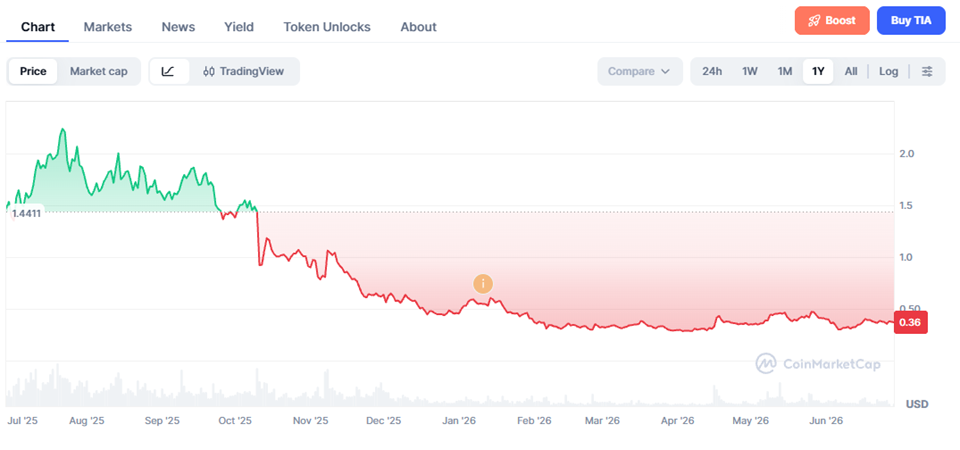
Image Source: https://coinmarketcap.com/currencies/celestia/
Short-Term TIA Price Prediction
The short-term Celestia forecast is mostly noise movements. This means that these factors may not have long-term effects on the price of the cryptocurrency.
To make sure you have a clearer image of the coin, you should have a look at the support and resistance concept.
This means that if Celestia falls below the support level, its value may continue decreasing. On the other hand, if there’s a break above the set resistance, then TIA tokens may have a bullish momentum, at least for a while.
Last but not least, Celestia tokens show extremely high volatility. This is mainly driven by token unlocks and shifting ecosystem narratives.
Celestia Prediction Table (2026–2040)
| Year | Pessimistic Case | Realistic Case | Optimistic Case |
|---|---|---|---|
| 2026 | $0.25 | $0.38 | $1.20 |
| 2027 | $0.50 | $2.40 | $4.50 |
| 2028 | $1.10 | $5.50 | $12.80 |
| 2029 | $1.80 | $9.20 | $22.00 |
| 2030 | $2.20 | $15.50 | $34.00 |
| 2035 | $5.80 | $28.00 | $65.00 |
| 2040 | $10.00 | $45.00 | $110.00 |
Celestia Price Prediction 2026
We’re currently in the middle of the year, and the market sentiment is in a cautious phase following a prolonged sector reset. More precisely, the Fear & Greed index reflects persistent volatility, keeping TIA trading heavily consolidated around the $0.38 range. Still, long-term projections remain optimistic.
Among the key drivers for Celestia are:
- Continued expansion of the modular blockchain ecosystem.
- Growing demand from Ethereum Layer 2 networks that require cost-effective data availability.
When it comes to regulatory developments, experts believe that ongoing upgrades in global cryptocurrency frameworks will heavily influence the layout of Celestia. If there is clearer regulatory compliance, the price of TIA tokens can move upward more reliably.
Celestia Price Prediction 2027
So far, Celestia’s price action has been mainly based on speculation, but the 2027 post-halving phase can change this toward utility adoption. Due to this, the price is expected to move upward out of its accumulation floor.
According to analysts, successful scaling upgrades, such as Hibiscus, combined with active L2 rollups, can boost organic network revenues. As a result, this can drive long-term holding value for the tokens.
Celestia Price Forecast 2028
By 2028, the crypto market should enter the mid-to-late cycle. During this period, Celestia could benefit from a bullish momentum if traditional institutions begin relying on its modular infrastructure for low-cost decentralized application (dApp) deployment.
In comparison to 2027, the price could accelerate if the scaling to a 1GB block goes live. This will make Celestia a primary settlement for many gaming and social decentralized apps.
Celestia Price Prediction 2030
The predictions for 2030 are also positive, supposing that Celestia becomes a foundational data availability standard. In other words, widespread modular crypto adoption is the major driver during this period.
More precisely, if there’s a widespread rollup adoption, TIA tokens may capture a notable percentage of the total crypto market capitalization. As a result, the base price could comfortably scale past $15.
Celestia Price Outlook 2040
The Celestia forecast for 2040 is definitely a long-horizon discussion that is affected by many technological risks, as well as market capitalization constraints.
While analysts believe the price will keep increasing alongside overall economic inflation and industry maturation, market-cap limitations exist. This means that while TIA could clear the $100 barrier in hyper-bullish cycles, its multi-billion token supply keeps structural targets grounded.
The Celestia Network
Celestia’s platform is built on a modified version of the Tendermint Core consensus algorithm and the Cosmos SDK framework, which allows it to reach consensus.
Simply put, validators stake the native TIA asset to agree on the ordering of transactions and blocks. Plus, it doesn’t rely on nodes to download entire blocks. Instead, lightweight nodes perform Data Availability Sampling (DAS)—randomly testing small chunks of data—to independently verify that all data has been published to the network.
What’s more, Celestia does not have a fixed transactions per second (TPS) limit because its throughput capacity naturally increases as more light nodes join the network to support larger block sizes. Also, Celestia lets you publish data as blobs on the blockchain through the PayForBlobs transaction.
As for the fees, they’re denominated in TIA and utilize a dynamic fee market model. This means that base fees are burned, and validators receive tips for priority inclusion.
When it comes to settlement, this is handled by independent Layer 2 and Layer 3 rollups built on top of the network.
Last but not least, Celestia’s biggest trade-off is higher off-chain coordination. More precisely, developers need to manage their own independent execution layers and establish stable settlement bridges.
How High Can Celestia Go? Price Targets Explained
Most crypto holders are interested in the maximum value that TIA tokens can reach. Given that TIA’s actual all-time high was $20.91 in early 2024, let’s look at realistic future targets.
Will Celestia Hit 10 Dollars?
Yes, this is highly possible in a healthy bull cycle. Because Celestia has already traded well above $20 in its history, hitting $10 merely requires the modular ecosystem to break out of its current 2026 accumulation phase and resume normal scaling adoption.
Will Celestia Hit 100 Dollars?
While Celestia is a leading infrastructure player, hitting $100 is a long-term target that is unlikely to happen soon. For TIA to reach $100, it would require massive, multi-year dominance over competing data availability layers (like Ethereum’s danksharding and EigenDA) and a massive influx of capital into the crypto market.
Will Celestia Hit 1,000 Dollars?
A price target of $1,000 is practically impossible. Because of Celestia’s inflating supply model (which will see well over 1 billion tokens in circulation over time), a $1,000 price tag would require a market capitalization exceeding $1 trillion. This would mean Celestia single-handedly matching the peak size of Bitcoin, which is highly unrealistic.
Conclusion
In summary, Celestia represents a fundamental technological pivot toward modular architecture, but its token value remains tied to market cycles and ecosystem execution.
While long-term targets for 2040 range from a conservative $10.00 base to an optimistic $110.00 bull case, realizing these numbers depends on consistent network utility and regulatory clarity.
Investors must balance Celestia’s unmatched data scaling potential against the stark reality of its structural token issuance and high-volatility profile.
Check more Price Predictions






Frequently Asked Questions
What is the Celestia price prediction for 2026?
The Celestia price prediction for the remainder of 2026 sits at a minimum floor of around $0.25, a realistic average of $0.38, and a potential short-term bullish recovery cap near $1.20.
What is the Celestia price prediction for 2030?
By 2030, if modular rollups scale successfully, TIA tokens are projected to reach a realistic base valuation of $15.50, with a bull case target up to $34.00.
What is the Celestia price prediction for 2040?
Estimates for 2040 show that a mature Celestia network could see TIA valued between a pessimistic low of $10.00 and an optimistic macro peak of $110.00.
How much will Celestia be worth in 5 years?
In five years (by 2031), TIA tokens are realistically forecasted to trade in the $18.00 to $40.00 range, assuming it maintains its market share against competing infrastructure layers.
Can Celestia reach $10 / $100 / $1,000?
A return to $10 is highly achievable during the next macro expansion cycle since TIA’s peak historical price is above $20. Reaching $100 is a viable long-term bull scenario for 2040, whereas a $1,000 target is fundamentally impossible due to market capitalization constraints.
Is Celestia a good investment?
Celestia can be a strong option for investors seeking high-risk, high-reward infrastructure plays. However, because growth is never guaranteed and supply dilution is ongoing, caution and strict risk positioning are required.
Can I use Celestia in crypto casinos?
Most mainstream crypto casinos do not accept TIA natively for deposits and withdrawals yet. To use your funds on those platforms, you will first need to utilize a crypto exchange to swap your TIA tokens for widely supported assets like Bitcoin, Ethereum, or USDT.
Sources
- https://coinmarketcap.com/currencies/celestia/
- https://changelly.com/blog/celestia-tia-price-prediction/
- https://www.okx.com/en-us/learn/what-is-celestia-tia
- https://www.binance.com/en/square/post/293741477789266
- https://finance.yahoo.com/news/celestia-unveils-ambitious-plan-scale
- https://medium.com/cumulo-pro/celestia-faq-become-an-expert

 shahnakul23@gmail.com