Jupiter did not become the dominant DEX aggregator on Solana by accident. It got there by routing trades better than everything else on the network, then kept expanding until it was no longer just an aggregator.
Perpetuals, lending, a native stablecoin, prediction markets, and tokenized equities.
JUP is now the infrastructure layer through which most of Solana DeFi operates, commanding roughly 95% of aggregator market share and over 50% of total Solana DEX volume.
Investors searching for a Jupiter price prediction are asking something worth taking seriously: does the token reflect what the protocol is actually worth?
JUP’s circulating supply sits near 3.32 billion tokens against a total cap of 10 billion—that supply gap matters. Monthly unlocks of roughly 53 million tokens are running through 2026, with a major 200M unlock hitting in January 2027.
Token unlocks have been a consistent headwind, and Jupiter has executed approximately $70 million in buybacks to offset the pressure. Whether that is enough depends on whether protocol revenue continues to grow.
JUP moves with Solana. When SOL runs, JUP tends to outperform it. When Solana sentiment turns, JUP gives it back faster. That beta relationship is consistent, and anyone trading JUP needs to have a view on Solana first.
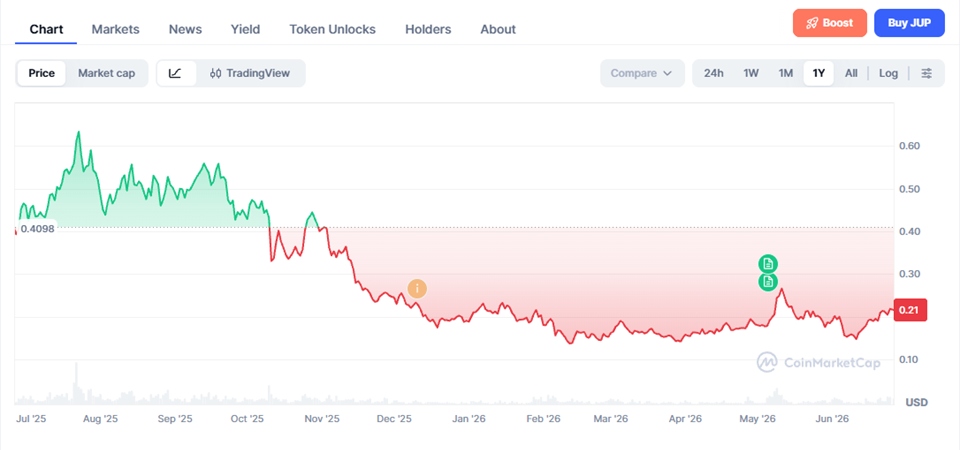
Key support: The $0.12–$0.15 band has been tested in 2026, serving as a firm macro bottom. Holding structurally above $0.19–$0.20 flips the short-term structure more constructively.
Key resistance: $0.35–$0.45 is the first serious zone. Above that, the path toward retesting the $2.04 ATH becomes a multi-cycle conversation rather than a short-term trade.
Volatility profile: Ecosystem announcements move JUP hard. The Polymarket integration, the Securitize tokenized equities launch, and the Jupuary airdrop all drove significant single-session moves in early 2026. News-driven spikes are common here.
JUP Price Prediction Table (2026–2040)
The price forecasts below reflect bear, base, and bull cases built around Solana ecosystem growth, protocol revenue expansion, and unlock schedule absorption.
Year
Pessimistic Case
Realistic Case
Optimistic Case
2026
$0.12
$0.45
$0.45
2027
$0.18
$0.90
$2.04
2028
$0.15
$1.40
$4.00
2030
$0.35
$3.00
$8.00
2040
$0.80
$8.00
$25.00
Securing your digital assets requires reliable crypto wallets that grant you complete ownership over your private keys. Solana-native wallets allow users to seamlessly connect with decentralized applications, swap tokens, track active staking rewards, and safely store JUP with minimal transaction friction.
Jupiter Price Prediction 2026
The second half of 2026 is where the unlock pressure starts to ease, and the protocol expansion story gets a chance to breathe. JupUSD launched in January 2026, backed by BlackRock-affiliated assets.
The Securitize partnership brought tokenized equities trading on-chain in May. The Polymarket integration landed in February alongside a $35 million ParaFi Capital investment. Jupiter is not a swap aggregator anymore. It is trying to be Solana’s financial OS, and the market has not priced that transition yet.
A base case of $0.45 assumes Solana continues recovering and Jupiter’s revenue growth catches the eye of value-focused DeFi investors. The bull case toward $1.20 requires a broad altcoin season with Solana leading the narrative. The bear case at $0.12 is persistent unlock pressure in a macroenvironment where risk appetite stays thin.
Jupiter Price Prediction 2027
By 2027, the January unlock cliff will have passed, and the circulating supply picture will be clearer somewhat. That structural shift matters more than most short-term traders appreciate.
If Jupiter’s Jupnet omnichain liquidity network gains traction, cross-chain routing enters public testing in Q4 2025, and the protocol stops being a Solana story and becomes a multi-chain story. That dramatically expands the addressable market.
A base of $0.90 assumes steady Solana growth and protocol revenue continuing to compound. The bull case of $2.04 is a return to ATH territory, plausible if the next crypto cycle puts Solana in the spotlight the way 2024 did.
Platforms where DeFi meets real-world financial activity, from institutional trading desks using tokenized equity on-chain to users on services like no KYC betting sites that rely on fast and cheap Solana-based payment rails, all benefit from a thriving Jupiter ecosystem underneath them.
JUP Price Forecast 2028
2028 is where the Uniswap comparison becomes either embarrassing for Jupiter or vindicating. Jupiter already processes a higher percentage of its native chain’s DEX volume than Uniswap commands on Ethereum. Uniswap’s market cap sits in the multi-billion-dollar range.
Jupiter sits at $643 million. If that valuation gap closes even partially, and it only needs a fraction of the narrative momentum Uniswap captured, the base case of $1.40 is conservative.
JUP Valuation 2030
By 2030, Jupiter will have had six years to prove whether “best price, “always”—the protocol’s stated mandate—is a durable competitive moat or a feature that any well-funded team can replicate.
The network effects argument is strong.
Every new liquidity pool added to Jupiter’s routing graph makes its quotes marginally better, which pulls more volume, which makes the routing data richer. That flywheel is real. It is also the kind of thing that gets disrupted by a faster chain or a better incentive structure when nobody is expecting it.
A base case of $3.00 in 2030 puts total market cap near $10 billion, comparable to what Uniswap commands today. The bull case at $8.00 requires Jupiter to have successfully executed on Jupnet and become a genuine multi-chain liquidity layer.
Some of that growth flows through regulated verticals where on-chain settlement matters, including VPN-friendly casinos and payment platforms that route volume through Solana’s low-fee infrastructure.
JUP Macro Vision 2040
The 2040 case for Jupiter is the infrastructure bet in its purest form. If Solana remains a top-tier blockchain and Jupiter maintains its role as the routing layer, the protocol accrues value the same way TCP/IP accrued value: invisibly, continuously, and at scale.
A base case of $8.00 implies a fully diluted market cap approaching $80 billion, a large number that only makes sense if DeFi has grown into a multi-trillion-dollar ecosystem.
The bull case at $25.00 reflects the scenario where Jupiter becomes DeFi’s settlement layer across chains. The bear case at $0.80 is survival without dominance, still used, still relevant, but long since displaced from the top spot it held today.
What Makes JUP Different From Other DEX Coins
Most DEX tokens are governance tokens in name only. JUP has real governance authority over material decisions: which liquidity sources to integrate, how protocol fees are allocated, the parameters of the perpetual product, and treasury management. Active stakers earn Active Staking Rewards in JUP.
Tokenomics and the Unlock Schedule
10 billion JUP total supply. 3.32 billion in circulation today. Monthly unlocks of ~53 million tokens through 2026, with a major 200 million token event in January 2027. Co-founder Meow’s personal tokens are locked until 2030, which removes one obvious source of insider selling.
Jupiter has executed $70 million in buybacks to absorb unlock pressure. The tokenomics are manageable but not clean; this is a token where supply dynamics genuinely affect the price trajectory.
Choosing the right crypto exchanges is vital for accessing liquid trading pairs, minimizing slippage, and ensuring institutional-grade security protocols.
While centralized venues offer deep fiat on-ramps, top-tier decentralized aggregators allow users to trustlessly match trades directly from their self-custody accounts.
Core Catalysts That Could Drive JUP Higher
1. Solana Ecosystem Growth
Jupiter’s ceiling is Solana’s ceiling. As Solana’s daily DEX volume grows, Jupiter’s fee revenue grows with it automatically. Every new DeFi protocol that launches on Solana routes through Jupiter by default.
That structural advantage compounds quietly and does not require any direct action from the Jupiter team.
2. Product Expansion Beyond Swaps
Perpetuals with up to 100x leverage, JupUSD stablecoin, Jupiter Lend, tokenized equity trading via Securitize, and prediction markets via Polymarket.
Each product line adds a new revenue stream and a new reason to hold JUP. The risk is execution; Jupiter is trying to build a full-stack financial platform while maintaining its core routing quality.
Doing both well simultaneously is harder than it looks.
3. Jupnet and Cross-Chain Expansion
If Jupnet delivers on its omnichain liquidity promise, Jupiter stops competing only for Solana volume and starts competing for cross-chain routing across every major network.
That expands the addressable market by an order of magnitude. It also puts Jupiter in direct competition with established cross-chain bridges and aggregators that have multi-year head starts.
How High Can JUP Go? Price Targets Explained
1. Can JUP Reach Its Previous ATH of $2.04?
Yes, but probably not in 2026. A return to ATH requires a full altcoin cycle with Solana leading, combined with meaningful absorption of the ongoing unlock schedule. More realistic as a 2027 target in a bull scenario.
2. Can JUP Reach $5.00?
Possible in a strong 2027–2028 cycle. A $5.00 price implies a market cap of roughly $16.6 billion at current circulating supply, comparable to what mid-tier Layer 1 networks command today. Requires Jupiter to have successfully expanded beyond Solana-only routing.
3. Will JUP Hit $10.00?
Long-term, yes, in a bull case. A $10.00 price implies a $33.2 billion market cap at current circulating supply. That puts Jupiter alongside the largest DeFi protocols by valuation and requires Solana to have cemented its position as a top-three blockchain. Achievable by 2030 in an aggressive bull scenario.
Investment Risks & Disclaimer
The monthly dilution of 53 million tokens throughout 2026 and the subsequent 200 million cliff in January 2027 present heavy structural sell pressure that even aggressive buybacks may fail to offset.
Competition, platforms such as Raydium and Orca, constantly vie for Solana’s liquidity, meaning Jupiter’s dominant aggregator position is never completely secure.
Furthermore, the persistent historical disconnect between excellent protocol usage metrics and stagnant JUP token performance highlights a core risk in utility token economics.
Cryptocurrency investments carry inherently high volatility, and these projections represent mathematical models rather than guaranteed financial outcomes.
Conclusion
In summary, Jupiter has successfully transcended its identity as a simple Solana swap tool to become a comprehensive financial ecosystem layer.
While its daily trading metrics, strategic integrations, and expanding product features make a robust case for long-term value, its short-term price remains heavily capped by aggressive token unlocks and its high beta correlation to Solana.
Should Jupiter successfully clear its 2027 unlock cliffs and scale cross-chain via Jupnet, its targets of $3.00 by 2030 and up to $25.00 by 2040 are entirely within reach. Ultimately, JUP remains an asymmetric bet on the long-term expansion of decentralized global finance.
Our dedicated crypto guides provide deep architectural analysis, historical data, and step-by-step tutorials designed to simplify decentralized finance.
The realistic base case targets $0.45, assuming broader market recoveries and continued protocol revenue growth. A strong altcoin season could push JUP toward $1.20, while persistent unlock pressure keeps a tight bear floor at $0.12.
What is the JUP price outlook for 2030?
If Jupiter holds its dominant position in Solana DeFi and Jupnet gains cross-chain traction, a base near $3.00 by 2030 is plausible. The bull case at $8.00 requires Jupiter to have become a genuine multi-chain liquidity layer
What will JUP be worth in 2040?
The base case stands at $8.00, assuming Jupiter survives as the primary DeFi routing layer in a much larger crypto ecosystem. The bull case of $25.00 requires it to have expanded across chains and become foundational Web3 infrastructure at scale.
What will JUP be worth in 5 years?
By 2031, $1.50–$5.00 covers most realistic outcomes depending on whether Solana holds its position as a top-tier chain and Jupiter successfully absorbs its unlock schedule without losing market share.
Why is JUP price low despite Jupiter’s strong volume?
Token unlocks create consistent sell pressure that buybacks have not fully neutralized. The market has also been slow to price DEX infrastructure by fundamentals. That gap between protocol performance and token price is a known dynamic in DeFi and tends to resolve in bull cycles.
Can you use JUP at crypto casinos?
JUP is primarily a governance and staking token rather than a payment instrument. It is not widely supported as a direct deposit method on gambling platforms, though its presence across Solana-compatible wallets makes it accessible on platforms that support the Solana ecosystem broadly.
He has worked with several companies in the past including Economy Watch, and Milkroad. Finds writing for BitEdge highly satisfying as he gets an opportunity to share his knowledge with a broad community of gamblers.
















 Article Contributors


 Fact checked by
 Read Time: 7mins
 Published: 23/06/2026 | Updated: 27/06/2026








 eabungana@gmail.com

