












 Polygon (POL) Price Prediction
 Article Contributors


 Fact checked by
 Read Time: 6mins
 Published: 22/05/2026 | Updated: 26/05/2026


In 2024, Polygon transitioned from the MATIC ticker to POL as part of its Polygon 2.0 upgrade.
Polygon Price Prediction Analysis (Today → Long-Term)
The current Polygon price is significantly lower than its all-time high of $1.29 reached in March 2024.
In the Polygon 2.0 architecture, POL is designed to have a 2% annual emission rate to provide continuous rewards for validators, balancing the gas fee utility with a model that supports long-term network security.
While high transaction speeds keep individual fees low, a high volume of transactions across thousands of connected chains is intended to drive cumulative value to the token.
Polygon’s success is intrinsically linked to Ethereum—if Ethereum remains the dominant smart contract platform, Polygon’s role as its primary scaling partner remains robust.
As a major infrastructure provider, Polygon is often viewed differently by regulators than private or centralized tokens, though global crypto frameworks still introduce volatility.
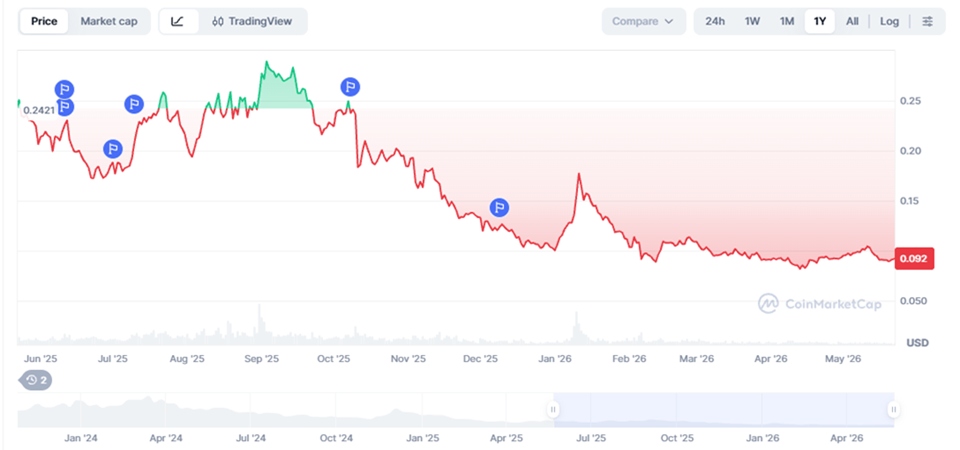
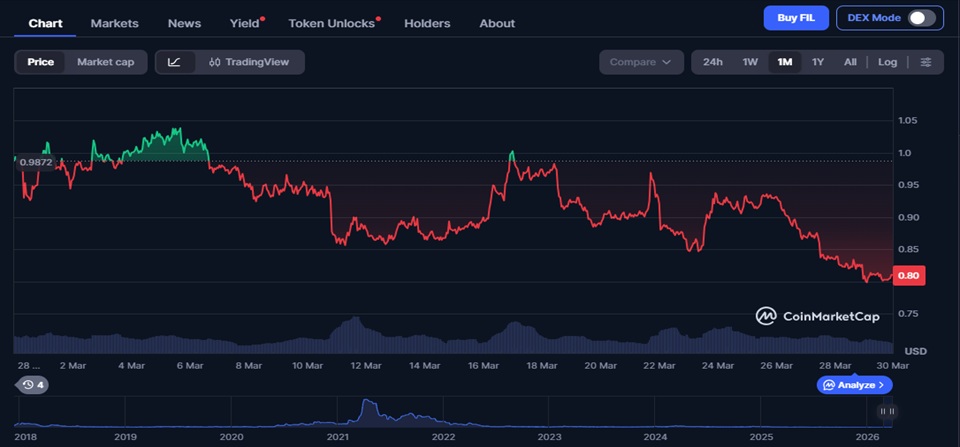
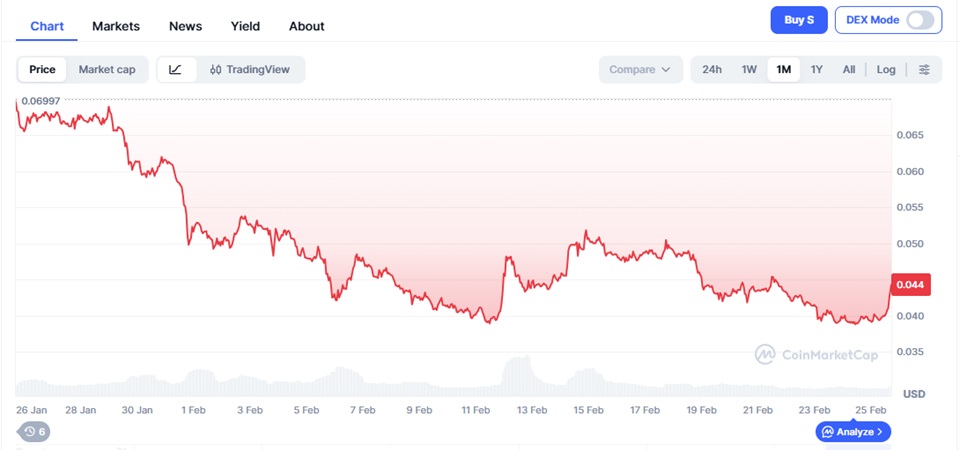
Image Source: https://coinmarketcap.com/currencies/polygon-ecosystem-token/
Short-Term Polygon Forecast
In the short term, Polygon is navigating a base-building phase. After the transition from MATIC to POL, the market is adjusting to the new tokenomics.
Adoption remains high among enterprises, but the price is currently experiencing a period of stabilization as it waits for a broader market catalyst, such as a Bitcoin halving cycle peak or a major Ethereum upgrade.
Polygon Prediction Table (2026–2040)
| Year | Pessimistic Case | Realistic Case | Optimistic Case |
|---|---|---|---|
| 2026 | $0.070 | $0.098 | $0.25 |
| 2027 | $0.065 | $0.11 | $0.34 |
| 2028 | $0.082 | $0.19 | $0.45 |
| 2030 | $0.14 | $0.31 | $1.21 |
| 2035 | $0.18 | $0.74 | $2.65 |
| 2040 | $0.23 | $1.45 | $4.80 |
Polygon Price Prediction 2026
For the remainder of 2026, the price is expected to hover near its current baseline. A bearish scenario could see a dip toward $0.07, while a bullish market rebound could push the price toward $0.25 as the AggLayer gains more connected chains.
Polygon Price Prediction 2027
In 2027, the baseline scenario suggests a slight recovery to $0.11. The pessimistic perspective considers the potential competition from other Layer 2 solutions, like Arbitrum or Optimism, which could capture market share and keep the price stagnant.
Polygon Price Forecast 2028
2028 could see a significant shift. If the broader crypto market enters a growth cycle, Polygon’s massive institutional partnerships (including major banks and retail brands) could drive the price toward $0.45.
Polygon Price Prediction 2030
By 2030, Polygon’s infrastructure will be fully mature. Projections suggest a realistic price of $0.31.
The bullish case of $1.21 assumes Polygon becomes the Transmission Control Protocol/Internet Protocol (TCP/IP) of the blockchain world, handling millions of transactions per second across its secondary networks.
Polygon Price Prediction 2035
By 2035, macroeconomic shifts and widespread Web3 integration are expected to solidify Layer 2 solutions.
If the network successfully sustains its 2% issuance against high institutional transaction volume, the realistic base case places POL around $0.74, with potential to reach $2.65 in a hyper-optimized ecosystem.
Polygon Price Outlook 2040
Long-term forecasts for 2040 are speculative but lean toward growth rather than collapse. If Polygon remains a top-tier infrastructure provider, the price could reach between $1.45 and $4.80.
A sub-cent crash is unlikely unless the network is entirely superseded by a new technology.
What Drives Polygon’s Price?
Lots of different factors go into the value of Polygon. There isn’t one overriding aspect; each one links together to decide how much Polygon is worth.
The Polygon Wallets
To protect your assets from online vulnerabilities, it is important to transfer your long-term investments off exchanges and store them in dedicated storage.
By using secure crypto wallets, you can ensure that you retain full ownership of your private keys, allowing you to keep your converted POL tokens completely under your control.
How High Can Polygon Go? Price Targets Explained
While there is no fixed upper limit to what any cryptocurrency can theoretically achieve, realistic valuations must be grounded in circulating supply and market capitalization (calculated as Price × Circulating Supply).
With Polygon’s transition to the POL token and its built-in 2% annual emission model, here is how the most common price targets stack up against market realities.
Can Polygon Reach $1?
Yes, this is highly achievable.
Reaching $1 would require a market capitalization of roughly $10 billion based on its initial 10 billion token supply.
Given that Polygon’s predecessor token, MATIC, achieved an all-time high of over $2.90 in 2021, a return to $1 is well within the realm of possibility.
For POL to hit this milestone, it requires broader adoption of its AggLayer architecture and a return to a sustained, market-wide crypto bull run.
Can Polygon Reach $5?
Yes, but it is a long-term bull case scenario.
At a price of $5, Polygon’s market capitalization would need to reach approximately $50 billion to $55 billion (accounting for future annual token emissions). To put this in perspective, a $50 billion market cap would place Polygon in the valuation territory currently held by top-tier Layer 1 networks like Solana.
For this to happen, Polygon would need to become the undisputed infrastructure standard for Ethereum scaling, capturing a massive share of institutional real-world assets (RWAs) and enterprise gaming networks.
Analysts do not project this happening before the 2030–2035 window.
Can Polygon Reach $10?
It is highly unlikely, though not entirely impossible in the ultra-long term.
A $10 price target implies a market capitalization of $100 billion or more. Only a handful of cryptocurrencies (such as Bitcoin and Ethereum) have ever sustained a valuation this high.
For Polygon to hit $10, the entire crypto asset class would need to see massive global capital inflows, pushing Ethereum into the multi-trillion-dollar bracket and driving immense transactional volume across Polygon’s secondary networks to offset the token’s 2% annual inflation.
It is not a realistic target for the foreseeable future.
Conclusion
As the market is bearish at the moment, you must approach Polygon investment with this in mind. Your usual bear market approach is the most common approach, but any market changes or new information might change this.
It’s unlikely to see big increases in value, with a consistent drop much more likely in the long term.
As it’s more for facilitating transfers on the Ethereum network, the price drop will make it cheaper to carry out transfers. If this changes with the rollout of Polygon 2.0, it could impact the value, and we will update our predictions.
If you want more info on crypto and to increase your knowledge, our crypto hub page gives you access to everything you need to become a crypto genius.































 shahnakul23@gmail.com