Ondo Price Prediction 2026–2040 – Long-Term Forecast & Scenarios
Ondo is a decentralized finance protocol that brings institutional-grade financial assets, such as U.S. Treasuries and stocks, onto the blockchain through tokenization.
Investors mostly search for price forecasts because they want to to navigate the inherent volatility of the Real-World Asset (RWA) sector.
In this guide, we evaluate the 2026–2040 timeframe. You’ll find updated price tables, fundamental drivers, and a reality check on market cap constraints.
Ondo Price Prediction Analysis (Today → Long-Term)
Ondo’s value primarily depends on the growth of Total Value Locked (TVL) and the broader adoption of tokenized securities. Ondo mainly focuses on the Real-World Asset (RWA) space and connecting traditional finance (TradFi) with blockchain speed and accessibility.
Key long-term value drivers include:
Institutional Integration: Partnerships with giants like BlackRock (BUIDL) and Goldman Sachs.
Regulatory Compliance: Securing licenses (like EU passporting) to operate across global jurisdictions.
Revenue Sharing: Mechanisms that distribute protocol earnings to token holders (fee-switch).
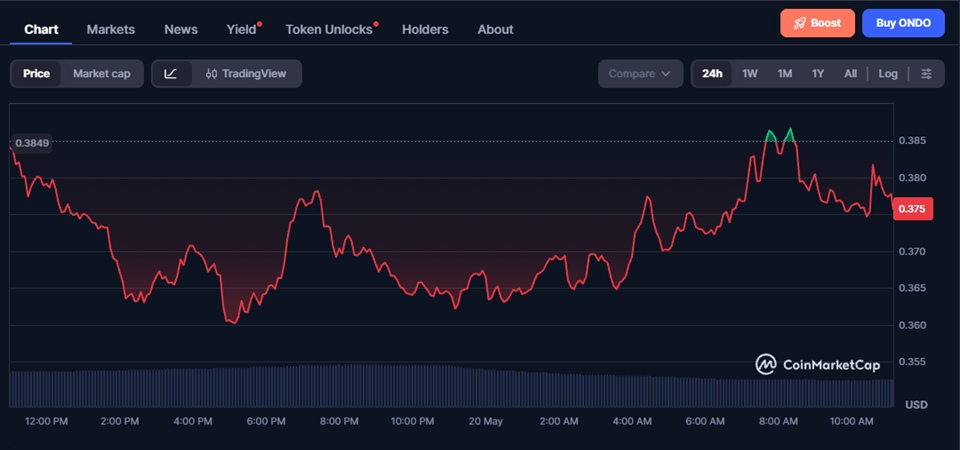
When it comes to the short-term forecast, it’s mostly noise movements: some temporary changes in the crypto market, news, developments, etc.
In other words, the short-term Ondo price prediction doesn’t give you an actual image of the token’s trajectory; however, understanding the support/resistance concept would help.
Basically, if the token breaks above the set resistance levels, it may indicate a possible bullish momentum. On the other hand, if it drops below the support levels, it may continue decreasing in value.
To trade ONDO or capitalize on its short-term volatility, investors rely on top-tier CEX and DEX, centralized and decentralized crypto exchanges. Major global platforms, such as Coinbase and KuCoin, actively list ONDO trading pairs.
Because of RWA narratives and other factors that affect Ondo, it has pretty high volatility; therefore, it experiences sharp price fluctuations and volume spikes.
Estimates for the remainder of 2026 remain cautiously bullish. The primary catalyst is the highly anticipated fee switch vote, which could transform ONDO from a pure governance token into a yield-bearing asset.
Ondo Global Markets recently secured EU passporting rights for 30 countries, opening the door to over 500 million European investors.
Ondo Price Prediction 2027
By 2027, the market is expected to enter a maturation phase following the 2024–2025 halving cycle. Ondo’s expansion into Layer-1 networks like Solana and XRP Ledger for institutional settlements provides a firm valuation floor.
ONDO’s link to tangible U.S. Treasury yields ($OUSG and $USDY) offers a stabilizing utility.
Ondo Price Forecast 2028
In 2028, tokenized Treasuries are projected to become a standard component of institutional on-chain portfolios. However, a potential risk factor is the Federal Reserve’s interest rate policy.
If rates drop significantly, the yield on Ondo’s core products may become less attractive compared to high-risk DeFi protocols, potentially capping the price at the $1.40 range.
Ondo Price Prediction 2030
Projections for 2030 assume Ondo captures a significant slice (3–5%) of the tokenized asset market, which the Boston Consulting Group (BCG) estimates could reach $16 trillion.
Clearer global regulations regarding tokenized securities should be settled by this point, reducing the regulatory risk premium and allowing ONDO to trade as a core infrastructure asset.
Ondo Price Outlook 2040
Forecasting to 2040 is highly speculative. For ONDO to reach prices above $50, the global financial system would need to migrate nearly all public securities (stocks, bonds, and ETFs) to blockchain rails.
The main constraint is the fully diluted valuation (FDV); at $100 per token, Ondo would have a market cap exceeding $1 trillion, rivaling the current size of Bitcoin.
The Ondo Network
Ondo utilizes a specialized Proof-of-Stake (PoS) consensus mechanism for permissioned validators and RWA compliance. The validators automatically verify with custodians that tokenized Real-World Assets (RWAs) are backed by underlying assets.
While there’s pretty high security, Ondo’s biggest trade-off comes from the slightly higher centralization than other cryptocurrencies.
Ondo uses a hybrid model. Governance is decentralized (via ONDO holders), but validators are often permissioned to ensure compliance with anti-money laundering (AML) laws.
Ondo’s network provides fast transaction speeds of around 5 seconds—faster than traditional T+2 settlement cycles in legacy finance—and low fees. This way, you can enjoy stellar on-chain settlement efficiency.
To securely store your ONDO tokens, choose from compatible crypto wallets that support Ethereum, Solana, and the XRP Ledger. Options like MetaMask, which integrates with Ondo Global Markets for tokenized stock trading, and hardware wallets like Ledger offer strong security and decentralized utility.
What Drives Ondo’s Price? (Core Fundamentals)
While numerous variables influence ONDO’s market value, its trajectory is primarily shaped by the following foundational pillars:
1️⃣ Regulatory Frameworks & Legal Developments:
Because Ondo bridges traditional finance with blockchain, regulatory clarity is its biggest catalyst. Favorable legal frameworks (like Europe’s MiCA) and positive SEC rulings reduce compliance risks, clearing the path for institutional capital and major exchange listings. Conversely, aggressive enforcement actions introduce market anxiety, driving down the price.
2️⃣ Institutional Integration & Utility:
ONDO’s long-term demand is tied directly to its adoption by enterprise players. High-profile partnerships with asset managers and real-world pilot programs drive network utility. As more institutions use the protocol to settle tokenized assets, on-chain activity spikes, creating an organic upward pressure on the token’s value.
3️⃣ Tokenomics & Supply Schedules:
Price stability relies heavily on supply and demand dynamics. Scheduled token unlocks, ecosystem incentives, and escrow releases temporarily increase circulating supply, which can create downward price pressure if demand doesn’t keep pace. On the flip side, potential future token burns or revenue-locking mechanisms can reduce active supply and support price growth.
4️⃣ Macroeconomics & Crypto Market Cycles:
ONDO does not move in a vacuum. It is heavily influenced by broader crypto market sentiment—often dictated by Bitcoin’s cycles—as well as macroeconomic factors. Interestingly, because Ondo’s core products are yield-bearing U.S. Treasuries, Federal Reserve interest rate hikes generally increase the attractiveness of its products, while rate cuts can cool down investor appetite.
How High Can Ondo Go? Price Targets Explained
Based on current market conditions and the expansion of the Real-World Asset (RWA) sector, we’ve explored the structural viability of ONDO reaching its most-discussed psychological milestones.
Will Ondo Hit $1?
Reaching $1 is an achievable target for ONDO in the current market cycle.
Its all-time high of $2.14, reached in late 2024, suggests that a moderate recovery in the altcoin market and ongoing demand for its yield-bearing products could help it return to this price.
At $1, its market capitalization would be about $4.9B, a reasonable valuation for a leading RWA infrastructure project.
Will Ondo Hit $5?
Analysts view this milestone as a highly realistic objective by 2028–2030.
To reach $5, ONDO needs to exceed its previous record high, raising its market cap to about $24.5 billion.
For this to happen, the protocol must successfully scale its cross-chain deployments (such as its expansions into Solana and XRP Ledger) and secure multi-billion-dollar corporate liquidities inside its tokenized short-term U.S. government bond funds ($OUSG).
Will Ondo Hit $10?
A $10 price target is considered a plausible long-term ceiling for the 2030–2035 window.
This level implies a circulating market cap of roughly $49 billion (and a fully diluted valuation of $100 billion).
Hitting $10 depends on systemic changes in finance, specifically whether decentralized networks are mature enough to handle standard institutional balance-sheet settlements and if international regulatory bodies universally legalize public-ledger securities passporting.
Will Ondo Hit $50?
Achieving a price of $50 per token for Ondo is an unlikely, speculative scenario.
Such a price would lead to a market cap of $245 billion, placing it among the top cryptocurrencies. To reach this milestone by 2040, a near-complete migration from traditional finance would be necessary, with Ondo serving as the primary transactional layer for institutional ETFs and stock trading.
Will Ondo Hit $100?
A $100 price target faces a major reality check due to tokenomics.
With a maximum supply of 10 billion tokens, this would lead to a fully diluted market cap of $1 trillion, rivaling the valuations of tech giants like Meta or Bitcoin’s peak.
While hyperinflation or complete global adoption by 2040 could affect valuations, a $100 price target is highly unlikely under the current economic structure.
Risks & Disclaimer
One of the biggest risks when it comes to Ondo price predictions is that they are inherently speculative. Aside from high volatility that can cause drastic price swings, macroeconomic shifts and evolving regulatory landscapes heavily impact the coin’s value.
To better understand how to navigate these market complexities, you can explore our comprehensive crypto guides for detailed strategies on risk management and asset analysis. Ultimately, you should always do your own research and assess your financial goals before deciding to purchase ONDO tokens.
Conclusion
Ondo Finance stands at the forefront of the Real-World Asset (RWA) tokenization movement, successfully bridging traditional financial structures with blockchain utility.
While short-term forecasts are highly sensitive to day-to-day regulatory news and macro trends, ONDO’s long-term trajectory through 2040 is fundamentally anchored to the global institutional adoption of tokenized U.S. Treasuries and equities.
By capturing a meaningful share of the estimated multi-trillion-dollar RWA market, the protocol has established a unique valuation floor compared to entirely speculative crypto assets.
However, achieving optimistic price milestones remains heavily dependent on navigating regulatory compliance, absorbing localized token unlock schedules, and the steady migration of global capital markets onto public ledger rails.
As of mid-2026, ONDO is expected to trade between $0.32 and $0.68, depending on the outcome of the fee-switch governance vote.
What is the Ondo price prediction for 2030?
Analysts project a realistic range of $1.10 to $3.50, assuming the RWA sector matures as expected.
Is ONDO a good investment?
ONDO is widely considered a high-potential Blue Chip in the RWA category. However, it carries risks related to regulatory changes and interest rate sensitivity.
Can I use ONDO in crypto casinos?
While some Ethereum-based (ERC-20) casinos accept ONDO, it is primarily an institutional utility token and is not yet a standard payment method in the gambling industry.
He has worked with several companies in the past including Economy Watch, and Milkroad. Finds writing for BitEdge highly satisfying as he gets an opportunity to share his knowledge with a broad community of gamblers.
















 Article Contributors


 Fact checked by
 Read Time: 6mins
 Published: 20/05/2026 | Updated: 20/05/2026


















 eabungana@gmail.com

