














 Bittensor (TAO) Price Prediction
 Article Contributors


 Fact checked by
 Read Time: 7mins
 Published: 25/06/2026 | Updated: 28/06/2026


Reading the TAO Market Right Now
TAO trades around $230 at the time of writing, ranked approximately #34 by market cap at around $2.5 billion. The circulating supply sits near 11.05 million tokens out of a hard cap of 21 million, meaning roughly 52.6% of the total supply is in circulation. Fully diluted valuation (FDV) runs near $4.8 billion, roughly double the current market cap.
Grayscale’s Bittensor Trust is live on OTC markets, giving institutions exposure before any ETF approval. The April 2026 ETF filings add a regulatory narrative that the 2024 ATH cycle never had.
Combined with dTAO, the dynamic mechanism that prices subnet rewards by market demand rather than fixed schedules, Bittensor enters this cycle with structural improvements that matter.
Finding crypto trading platforms with deep liquidity is crucial for trading high-volatility assets like TAO. Our vetted exchange reviews highlight platforms offering competitive fee structures, robust security protocols, and reliable fiat on-ramps.
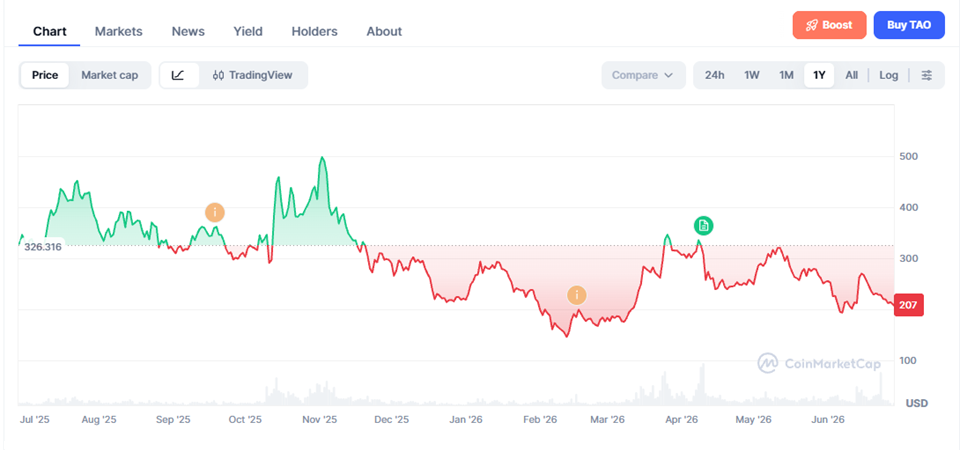
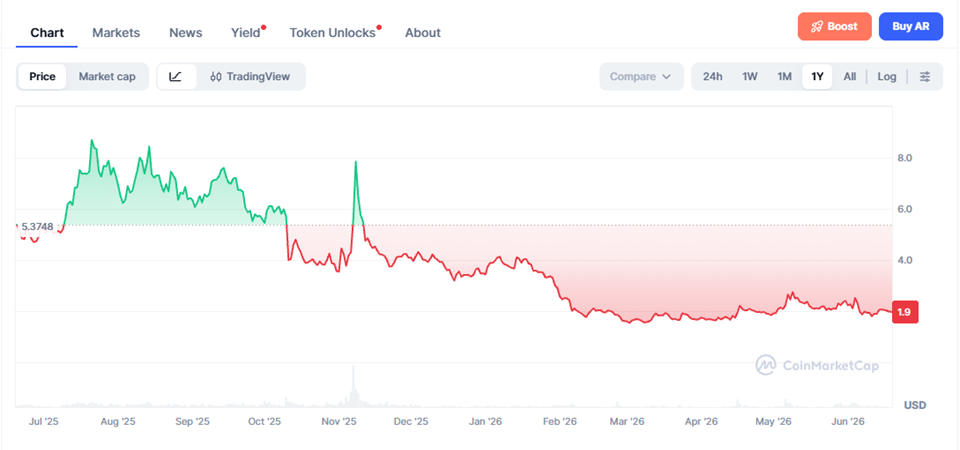
Image Source: https://coinmarketcap.com/currencies/bittensor/
Short-Term TAO Price Dynamics
TAO trades like a high-conviction infrastructure asset when markets are risk-on and like a speculative AI token when they are not. The switch happens fast. A 50% spike in 24-hour volume followed the April 2026 ETF filings. A co-founder wallet sale of 37,000 TAO triggered $9 million in liquidations on a different day. Thin order books amplify everything here.
- Key Support: The $200–$220 range has been tested repeatedly in mid-2026. Holding above this floor prevents the technical structure from decaying.
- Key Resistance: $350–$450 is the first serious clearing zone. Above that, an all-time high (ATH) retest becomes a highly viable conversational pivot.
- Volatility Profile: High-beta AI token with an institutional overlay. Subnet news, ETF developments, and large wallet movements can each significantly move the market in either direction.
Keeping your digital assets secure means moving them off exchanges into self-custodial infrastructure. Our recommended wallet guides break down the best hardware and software crypto wallets to ensure your private keys remain exclusively in your hands.
TAO Price Prediction Table (2026–2040)
The TAO cryptocurrency price forecasts below reflect bear, base, and bull cases built around halving dynamics, subnet adoption, ETF narrative progress, and decentralized AI infrastructure demand.
| Year | Pessimistic Case | Realistic Case | Optimistic Case |
|---|---|---|---|
| 2026 | $150 | $450 | $760 |
| 2027 | $200 | $850 | $1,800 |
| 2028 | $170 | $1,300 | $3,500 |
| 2030 | $300 | $3,000 | $9,000 |
| 2040 | $700 | $15,000 | $60,000 |
What Makes Bittensor Different From Other AI Tokens
Most AI tokens are governance wrappers over products that could exist without a blockchain. TAO is the settlement layer of a competitive market where the product is intelligence itself.
Validators assess the quality of miner outputs, and miners compete to produce better responses.
1. The Bitcoin Supply Model and Halving Schedule
21 million TAO maximum. Halvings occur every four years. The December 2025 halving cut daily emissions in half, and the next one arrives around late 2029. Each cycle, fewer new TAO enter circulation.
If demand grows faster than supply, price pressure shifts upward and compounds. That is the same mechanic that drove Bitcoin from early adoption to global prominence, applied to compute and intelligence rather than value storage.
2. dTAO and the Subnet Economy
dTAO replaced fixed subnet rewards with market-priced emissions. Subnets that attract real external demand get more TAO; subnets nobody uses get less.
Over 128 subnets are active, covering inference, text generation, compute routing, and data validation. This shift turns Bittensor from a research project into an actual market with measurable economics.
How High Can TAO Go? Price Targets Explained
Can TAO Reach Its Previous ATH of $757.60?
Yes. It neared this level in early 2024 before the supply dynamics tightened and before institutional ETF filings. The structural improvements since make a retest defensible once general altcoin momentum builds.
Can TAO Reach $2,000?
Possible by 2027 in a bull case scenario. A $1,800 to $2,000 price implies a market cap near $22 billion at the current circulating supply, which sits well below historical valuations reached by major Layer-1 protocols.
This requires TAO to be recognized as a top-tier AI infrastructure with real subnet revenue.
Will TAO Hit $10,000?
This remains a long-term stretch target, most realistic as a post-2030 target. It requires Bittensor to establish itself as the dominant neutral AI marketplace globally.
It is ambitious but structurally plausible given the fixed supply model and halving roadmap.
Conclusion
Bittensor represents a bold, fundamentally unique experiment in the digital asset landscape: mapping Bitcoin’s hard-capped scarcity model directly onto a decentralized marketplace for machine learning.
While short-term prices face headwinds from historical governance disputes and overall altcoin market cycles, structural developments like the late 2025 halving, dTAO subnet mechanics, and institutional spot ETF filings provide strong fundamental pillars.
Ultimately, TAO’s long-term value will depend entirely on its capability to transition from a speculative crypto narrative into a highly utilized, neutral alternative to centralized Big Tech infrastructure.
Check More Crypto Price Prediction Pages





Frequently Asked Questions
What will the TAO price be in 2026?
Our base case targets roughly $450, assuming post-halving supply tightening and ETF narrative building through the year. A strong altcoin season could push TAO toward a bull target of $760. The bear case keeps it near $150 if macro trends remain risk-off.
What is the TAO price outlook for 2030?
If Bittensor establishes itself as a neutral AI infrastructure layer with real external subnet revenue, a base near $3,000 by 2030 is defensible. The bull case at $9,000 requires TAO to reach top asset status with institutional adoption at scale.
What will TAO be worth in 2040?
A base case of $15,000 assumes continued halving-driven scarcity compounding with AI infrastructure demand. The bull case of $60,000 requires Bittensor to become the dominant decentralized AI settlement layer globally.
What will TAO be worth in 5 years?
By 2031, a price range between $2,000 and $5,500 covers most realistic outcomes depending on ETF approval status, subnet revenue metrics, and whether the AI decentralization narrative holds through the next market cycle.
Is TAO a good investment?
TAO has one of the strongest supply cases in the AI token sector, featuring Bitcoin-modeled scarcity with halvings and a genuine marketplace design. It suits investors with high risk tolerance who believe decentralized AI infrastructure will capture meaningful market share from corporate tech giants over the next decade.
Why is TAO below its ATH despite growing subnet activity?
The 2024 ATH was heavily narrative-driven before the network had matured its structural utility. Higher historical emissions, internal governance friction, and tighter macro conditions across the altcoin sector created price corrections. The late 2025 halving adjusted the supply side, but market repricing lag remains visible.
Can you use TAO at crypto casinos?
TAO is primarily a staking and governance token within the Bittensor ecosystem. It is not widely supported as a direct deposit method on gambling platforms, though its listing on major exchanges makes it easily swappable for assets that are commonly accepted.


 eabungana@gmail.com

