Arweave made one promise and built everything around it: store data forever. Not for a subscription period, not until the servers are turned off, not until the company runs out of money. Forever.
That is either the most compelling value proposition in Web3 infrastructure or an engineering problem that has not fully revealed its limits yet. Investors looking for an Arweave price prediction are really asking which of those two things it turns out to be.
Today → Long-Term AR Price Prediction Analysis
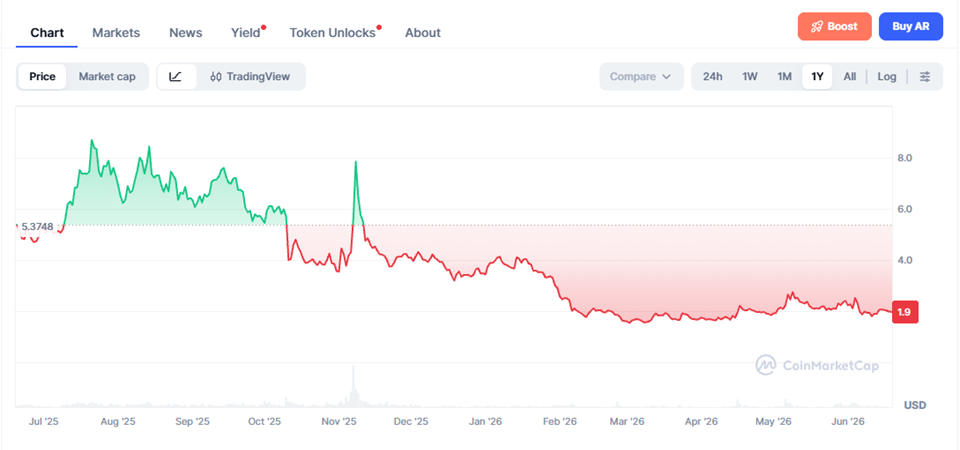
AR’s market cap is nearly $128 million. The supply picture is unusually clean for crypto: 65.65 million tokens in circulation out of a maximum of 66 million. Virtually all AR that will ever exist already exists.
There are no major unlock cliffs, no team vesting schedules creating overhang, and no severe inflation diluting holders.
Supply is essentially fixed, which means the price equation is almost entirely a function of storage demand and ecosystem compute utility driving token velocity.
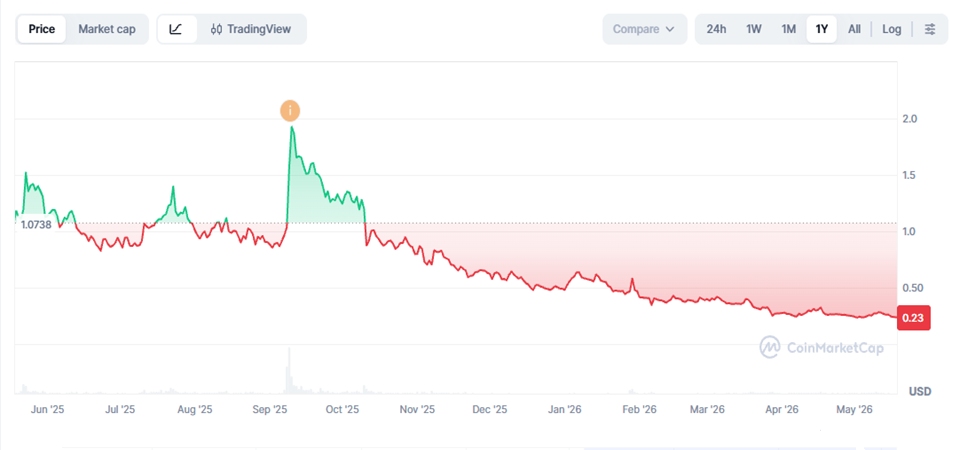
AR is a low-liquidity asset relative to its conceptual reputation. It moves fast on news and gives gains back just as fast in thin markets. A 24-hour block production halt in early February 2026 eroded confidence significantly and contributed to months of underperformance.
That kind of infrastructure failure hits Arweave harder than it would most tokens because the project’s foundational pitch is absolute reliability.
Key support: The $1.50–$1.75 band has been tested repeatedly through early 2026. If broken, the $1.00 level serves as the ultimate psychological floor the market watches most closely.
Key resistance: $2.20–$2.50 is the immediate macro zone to clear. The 200-day moving average sits notably higher, signaling a structural downtrend that needs sustained buying to reverse.
Volatility profile: Low-cap, low-liquidity. A single large buy order or a meaningful ecosystem partnership can move AR 20–30% in hours, but exits in a thin market can be equally brutal.
Understanding the volatile world of decentralized physical infrastructure networks (DePIN) and long-term blockchain investments requires knowledge of market fundamentals. Our crypto guides offer actionable insights, clear tokenomics explanations, and portfolio strategies to help investors make informed decisions.
AR Price Prediction Table (2026–2040)
The following AR crypto price predictions range below reflect bear, base, and bull cases built around permanent storage adoption, AO network traction, and broader crypto market conditions.
Year
Pessimistic Case
Realistic Case
Optimistic Case
2026
$1.20
$3.50
$8.00
2027
$1.80
$8.00
$18.00
2028
$2.50
$14.00
$32.00
2030
$3.00
$28.00
$60.00
2040
$5.00
$85.00
$250.00
Arweave Price Prediction 2026
Developer activity around the AO compute network is the main story for AR in 2026. AO launched as a decentralized supercomputer built on top of Arweave’s permanent storage layer, creating a new demand vector for AR tokens that goes beyond simple file archiving.
Projects like Nau Finance, building a stablecoin pegged to storage costs, and a string of AI demonstrations at Arweave Day Asia are early signals that the ecosystem is building, not just theorizing.
A realistic base case of $3.50 requires the altcoin market to stabilize and AO adoption to generate visible on-chain storage demand.
The optimistic bull case toward $8.00 needs a DePIN sector rally where Arweave benefits from renewed interest in decentralized infrastructure broadly.
The bear case at $1.20 is a world where network stability concerns linger after the February 2026 outage, and the market treats AR as a broken story rather than a patient one.
Arweave Price Prediction 2027
By 2027, the AO network will have had two full years on mainnet to convert developer interest into actual usage. That is the only metric that matters at this stage.
If dApps are deploying on AO, if AI models are using Arweave for provable data permanence, and if enterprise integrations with healthcare or legal records start generating consistent storage fees, the protocol’s revenue model begins to justify a much higher AR price.
The Starknet integration that drove sharp positive reactions in prior cycles is a prime example of how partnership momentum translates to price.
Platforms that deal in permanent records, transparency requirements, and verifiable data histories—including regulated industries like no-KYC betting sites that need provable, tamper-proof transaction logs—represent exactly the kind of recurring storage demand Arweave’s endowment model is built to serve.
A base of $8.00 is achievable if that adoption story starts converting in 2027.
The bull case of $18.00 needs a strong altcoin cycle and a clear narrative around decentralized AI data permanence.
AR Price Forecast 2028
2028 is where permanent storage either becomes a recognized infrastructure category or gets lumped in with Web3 experiments that sounded compelling but never scaled. Filecoin and Storj are the direct competitors. They offer cheaper, temporary storage with different guarantee structures.
What they do not offer is true permanence: pay once, store forever. That distinction is either Arweave’s permanent moat or a premium niche that too few customers want to pay for.
A base case of $14.00 assumes the permanent storage market has found its lane, and Arweave is the clear winner in it.
The bull case of $32.00 requires broader recognition from enterprise entities—such as AI training datasets, government transparency archives, and medical logs—to drive demand at a scale that makes the one-time fee model generate massive protocol revenue.
AR Valuation 2030
By 2030, the question is whether permanent storage has become a standard infrastructure requirement, the way SSL certificates and cloud redundancy are today.
If enterprise and institutional buyers default to Arweave for any data that needs to be provably immutable, the protocol’s revenue base compounds quietly, and the AR token reflects it. If the market for true permanence remains a tech-enthusiast niche, the token stays niche too.
A base of $28.00 in 2030 puts the total market cap near $1.8 billion, a reasonable number for a protocol with genuine institutional adoption.
The bull case at $60.00 is the scenario where Arweave is recognized as a top-tier DePIN asset on par with the permanent web vision its founders articulated.
Some of that adoption runs through digital platforms where data integrity is operationally critical, including secure fintech operators and legal jurisdictions that need immutable audit trails for compliance reasons.
AR Macro Vision 2040
A 14-year forecast for any digital asset is highly speculative. But Arweave’s 2040 case has a specific logic to it. The endowment model—a one-time upfront payment that funds storage in perpetuity through conservative interest on the capital pool—is designed to be self-sustaining for centuries. If the model holds, every year that passes without Arweave collapsing makes the protocol’s permanence promise more credible. And credibility for an archival protocol compounds over time.
A base of $85.00 in 2040 implies a market cap near $5.5 billion, reasonable for a protocol that has genuinely solved long-term data permanence in a world that generates exponentially more data every year.
The bull case at $250.00 requires Arweave to have become the default archive layer of the internet, the place where governments and institutions store anything they cannot afford to lose.
The bear case at $5.00 represents basic network survival without market dominance.
The Arweave Network
What Makes Arweave Different From Other Storage Tokens
Filecoin charges recurring fees. IPFS does not guarantee persistence. Traditional cloud storage depends entirely on a centralized company staying solvent.
Arweave’s model is structurally different: pay once, store forever, backed by a mathematical storage endowment rather than a corporate promise.
The AO Supercomputer
AO is Arweave’s most significant expansion. It layers a decentralized compute environment on top of the permanent storage base, enabling smart contracts and AI processes to run on verifiable, permanent data.
Every computation on AO creates an on-chain record stored directly back into Arweave. This creates a powerful, direct link between AO compute adoption and AR token demand that did not exist before its introduction.
Core Catalysts That Could Drive AR Higher
1️⃣ AI Data Permanence Demand
AI training datasets need to be auditable, reproducible, and tamper-proof. Arweave’s permanent storage is technically better suited for this than any centralized alternative. If AI developers treat AR as the default place to archive training data and model checkpoints, the demand for AR tokens grows with every model trained globally.
2️⃣ Enterprise and Government Archival Adoption
Legal records, medical data, government transparency archives, and supply chain documentation all benefit from fixed-cost permanence. Any data category where permanent verifiability has regulatory or legal value is a potential target market.
3️⃣ DePIN Sector Momentum
Arweave consistently ranks among the most prominent DePIN projects by utility. When DePIN narratives run and attract retail and institutional capital into decentralized physical infrastructure networks, AR moves favorably alongside the sector.
Securing your assets is paramount when investing in highly volatile infrastructure tokens like Arweave. Using reliable crypto wallets ensures that you retain full ownership of your private keys, shielding your funds from exchange insolvency or counterparty risks.
How High Can AR Go? Price Targets Explained
1. Can AR Hit $5.00?
Yes, in a standard altcoin recovery. A $5.00 price implies a market cap of roughly $328 million, which is highly achievable given its fixed token structure and historical performance.
2. Can AR Hit $10.00?
Yes, in a strong altcoin cycle. A $10.00 price implies a market cap of roughly $657 million, which is a mere fraction of Arweave’s 2021 peak market cap of over $5.9 billion.
3. Can AR Hit $20.00?
Possible by 2027–2028 if the broader market enters a structural bull phase. A $20.00 price puts the market cap near $1.3 billion, requiring sustained AO developer adoption to validate the valuation.
4. Will AR Hit $50.00?
This is a long-term bull target. A $50.00 price implies a market cap near $3.3 billion. For this to occur toward the next decade, Arweave must establish itself as an essential global infrastructure layer for AI training logs and enterprise archiving.
5. Will AR Hit $100.00?
This represents an ultimate macro bull case, not a short-term target. A $100.00 price implies a market cap near $6.6 billion, requiring Arweave to successfully scale into the default permanent web storage protocol at internet scale.
When buying or selling AR tokens, using secure crypto exchanges is critical for minimizing slippage and ensuring fair market pricing. Top-tier global exchanges provide advanced trading pairs, robust compliance frameworks, and the deep liquidity needed to handle low-cap volatility.
Investment Risks
Investing in digital infrastructure tokens carries severe risks that must be carefully managed. The February 2026 block production halt is the most critical risk signal in recent history.
A protocol that promises permanent storage cannot afford extended network outages without heavily eroding its core trust proposition. That event alone may have delayed institutional adoption conversations by months, and it simply cannot happen again.
Furthermore, competition from alternative networks like Filecoin remains fierce. Token concentration also presents a structural vulnerability: the top 100 addresses reportedly control a major portion of the circulating supply, making coordinated selling a significant risk during rallies.
Additionally, the asset’s relatively thin spot markets mean that it experiences aggressive volatility.
Conclusion
Arweave remains one of the most uniquely architected protocols in the Web3 ecosystem. By tying its economic model to a permanent storage endowment and layering it with the AO decentralized computer, it creates a unique mechanism where storage demand translates directly into token utility.
However, the asset must overcome the reputational friction caused by its 24-hour network outage in early 2026 and prove that its “pay once, store forever” thesis can scale commercially.
If enterprise and AI industries adopt it as a standard archival layer, AR has an incredibly strong, fixed-supply runway ahead; if it stays confined to a Web3 niche, its low liquidity volatility will continue to dominate.
Our base case targets roughly $3.50, assuming AO adoption builds and the broader altcoin market finds its footing. A major DePIN sector rally or enterprise announcement could push AR toward $8.00, while a bear case keeps it stagnant near $1.20 if network stability anxieties linger.
What is the AR price outlook for 2030?
If Arweave establishes itself as the primary layer for permanent AI and enterprise data compliance, a base near $28.00 by 2030 is plausible. The bull case of $60.00 requires the protocol to achieve status as top-tier global data infrastructure.
What will AR be worth in 2040?
Our base case of $85.00 assumes Arweave successfully compounds its storage endowment model into a globally recognized archive layer. The bull case of $250.00 requires it to become a foundational, permanent storage solution at internet scale.
What will AR be worth in 5 years?
By 2031, a range of $20.00–$60.00 covers most realistic outcomes depending on AO ecosystem expansion and whether enterprise storage adoption accelerates through the late 2020s.
Why is the AR price lower relative to its previous all-time highs?
The February 2026 network outage damaged market confidence, and thin liquidity makes the asset highly susceptible to broader macro downturns. Token concentration creates selling risk at rallies, meaning the market has valued AR more on short-term sentiment than long-term infrastructure fundamentals.
Can you use AR at crypto casinos?
AR is not widely supported as a direct payment method on gambling platforms. It functions primarily as a storage utility token rather than a mainstream payment instrument, and support varies considerably by platform.
In 2016, he worked on his first client to help write a white paper for a crypto and blockchain project they were building, and started delving deeper into blockchain and distributed ledger technology.
















 Article Contributors


 Fact checked by
 Read Time: 8mins
 Published: 17/06/2026 | Updated: 19/06/2026





 shahnakul23@gmail.com