Pump.fun is a prominent Solana-based decentralized platform and launchpad that enables users to create and trade memecoins instantly.
Utilizing an automated bonding curve mechanism, it ensures tokens can be traded safely and automatically “graduate” to decentralized automated market makers (like its in-house PumpSwap) as soon as they hit a designated market cap threshold.
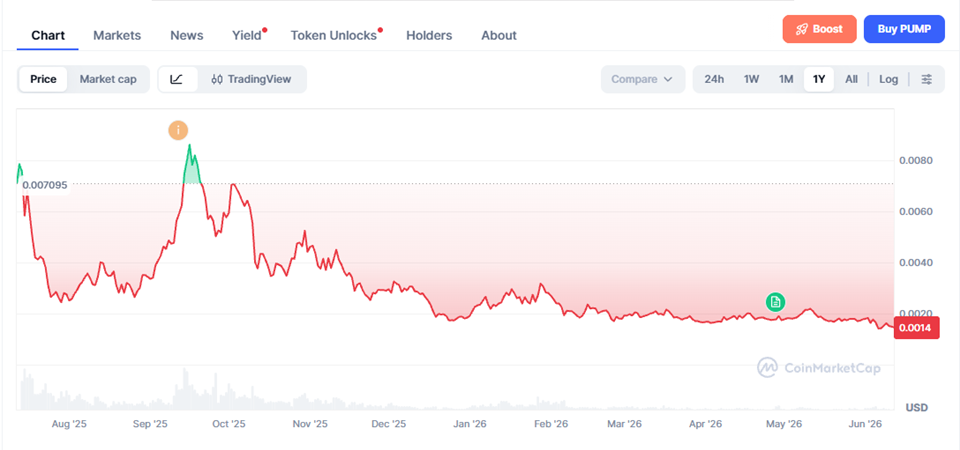
Investors frequently track native ecosystem tokens to gauge long-term protocol viability and maximize potential returns. Following the launch of its native token (PUMP), we have compiled a definitive price movement analysis spanning from 2026 to 2040.
Please bear in mind that all digital asset forecasts are strictly scenario-based and highly speculative.
Pump.fun separates itself from standard decentralized exchanges by removing the barrier of upfront liquidity provisioning, drastically reducing the cost and technical expertise required to launch a token. By using a virtual bonding curve model, token creation is streamlined, making trading fast and affordable.
The primary catalyst for the native PUMP token’s valuation is the macro health of the Solana memecoin ecosystem. However, broader elements like sustained platform revenue sharing, regulatory compliance, and protocol utility upgrades act as the ultimate long-term drivers.
In the short term, PUMP token price action is heavily dictated by market noise and speculative trading volume. Utilizing classic technical analysis concepts, such as support and resistance levels, provides the clearest picture of immediate price trajectories.
A definitive breakout above immediate resistance structures signals a bullish continuation where the asset may establish new short-term floors. Conversely, falling below key support risks triggering strong bearish momentum.
Because Pump.fun is inherently tied to highly volatile memecoin launches, this token experiences significant price swings based on daily network activity and broader crypto sentiment.
Pump.fun Prediction Table (2026–2040)
The PUMP crypto price prediction table below has been calculated to reflect a realistic progression via ongoing protocol buybacks and burns.
Year
Pessimistic Case
Realistic Case
Optimistic Case
2026
$0.0010
$0.0025
$0.0085
2027
$0.0012
$0.0038
$0.0120
2028
$0.0015
$0.0055
$0.0185
2029
$0.0018
$0.0072
$0.0240
2030
$0.0022
$0.0095
$0.0350
2035
$0.0045
$0.0280
$0.1050
2040
$0.0065
$0.0500
$0.1800
Yearly Breakdown
Pump.fun 2026 Price Prediction
As we move through 2026, the digital asset market shows cautious optimism. Growth targets for PUMP hinge on structural changes, including a revenue-sharing model that uses a portion of Pump.fun’s fees to buy back tokens, reducing supply pressure.
The platform is also evolving into an interactive social ecosystem with live streaming and tokenized bounty systems, enhancing its utility. Additionally, new regulations like the EU’s MiCA are creating compliance standards that could reshape global retail access to launchpads.
Pump.fun Price Prediction 2027
Following post-halving macroeconomic trends, analysts anticipate that the PUMP token’s valuation will pivot primarily toward ecosystem utility.
If Pump.fun successfully deploys advanced creator-monetization suites and DAO-governed curation systems, the token’s role shifts from a speculative asset to essential platform infrastructure. Deep-tier organic adoption is critical to maintaining a healthy baseline price.
Pump.fun Price Forecast 2028
By 2028, institutional infrastructure in the DeFi space is expected to mature significantly. For Pump.fun, sustained valuation gains depend on deep integrations with major Solana liquidity hubs and professional-grade tooling.
Capturing a consistent 7% to 9% of all on-chain speculative token launches on Solana will be key to compounding its treasury value.
Pump.fun Price Prediction 2030
Looking toward 2030, the narrative shifts to cross-chain interoperability. Should the protocol scale its bonding curve infrastructure to alternative networks like Ethereum layer-2s or BNB Chain, it could establish itself as a universal decentralized launch architecture.
Global regulatory clarity by this era will likely distinguish fully compliant utility networks from high-risk platforms, dictating whether PUMP achieves sustained baseline growth.
Pump.fun Price Outlook 2040
Predicting prices nearly a decade and a half away introduces immense structural uncertainty. For PUMP to command a high valuation in 2040, it must rely on permanent supply-deflation dynamics and long-term protocol persistence.
Market cap realities remain the ultimate anchor, preventing irrational mathematical valuations over this extended horizon.
The Pump.fun Network
Pump.fun does not operate on a native standalone blockchain. Instead, it is deployed directly on the Solana network, meaning its transactions are secured, ordered, and validated by Solana’s global validator nodes via a hybrid Proof-of-Stake (PoS) and Proof-of-History (PoH) consensus mechanism.
The platform relies strictly on its proprietary smart contract logic to dictate virtual bonding curves, fee collection, and the creation of internal AMM trading pairs.
By leveraging Solana’s base infrastructure, Pump.fun inherits high transaction throughput, minimal latency, and fractional-cent network fees, allowing retail users to launch and swap tokens instantly.
Note: Safely storing assets like PUMP requires non-custodial Web3 wallets compatible with the Solana network ecosystem.
What Drives Pump.fun Price? (Fundamentals)
Regulation & Legal News
Legal clarity significantly influences the PUMP token ecosystem. Because launchpads handle high volumes of speculative retail assets, changes in registration requirements or jurisdictional bans (such as historical regional restrictions) can heavily impact active user metrics and market sentiment.
Ecosystem Expansion & Product Utility
Rather than basic payment narratives, PUMP’s value is driven by the performance of the underlying launch platform. The expansion of features like decentralized live streaming, copy-trading tools, and user bounties converts speculative users into long-term network participants.
Supply Dynamics & Burn Mechanisms
With a maximum supply capped at 1 trillion tokens, price sustainability depends on the distribution schedule. Open-market token buybacks and permanent burn implementations funded by protocol transaction fees are the main counterweights against circulating inflation.
Market Dynamics
As with all alternative digital assets, PUMP remains highly correlated to broader market cycles led by Bitcoin ($BTC$) and Solana ($SOL$). Macroeconomic factors, such as global liquidity indices, interest rates, and retail risk appetite, strongly govern overall volume.
How High Can Pump.fun Go? Price Targets Explained
Will Pump.fun Hit 5 Cents ($0.05)?
Yes, achieving $0.05 is within the realm of probability over a medium-term horizon. If the platform sustains its daily launch volume and continues to use 100% of its protocol fees to buy back and burn the token, reducing circulating supply inflation, an optimistic market cycle could push PUMP to $0.05 before the end of the decade.
Will Pump.fun Hit 1 Dollar ($1)?
Reaching $1 is a monumental milestone that requires deep economic adjustments. At a raw 1-trillion-token cap, a $1 price tag implies a $1 trillion market capitalization. However, under an extended timeline (such as 2035) in which aggressive, continuous protocol burns successfully eliminate a large percentage of the total supply, a $1 target becomes possible as the token architecture turns highly deflationary.
Will Pump.fun Hit 5 Dollars ($5)?
A $5 target represents the ultimate long-term ceiling for Pump.fun, projected as a maximum optimistic case for 2040.
For this scenario to play out, Pump.fun must transition from a simple Solana launchpad into a dominant, multi-chain decentralized financial engine. Furthermore, hitting $5 requires the circulating supply to be aggressively reduced through decades of transactional burns to keep the ultimate market cap balanced and healthy.
Investment Risks & Disclaimer
Every tier of digital asset forecasting—whether evaluating short-term momentum or looking multiple years into the future—is entirely speculative. Cryptocurrency assets are subject to intense volatility, regulatory updates, and systemic smart contract risks.
Furthermore, launchpad protocols are highly dependent on retail trading volumes, which can shift abruptly to competing platforms. Never allocate capital that you cannot afford to lose, and always perform thorough independent research.
Note: Securing PUMP tokens safely involves using verified centralized or decentralized crypto exchanges that support adequate liquidity pools.
Conclusion
In summary, realistic mathematical analysis indicates that PUMP is bounded by its 1-trillion-token supply. Under highly optimistic long-term conditions, targets scaling toward $0.18 are achievable, while more conservative bear markets could see the asset trade below its initial $0.004 ICO price floor.
Ultimate price stability will depend on revenue sharing from platform fees, user adoption metrics, and maintaining a competitive edge in the Solana ecosystem.
Our crypto guides are designed to simplify complex decentralized web ecosystems, helping all traders navigate emerging market trends safely.
For 2026, realistic projections estimate the PUMP token trading within a range of $0.0010 on the bearish end to a maximum of $0.0085 under highly favorable market conditions.
What is the Pump.fun price prediction for 2030?
By 2030, analysts project that if the platform successfully maintains its market dominance and fee-burning mechanics, the token could aim for a realistic baseline of $0.0095, with an optimistic ceiling of $0.0350.
What is the Pump.fun price prediction for 2040?
Long-term 2040 forecasts are highly uncertain. If the protocol achieves permanent historical relevance, it could climb toward a maximum realistic target of $0.1800; structural stagnation could see it drop to $0.0065.
Can Pump.fun reach $0.05 / $1 / $5?
Yes. A target of $0.05 is achievable by 2029 under strong market conditions. The higher thresholds of $1 and $5 require extensive periods of token deflation, aligning with the optimistic projections for 2035 and 2040, respectively, as the overall token supply is systematically reduced.
He has worked with several companies in the past including Economy Watch, and Milkroad. Finds writing for BitEdge highly satisfying as he gets an opportunity to share his knowledge with a broad community of gamblers.
















 Article Contributors


 Fact checked by
 Read Time: 5mins
 Published: 12/06/2026 | Updated: 12/06/2026






 eabungana@gmail.com

