














 Flare (FLR) Price Prediction
 Article Contributors


 Fact checked by
 Read Time: 6mins
 Published: 11/06/2026 | Updated: 11/06/2026


Today → Long-Term FLR Price Prediction Analysis
FLR’s valuation is in the mid-cap range by crypto standards. That level tells you the market sees promise, but not certainty. Traders understand the protocol has credible technology, yet they remain cautious because infrastructure tokens often require years of ecosystem buildout before the price fully reflects utility.
Tokenomics shape the long-term ceiling. Flare launched with a very large total supply, ultimately targeting 100 billion FLR, and that naturally limits how quickly the price can appreciate without major demand expansion. Still, supply size is only half the equation.
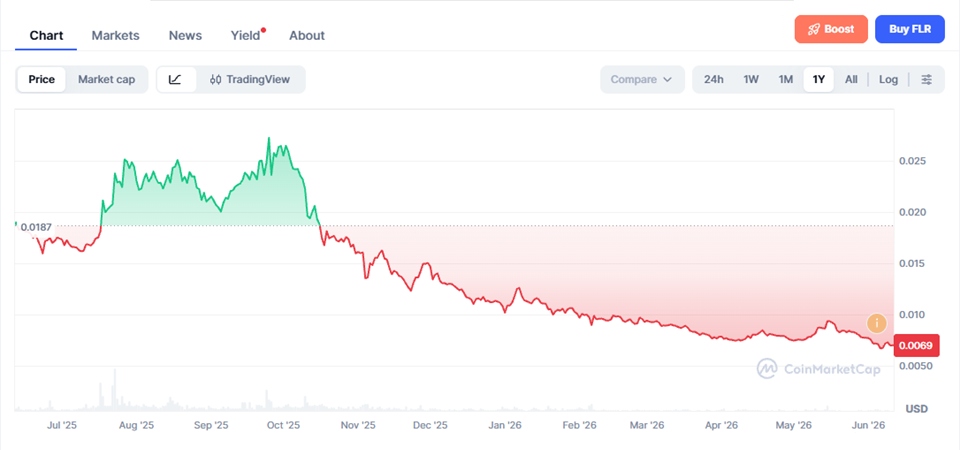
Image Source: https://coinmarketcap.com/currencies/flare/
Short-Term Flare Market Action
Projecting near-term FLR movement means following ecosystem activity, not just headline chart formations. Market participants are watching whether Flare can attract meaningful DeFi, data-provider participation, and cross-chain usage.
If on-chain demand accelerates, FLR can rerate quickly because infrastructure assets tend to move sharply once revenue narratives become believable.
In the meantime, volatility remains part of the package. FLR often trades like a token caught between patient long-duration investors and shorter-term speculators rotating capital into faster narratives. To put it simply, the question is, can Flare become an indispensable middleware for dApps that need trusted external data and cross-chain state access?
FLR Price Prediction Table (2026-2040)
| Year | Pessimistic Case | Realistic Case | Optimistic Case |
|---|---|---|---|
| 2026 | $0.004 | $0.012 | $0.025 |
| 2027 | $0.006 | $0.018 | $0.035 |
| 2028 | $0.005 | $0.026 | $0.055 |
| 2030 | $0.011 | $0.050 | $0.110 |
| 2040 | $0.030 | $0.160 | $0.380 |
FLR Price Forecasts By Year
Core Catalysts Fueling FLR
How High Can Flare Go? Price Targets Explained
Can FLR Reach $0.025?
Yes. A move to $0.025 would require a market cap in the low multi-billion range, depending on the circulating supply at the time. This is entirely achievable if Flare posts credible ecosystem growth and benefits from a strong, broad altcoin expansion cycle.
Can FLR Reach $0.11?
This is much tougher, but possible over a multi-year horizon. At $0.11, FLR would need a valuation that places it among the vital infrastructure assets in crypto.
That only happens if the market views Flare as essential middleware rather than a secondary smart contract chain with good ideas.
Will FLR Hit $0.50?
A $0.50 price target would require massive global adoption and a massive market value that approaches tens of billions in capitalization. Reaching this level would require years of flawless execution, deflationary changes to supply dynamics, and heavy network demand.
Will FLR Hit $1.00?
An absolute valuation of $1.00 is highly improbable and functionally unrealistic under current tokenomic conditions. Because Flare’s maximum supply scales up toward 100 billion tokens, hitting a dollar would demand a market capitalization near $100 billion.
For context, that would require Flare to surpass almost every major layer-1 network in existence and achieve global, institutional-scale ubiquity as the underlying data layer for the entire financial blockchain sector.
Conclusion
Flare stands out in a crowded Layer 1 landscape by focusing purely on native data interoperability and decentralized infrastructure through its built-in oracle systems. While its short-term price movement remains constrained by a large circulating supply and broader altcoin market trends, its long-term viability hinges completely on adoption.
If it successfully embeds itself into institutional data layers, cross-chain DeFi, and asset tokenization protocols, it boasts substantial utility-driven upside. However, if it fails to outpace competing middleware solutions, it risks structural stagnation.
Disclaimer: The price forecasts and analysis provided in this article are for informational and educational purposes only. They do not constitute financial or investment advice.
Cryptocurrencies are highly volatile assets; always conduct independent research and consult a professional advisor before investing your capital.
Find Other Crypto Price Predictions




Frequently Asked Questions
What is the 2026 Flare price prediction?
A realistic base range sits around $0.012 to $0.018, assuming the network starts accumulating real utility. If on-chain activity builds alongside a favorable market mood, an optimistic move toward $0.025 is achievable
What is the FLR price prediction for 2030?
By 2030, the asset’s value will depend entirely on its role as a fundamental data layer. If it succeeds as a go-to decentralized infrastructure rail, holding a base target around $0.050 is achievable, while a powerful bull cycle could stretch the token toward $0.110.
What is the FLR price prediction for 2040?
At a 14-year macro horizon, network relevance dictates the price. If Flare remains a surviving piece of active crypto infrastructure, a base price of $0.160 makes sense, with deeper integration pushing the upper bound toward $0.380.
How much will Flare be worth in 5 years?
In five years, a reasonable target range spans from a conservative $0.020 to an optimistic $0.065. Growth will not be linear, as it depends directly on token unlock schedules and value capture mechanics.
Can FLR reach $0.025 / $0.11 / $0.50?
A target of $0.025 is completely within reach in a constructive market cycle. Reaching $0.11 requires deep industry integration and consistent execution over several years. A price of $0.50 is an aggressive, long-term scenario where almost every structural milestone is hit flawlessly.
Is Flare a good investment?
It leans more toward slow-burning infrastructure than fast retail speculation. This offers asymmetric appeal for patient investors, but it comes with notable dilution risks and steep competition from entrenched oracle networks.
Why is FLR rising/falling?
Short-term fluctuations are generally driven by overall altcoin market sentiment, ecosystem milestones, and scheduled token unlock schedules. Over the long term, this speculative noise clears, leaving actual transaction demand as the true price driver.
Can I use Flare in crypto applications widely?
While Flare is fully operational for smart contract development and decentralized price queries, its integration as a mainstream payment asset is still minor compared to foundational assets like BTC or dominant stablecoins.


 eabungana@gmail.com

