












 Quant (QNT) Price Prediction
 Article Contributors


 Fact checked by
 Read Time: 8mins
 Published: 10/06/2026 | Updated: 11/06/2026


Today → Long-Term QNT Price Prediction Analysis
Quant (QNT) is a scarce digital token with a maximum supply of approximately 14.61 million tokens, almost all of which are already in circulation. This tight float often translates into a scarcity premium attaching to enterprise-oriented networks.
However, this premium is entirely subject to real-world integration. Long-term holders need explicit utility rather than speculative scarcity; this must come via licensing fees, developer lockups, and transaction routing within the Overledger ecosystem.
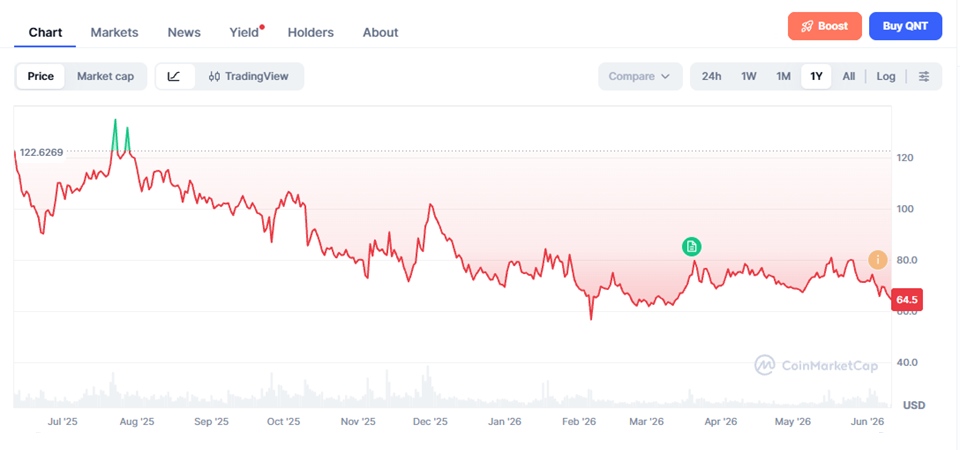
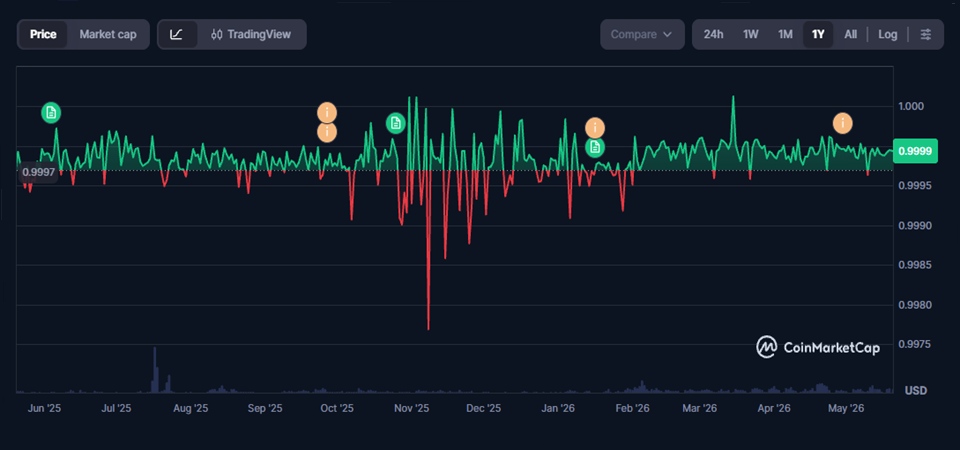
Image Source: https://coinmarketcap.com/currencies/quant/
Short-Term Quant Market Action
Quant (QNT) prices historically follow broader altcoin momentum, with sharp spikes tied to infrastructure breakthroughs—specifically, institutional partnerships or milestones regarding Central Bank Digital Currencies (CBDCs) and asset tokenization initiatives.
Price movements are highly volatile, frequently breaking out unexpectedly after long periods of sideways consolidation.
Support & Resistance: Trading around the $65–$70 mark, buyers have historically established strong structural support in the $50 to $65 zone during macro market downturns. For a convincing long-term trend reversal, QNT needs to decisively reclaim and hold the $140 to $165 resistance band on high trading volume.
Volatility: Expect sharp swings. A meaningful institutional partnership or a major tokenization framework update can move QNT by 15% to 30% in just a few trading sessions.
Quant Price Prediction Table (2026-2040)
These ranges are purely scenario-driven estimates based on current tokenomics. The mathematical projections are calculated using approximately 14.54 million circulating supply.
| Year | Pessimistic Case | Realistic Case | Optimistic Case |
|---|---|---|---|
| 2026 | $50 | $110 | $195 |
| 2027 | $65 | $150 | $280 |
| 2028 | $80 | $210 | $410 |
| 2030 | $120 | $450 | $850 |
| 2040 | $250 | $1,200 | $2,500 |
QNT Yearly Valuation
What Drives Quant Price: Core Catalysts
1️⃣ Institutional Tokenization Growth:
The primary macro catalyst for QNT is the institutional tokenization of real-world assets (RWAs).
As multinational banks and asset managers launch sovereign bonds, tokenized cash deposits, and real estate funds across distinct networks, they require orchestrating middleware to move assets securely between ledgers.
2️⃣ Cross-Chain Enterprise Demand:
Modern enterprises rarely deploy their systems onto a single blockchain.
They require modular access to public and private ledgers simultaneously while maintaining strict security, user permissions, and compliance reporting. Quant benefits directly if businesses prioritize cross-chain flexibility over ecosystem loyalty.
3️⃣ The Regulated Finance Infrastructure Pivot:
As digital asset legislation solidifies globally, the boundary dividing native crypto trading and traditional regulated financial clearing continues to disappear.
Sophisticated institutional players favor underlying infrastructure investments that secure multiple high-value transaction rails over individual dApps or volatile retail coins.
How High Can Quant Go? Price Targets Explained
Can QNT Reach $500?
Yes, this target is highly realistic over a long-term macro horizon. Given QNT’s fixed circulating supply of roughly 14.54 million tokens, hitting a price of $500 requires a market capitalization of approximately $7.27 billion.
For an established infrastructure asset operating globally inside tokenization workflows, that valuation is entirely achievable during a robust altcoin expansion phase.
Can QNT Reach $1,000?
This milestone is substantially more difficult but remains within the realm of mathematical possibility. A token price of $1,000 translates to a market capitalization of roughly $14.54 billion.
Achieving this requires more than retail hype; it demands ironclad proof that Overledger is actively facilitating large-scale cross-border settlements, central bank digital currencies, or institutional financial clearing networks.
Will QNT Hit $5,000?
This is where speculative expectations must be reined in. A price of $5,000 per token would require a market capitalization exceeding $72.7 billion.
While its low supply makes high numbers visually tempting, a $72+ billion valuation implies that Quant has successfully become the universal foundational standard for global digital finance.
While theoretically possible in a hyper-inflationary or total-adoption scenario decades from now, it should not be treated as a base-case investment expectation.
Our Crypto Resources
Crypto Guides: Our comprehensive crypto guides are designed to break down complex blockchain concepts, tokenomics models, and trading strategies into easy-to-understand insights.
Crypto Exchanges: Finding the right platform to trade assets is crucial, which is why our reviews evaluate the top crypto exchanges based on security, fee structures, and liquidity.
Crypto Wallets: Keeping your digital assets secure should always be a top priority when investing in long-term infrastructure plays. Our dedicated crypto wallet reviews highlight the best hardware and software storage solutions, focusing heavily on private key ownership, ease of integration, and security protocols.



Conclusion
Quant (QNT) presents a compelling fundamental thesis centered around corporate interoperability, API abstraction, and an ultra-scarce token economic structure.
While its fixed maximum supply of 14.61 million tokens provides immense upside potential during demand spikes, its long-term valuation is explicitly tied to deep corporate integration rather than retail market speculation.
Facing severe competition and the inherent secrecy of corporate contracts, QNT remains a high-risk, high-reward infrastructure play. Its ultimate success depends on whether Overledger transforms into a universal financial standard or remains a secondary corporate middleware alternative.
Find Other Crypto Price Predictions



Frequently Asked Questions
What is the Quant price prediction for 2026?
Our base-case projection places QNT around $110 by the end of 2026, contingent on pilot programs scaling into operational infrastructure. If an aggressive altcoin bull cycle occurs, prices could reach an optimistic ceiling of $195.
What is the QNT price prediction for 2030?
If interoperability becomes a legal and operational mandate for institutional digital assets by 2030, a realistic base target is $450. In a highly successful adoption scenario, a bull market could drive values up toward $850.
Where will the price of QNT be in 2040?
Over a multi-decade timeframe, if Quant retains a market-leading role in global cross-chain finance, prices are projected between a base case of $1,200 and a bull market peak of $2,500. This is supported mathematically by its ultra-low supply cap.
What will Quant be worth in 5 years?
In five years (2031), assuming continuous growth in asset tokenization and macro crypto market expansion, QNT is projected to trade within a realistic corridor of $450 to $900.
Can QNT reach $500 / $1,000 / $5,000?
A target of $500 is completely achievable during a standard market expansion. Reaching $1,000 is mathematically plausible but requires deeply entrenched, high-volume enterprise utility. A valuation of $5,000 remains highly improbable, as it requires a $72.7+ billion market cap, demanding near-monopoly status over global financial routing.
Is Quant a good investment?
Quant offers specialized exposure for investors targeting institutional ledger integration rather than speculative retail dApps. However, it is an inherently risky asset due to corporate competition and the challenge of auditing real enterprise transaction volume.
Why is QNT going up/down?
In the short term, QNT moves based on macroeconomic shifts, liquidations, and major corporate announcements regarding institutional testing. Long-term trajectories are strictly dictated by genuine utility and corporate subscription lockups within the Treasury.
Can I play casino games using Quant?
No, QNT is not a mainstream transaction asset or gambling utility token. Online gambling platforms overwhelmingly favor highly liquid retail payment currencies (like Bitcoin, Ethereum, or stablecoins) that integrate seamlessly with merchant processors, rather than enterprise-level middleware tokens.

 shahnakul23@gmail.com