












 LayerZero (ZRO) Price Prediction
 Article Contributors


 Fact checked by
 Read Time: 5mins
 Published: 15/06/2026 | Updated: 17/06/2026


LayerZero Price Prediction Analysis (Today → Long-Term)
The price trajectory of the LayerZero token depends on cross-chain adoption, network activity, and structural token unlocks. Aside from these native catalysts, shifting regulatory environments stand as another crucial factor for the LayerZero price prediction tomorrow, next week, next month, or in the longer run.
What makes it different from traditional cryptocurrencies is that instead of wrapping tokens or routing assets through centralized entities, LayerZero enables you to move assets natively across hundreds of chains.
Additionally, users do not need to hold native gas tokens on every single chain that they interact with.
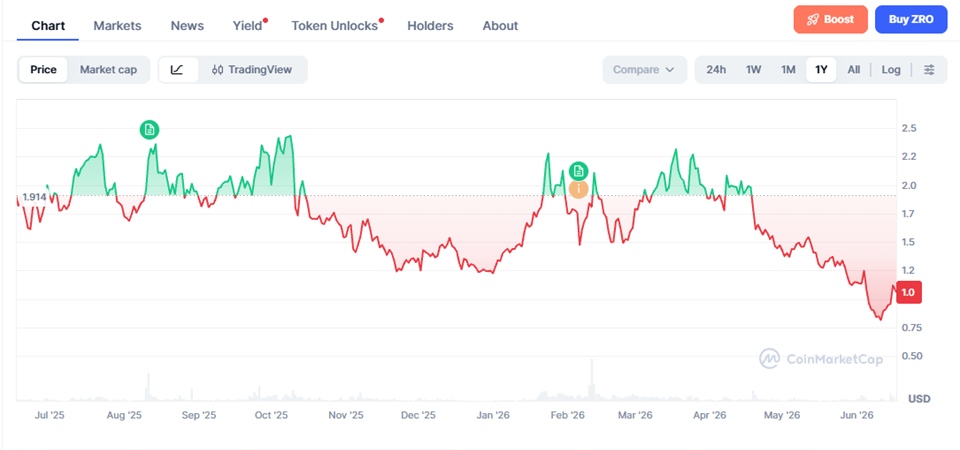
Image Source: https://coinmarketcap.com/currencies/layerzero/
Short-Term LayerZero Forecast
Short-term token movements rely heavily on market noise. This means that hourly, daily, or weekly price points are largely driven by temporary sentiment and macro liquidity shifts.
This is where support and resistance levels come in handy as indicators for ZRO price momentum. If the price successfully breaks above historical resistance levels, it can trigger a bullish expansion phase.
In contrast, if the price falls below key support levels, it usually confirms a bearish trend and indicates a potential further decline in value. LayerZero also experiences sharp and significant daily price swings, reinforcing that the token remains highly volatile.
LayerZero Prediction Table (2026–2040)
The following crypto price forecasts are scenario estimates and may change at any time.
| Year | Pessimistic Case | Realistic Case | Optimistic Case |
|---|---|---|---|
| 2026 | ~$0.75 | ~$1.20 | ~$2.45 |
| 2027 | ~$0.90 | ~$1.85 | ~$3.10 |
| 2028 | ~$1.10 | ~$2.40 | ~$4.50 |
| 2029 | ~$1.35 | ~$3.10 | ~$5.80 |
| 2030 | ~$1.60 | ~$3.90 | ~$7.20 |
| 2035 | ~$3.10 | ~$7.50 | ~$14.00 |
| 2040 | ~$5.00 | ~$12.00 | ~$22.00 |
Yearly Breakdowns
Trading tokens like ZRO requires secure crypto exchanges with robust order books and competitive fee structures. Our exchange reviews grade security architectures, global compliance metrics, and asset liquidity to ensure your trading remains secure.
What Drives LayerZero Price? (Fundamentals)
1. Regulation & Legal News
Regulatory developments affect the ZRO price directly. Positive regulatory compliance boosts general market confidence, enhances liquidity via exchange listings, and attracts institutional participation. Conversely, systemic regulatory crackdowns can lower investor sentiment and spark broad asset devaluations.
2. Institutional Adoption & Payments Narrative
Sustained network transaction velocity is vital for driving native token demand. Enterprise partnerships, real-world asset deployment, and institutional payment-rail use cases provide long-term structural support for the protocol’s valuation.
3. Supply & Token Release Dynamics
Token supply mechanics—including scheduled unlocks, foundation distributions, and vesting schedules—create structural market supply pressure. When circulating token inflation outpaces market demand, price depreciation occurs, making ecosystem utility crucial to balance the incoming supply.
4. Market Dynamics
Broader crypto market trends and global macroeconomic conditions heavily dictate ZRO price action. Macro sentiment, tracking indicators like interest rates, inflation figures, and overall risk appetite among institutional asset managers, dictates capital flows.
How High Can LayerZero Go? Price Targets Explained
Conclusion
The long-term trajectory of LayerZero relies on organic transaction volumes, institutional integrations, macro-regulatory frameworks, and token unlock dilution.
While structural long-term targets look optimistic, realistic projections place ZRO’s value between $5.00 and $22.00 by 2040, depending heavily on its capability to capture global real-world asset tokenization rails.
Staying updated via our comprehensive crypto guides ensures you stay informed on moving market metrics, asset utility alterations, and shifting regulatory realities. By mastering the fundamental variables driving these cross-chain systems, investors can approach volatile ecosystems with better clarity.
Explore Other Cryptocurrency Price Predictions



Frequently Asked Questions
What is the LayerZero price prediction for 2026?
The adjusted LayerZero price prediction for 2026 projects a price range between $0.75 in bearish cycles and $2.45 in optimistic market expansions.
What is the LayerZero price prediction for 2030?
By 2030, models project ZRO trading between $1.60 and $7.20, depending heavily on structural cross-chain protocol adoption.
What is the LayerZero price prediction for 2040?
The adjusted LayerZero forecast for 2040 projects an ultimate long-term range of $5.00 to $22.00, assuming widespread network utility.
How much will LayerZero be worth in 5 years?
In five years, predictions indicate ZRO could trade between a pessimistic floor of $1.90 and an optimistic target of $8.50.
Can LayerZero reach $1 / $5 / $10 / $100 / $1,000?
LayerZero trades near or above $1 and has historically cleared $5, making both levels entirely functional baseline targets. While a move up to $10 is achievable across multi-year cycles, targets of $100 and $1,000 are structurally constrained by the multi-billion and trillion-dollar market caps required against the asset’s supply schedule.
Is LayerZero a good investment?
ZRO may appeal to investors seeking exposure to high-risk, high-reward cross-chain infrastructure. However, you must carefully evaluate its underlying token release schedules, technological dependencies, and native volatility before committing capital.
Can I use LayerZero in crypto casinos?
LayerZero functions as an underlying cross-chain communication protocol rather than a transactional currency; while casino web3 applications may use its backend technology to move liquidity between chains, ZRO itself is rarely accepted as a direct consumer deposit asset.

 shahnakul23@gmail.com