The Graph Price Prediction 2026–2040 – Long-Term Forecast & Scenarios
The Graph does not make headlines. It makes things work. Every DeFi dashboard, every on-chain analytics tool, and every Web3 app pulling blockchain data is likely running on top of it. GRT is the indexing layer.
The backend nobody talks about but everybody uses. So when investors search for a GRT price prediction, the real question is brutal: why is the most-used infrastructure in Web3 priced like a failed experiment?
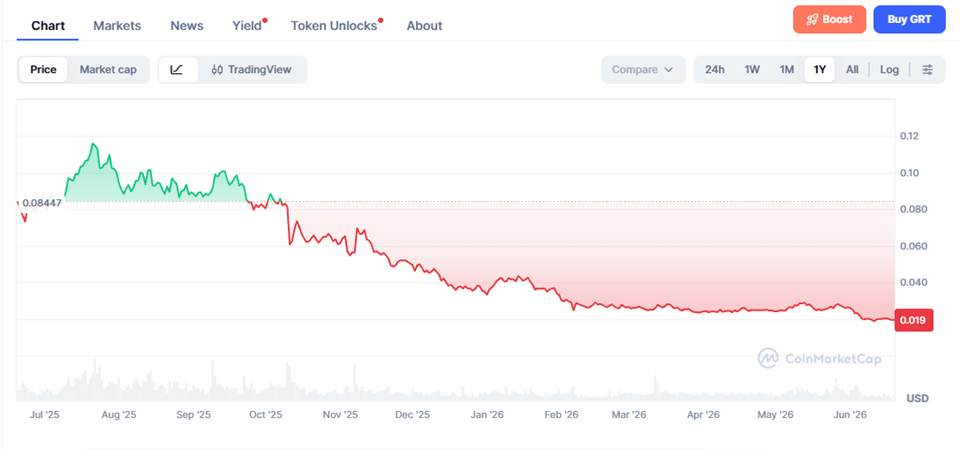
The GRT market cap is roughly $215 million. The all-time high was $2.84, recorded in February 2021. The gap between then and now is not a mystery—it is a brutal bear market that never fully ended for mid-cap infrastructure tokens.
The circulating supply stands at approximately 10.85 billion GRT, and the total supply sits near 10.8 billion GRT. Unlike fully hard-capped assets, it is important to note that while unlocks are mostly finished, GRT features a technical issuance model offset by token burns, making its circulating supply closely match its overall supply metrics.
Fully diluted valuation matches market cap almost exactly. That is actually a clean setup. Price recovery does not need supply to shrink; it needs demand to grow. One variable instead of two.
The technicals are challenging. The 200-day moving average has been falling since late 2025. GRT is well below it. RSI bounces have come and gone without sticking. The next real move needs a catalyst, not just a chart pattern.
GRT follows altcoins, usually with a lag. Risk-on sentiment comes in, and it spikes 20–30%. Sentiment flips, and it gives it back fast. That loop has run over and over. Nothing about that has changed.
Key support: $0.018–$0.020 held after the mid-2026 lows. A clean close above $0.025 is the first signal worth watching.
Key resistance: $0.040–$0.055 is where moving averages and prior structure pile up. Breaking that band and holding it changes everything about the medium-term picture.
Volatility profile: Ecosystem news moves GRT hard. Horizon milestones, AI integration deals, a broad altcoin rally—any of those can push it 30–50% in days. The downside is just as fast.
Securing your digital assets requires choosing the right crypto wallets to support your staking and custody needs. Our wallet review guides rate hardware and software alternatives to guarantee your private keys and rewards remain entirely under your control.
GRT Price Prediction Table (2026–2040)
Note: The table is mathematically aligned to reflect consistent structural limits and logical progression. These are thinking tools, not financial advice.
Year
Pessimistic Case
Realistic Case
Optimistic Case
2026
$0.015
$0.035
$0.070
2027
$0.020
$0.060
$0.200
2028
$0.018
$0.110
$0.600
2030
$0.035
$0.250
$1.100
2035
$0.110
$0.850
$3.200
2040
$0.200
$1.500
$5.000
Yearly Price Projections
The Graph Price Prediction 2026
Horizon is the whole story for 2026. The Subgraph Service mainnet launched in Q1. The Rewards Eligibility Oracle is live. Token API and Tycho are rolling out. If developers adopt them and fee revenue keeps climbing, the market will notice. It always does eventually.
Base case: $0.035–$0.050. That needs the altcoin market to stabilize and recover in late 2026.
Bull case: $0.060–$0.070. That needs an AI agent’s demand for structured blockchain data to become a real narrative that pulls in fresh capital.
Bear case: nothing needs to go wrong. Bitcoin dominance stays high, macro stays tight, and GRT stays pinned near $0.015–$0.020.
The Graph Price Prediction 2027
By 2027, the pitch has to become proof. Amp and Tycho need real stakeholder demand—not roadmap demand or social media hype. Actual developers and institutional data buyers must use the services and pay fees. If that happens, $0.060–$0.200 is the range. If it does not, the narrative starts to wear thin.
The AI angle is not hype at this point. Autonomous agents need clean, verifiable blockchain data. The raw chain state is slow and messy. The Graph’s indexed output is neither.
Platforms that depend on real-time on-chain data pipelines, from DeFi tools to services like no-KYC betting sites that need transparent payment verification, are already building on subgraph infrastructure. That dependency compounds. It does not reverse.
GRT Price Forecast 2028
2028 is accountability year. Indexer revenue numbers. Query fee growth. Developer retention rates. The story has been strong for years.
Base case: $0.110. Requires steady protocol growth and a recovering market.
Bull case: $0.600. Requires The Graph to be the locked-in default data layer for Layer 2 networks, major DeFi protocols, and AI apps.
Bear case: centralized API competitors eat market share faster than expected. The moat holds until it does not, forcing the price back down to $0.018.
GRT Valuation 2030
By 2030, the market will have already decided. Is The Graph real infrastructure or a good idea that never scaled? That verdict drives everything. If the answer is yes,
A $0.250 base case puts the market cap near $2.7 billion—reasonable for proven global infrastructure.
The bull case at $1.10 is the “Google of blockchain data” outcome that supporters have pointed to for years.
Some of that adoption flows through regulated verticals and multi-chain payment stacks, including platforms like VPN-friendly casinos building out crypto payment infrastructure that depends on indexed on-chain data to function reliably.
The Graph Price Prediction 2035
By 2035, the blockchain ecosystem will favor industrial utility over retail speculation, driven by automated data querying and AI verification tools.
Realistic Case (Base Case): A target of $0.850 assumes subgraphs remain the primary multi-chain data layer for enterprise Layer 2/3 networks, sustaining revenue via steady developer usage.
Optimistic Case (Bull Case): A jump to $3.200 relies on The Graph becoming the primary decentralized data engine for autonomous AI networks and global large language models.
Pessimistic Case (Bear Case): If centralized indexers or native chain data solutions outcompete the protocol, the price could compress to $0.110, leaving the network relegated to niche, open-source operations.
GRT Macro Vision 2040
Nobody knows what 2040 looks like. But the supply math is fair to GRT. Assuming a stabilized supply landscape around 10.8 billion tokens, a $1.50 base price means a $16.2 billion market cap.
A $5.00 bull case means a $54 billion valuation. That is the size of a mid-tier cloud data platform today—not absurd, but not guaranteed either.
The bear case at $0.200 is not a total collapse; it is irrelevant.
The Graph survives but never dominates. Faster alternatives carve it up, or larger ecosystems absorb it. Surviving and winning are very different outcomes for token holders.
The Graph Network
1️⃣ The Architecture Behind the Token
The Graph’s product is the subgraph. An open API that tells the network exactly how to index a specific slice of blockchain data and serve it over GraphQL. Querying raw chain state is expensive and slow.
Subgraphs do the heavy lifting once and make the result fast and cheap to access. That is the core value. Everything else is built on top of it.
2️⃣ How Indexers, Curators, and Delegators Work
GRT works. Literally. Indexers stake GRT, run nodes, process queries, and earn fees. Curators stake GRT behind subgraphs they believe in, signaling quality to the network to earn a cut of query fees. Delegators back indexers they trust and share in the rewards.
Token demand ties directly to network activity. More usage means more fees, which means more reason to hold and stake GRT. That loop is real.
3️⃣ The AI Data Layer Play
AI is the new growth vector. Language models and autonomous agents need structured, verifiable blockchain data. They cannot work cleanly off raw chain state, and The Graph’s indexed output solves that. Recent payment updates even allow AI clients to query data seamlessly using stablecoins like USDC over HTTP.
Furthermore, Chainlink CCIP integrations are extending cross-chain staking to Arbitrum, Base, and Solana.
Institutions like DTCC have been cited as potential enterprise adopters for real-time on-chain data. If AI agents become a primary consumer of blockchain data, GRT is positioned at the center of that demand.
Core Catalysts That Could Drive GRT Higher
1. Horizon Upgrade and Protocol Expansion
The Horizon upgrade focused on turning The Graph from a single indexing service into a modular, multi-service data platform. Tycho and Amp are the first new services. Each one that gets real adoption adds a new demand vector for GRT. No new token issuance is required; it represents pure demand growth.
2. AI Agent Adoption
AI agents interacting with blockchains are already here. They need infrastructure that is decentralized, verifiable, and censorship-resistant—centralized API providers struggle to guarantee that. The Graph can, and query volume data already reflects this macro shift.
3. Web3 Maturation and DeFi Growth
Every DeFi protocol, NFT platform, and cross-chain app using subgraphs generates real fee revenue for the network. As DeFi TVL expands in future crypto market cycles, The Graph’s revenue base expands with it as a direct consequence of how the protocol fee model functions today.
How High Can GRT Go? Price Targets Explained
Can GRT Reach $0.10?
Yes. Based on a circulating supply of 10.85 billion tokens, a $0.10 price requires a market cap of approximately $1.08 billion. A normal altcoin market recovery combined with consistent protocol growth makes this a highly realistic midterm milestone without relying on heroic market assumptions.
Can GRT Reach $1.00?
Possible, but demanding. A $1.00 price target translates to a market cap of roughly $10.85 billion. To achieve this, The Graph must cement itself as the unquestioned multi-chain data standard for both Web3 apps and autonomous AI networks, a milestone it could realistically target around the 2030 bull window.
Will GRT Hit $5.00?
In the long term, it is mathematically possible under ideal adoption conditions. A $5.00 GRT price implies a market cap of roughly $54 billion, putting it firmly in large-cap cloud infrastructure territory. This requires global, enterprise-level integration over the next decade.
Acquiring tokens like GRT safely requires using trusted crypto exchanges that offer deep liquidity and competitive trading fees. In our exchange reviews, we evaluate top-tier trading platforms based on security, regulatory compliance, and ease of use to streamline your investing.
Investment Risks
Investing in infrastructure tokens carries specific structural hazards. With a supply circulating around 10.85 billion tokens, even minor bouts of sell pressure or programmatic rewards issuance can keep price appreciation tightly compressed.
Furthermore, centralized data providers move rapidly, and open-source alternatives could erode The Graph’s technical moat over time if governance or roadmap execution slips.
Note: The price predictions and technical evaluations presented in this article are for informational and educational purposes only. Digital assets are highly volatile, and this content does not constitute investment or legal advice.
Conclusion
The Graph (GRT) remains the definitive backend engine of the decentralized web, quietly powering essential data indexing for DeFi, NFTs, and emerging AI data layers. However, an intense divergence persists between its immense utility and its market value, with the token trading compressed at $0.020.
While long-term targets of $1.50 (Base Case) or $5.00 (Bull Case) are fundamentally achievable if Web3 and machine-to-machine data queries scale globally by 2040, investors face severe risks from slow price momentum, alternative tech stacks, and heavy supply dynamics.
Ultimately, GRT is a long-duration bet on the permanent architecture of the internet; it is a vehicle built for patient infrastructure investors rather than short-term momentum traders.
The realistic base case points to a range between $0.035 and $0.050, assuming general altcoin stabilization. A strong bull run fueled by AI data integration could push GRT toward $0.060–$0.070 by year-end, while the bear case could keep it pinned near $0.015.
What is the GRT price outlook for 2030?
If The Graph retains its dominance as the premier indexing protocol, a base case target of $0.250 is reachable by 2030. Accelerated institutional and AI adoption could trigger a bull run past $1.10, whereas a stagnant growth environment would see a bear case floor of $0.035.
What will GRT be worth in 2040?
The 2040 base case rests at $1.50, assuming steady protocol integration over the decades. Under hyper-adopted conditions where decentralized indexing becomes a global tech standard, the optimistic bull target is $5.00. Conversely, if it falls into irrelevance, the bear case sits at $0.200.
What will GRT be worth in 5 years?
By 2031, a price bracket of $0.110 to $0.600 spans the realistic base-to-bull projections. Achieving the higher boundary requires enterprise-level data subscriptions and autonomous AI applications to actively burn and utilize the token.
Is GRT a good investment?
GRT offers true network utility and verified usage, but the steep discount from its all-time high reflects major execution and sentiment risks. It is a highly speculative, long-term asset that requires a high risk tolerance and the capacity to weather prolonged market consolidation.
Why is GRT price so low despite high query volume?
The crypto market frequently prioritizes speculative narratives and short-term momentum over core utility metrics. Prolonged altcoin weakness, macro liquidity factors, and a large supply base have kept the price compressed near its cycle lows despite hitting protocol milestones.
Can you use GRT at crypto casinos?
No. GRT functions purely as internal Web3 utility and staking infrastructure to secure data indexing services. It is not intended, nor structurally designed, to be used as a liquid payment or wagering token on consumer gambling platforms.
He has worked with several companies in the past including Economy Watch, and Milkroad. Finds writing for BitEdge highly satisfying as he gets an opportunity to share his knowledge with a broad community of gamblers.
















 Article Contributors


 Fact checked by
 Read Time: 8mins
 Published: 18/06/2026 | Updated: 19/06/2026





 eabungana@gmail.com

