Synthetix helped invent on-chain synthetic assets, then spent years losing traders to faster perpetual exchanges. Its technology became important infrastructure, but that importance did not translate into a durable SNX bid. Fragmented deployments, an unstable sUSD transition and a complicated staking model left the market asking whether the protocol was pioneering or simply early.
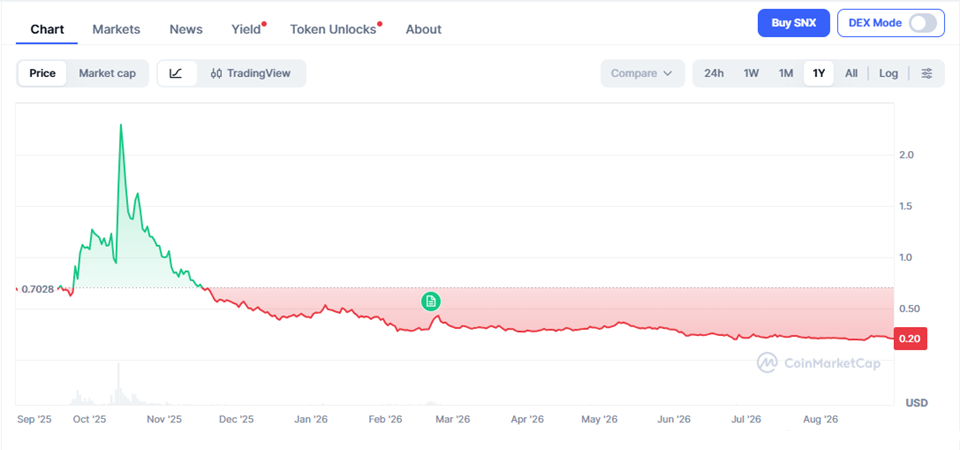
The 2026 project is narrower and more aggressive. SNX trades around $0.21 with a market capitalization near $120 million. Synthetix has returned its focus to Ethereum mainnet, launched a central-limit-order-book perpetual venue, acquired the Kwenta and TLX frontends, and directed trading revenue toward sUSD and SNX buybacks. The Synthetix price prediction now turns on a measurable question: can a rebuilt exchange produce enough volume and fees to repair the token economy?
SNX is priced like a distressed DeFi asset rather than an established derivatives protocol. It sits more than 99% below its 2021 peak near $28.50, and the chart reflects years of inflation, strategic resets, and lost market share. The 2026 roadmap argues that the supply overhang has ended, with team and venture unlocks no longer hanging over the market.
That creates a cleaner experiment. More than half of circulating SNX was reportedly staked entering 2026, while trading revenues initially split between SNX and sUSD purchases. If the sUSD peg becomes stable, the roadmap calls for buybacks to focus solely on SNX. The mechanism is attractive, but the input is what matters: without competitive exchange volume, there is little revenue to recycle.
SNX trades as a high-beta DeFi recovery token. Mainnet product releases and volume data can reprice it quickly, while any sUSD stress revives the market’s oldest concern.
Key support: $0.18–$0.20 is the immediate floor around the current range. Losing $0.17 would expose the market to a fresh price-discovery leg.
Key resistance: $0.25–$0.30 is the first serious supply zone. A weekly close above $0.40 would suggest revenue expectations are changing, not merely sentiment.
Volatility profile: Very high. SNX responds to perps volume, buyback execution, the sUSD peg, staking participation, and Ethereum DeFi flows.
SNX Price Prediction Table (2026–2040)
These estimates use bear, base, and bull cases built around exchange volume, protocol revenue, buybacks, collateral health, and future token supply. They are not financial advice.
Year
Pessimistic Case (Bear)
Realistic Case (Base)
Optimistic Case (Bull)
2026
$0.10
$0.35
$0.75
2027
$0.08
$0.60
$1.50
2028
$0.07
$0.90
$2.50
2030
$0.10
$1.60
$5.00
2040
$0.20
$4.00
$12.00
Yearly Breakdowns
Synthetix (SNX) Price Prediction 2026
The rest of 2026 is about opening the venue, broadening markets, and showing that sub-100-millisecond execution can coexist with Ethereum settlement. A $0.35 base case assumes trading volume grows from private-beta levels, sUSD improves toward its peg, and buybacks remain visible.
The bull case at $0.75 requires a genuine product breakout, not just a better interface. Synthetix must win active traders from established centralized and decentralized venues. The $0.10 bear case reflects weak volume, renewed collateral stress, or a roadmap that ships features without liquidity.
Synthetix (SNX) Price Prediction 2027
By 2027, revenue should be easy to judge. A healthy derivatives venue produces repeat volume across market conditions; a promotional venue fades when incentives stop. A $0.60 base assumes Synthetix earns a durable share of Ethereum perps and converts a meaningful portion of fees into buy pressure.
Perpetual markets are structurally connected to price differences and hedging. Users who understand arbitrage crypto betting will recognize the same core discipline: execution, price comparison and controlled exposure matter more than a directional hunch. For SNX, the value accrues only if traders choose its liquidity repeatedly.
SNX Price Forecast 2028
The 2028 base of $0.90 implies a mid-hundreds-of-millions valuation at today’s reported supply, reasonable for a profitable DeFi derivatives venue. The $2.50 bull case demands deeper liquidity, real-world-asset markets, and composability that lets other Ethereum applications route through Synthetix.
The $0.07 bear case is protocol survival without token recovery. Synthetix could remain functional while order flow concentrates elsewhere and revenue is too small to offset selling. A working exchange is not automatically a valuable token.
SNX Valuation 2030
A $1.60 base in 2030 would value SNX near $900 million if supply remained around current CoinGecko estimates. That outcome requires several years of fee generation and a credible link between exchange use and token demand. The $5 bull case approaches a multi-billion-dollar valuation, achievable only if Synthetix becomes a major neutral derivatives layer.
Distribution helps. SNX remains available through many crypto exchanges, but decentralized-product success depends on on-chain liquidity, not listing count. A liquid token with thin protocol revenue is still a speculative asset.
SNX Macro Vision 2040
By 2040, decentralized derivatives could be ordinary financial infrastructure. A $4 base assumes Synthetix survives multiple cycles, maintains a strong Ethereum position and uses revenue to support a constrained token economy. The $12 bull case requires global-scale on-chain derivatives and sustained value capture for SNX.
The $0.20 bear case is a sobering alternative: the protocol remains recognizable, but governance fragments, traders prefer other venues, and buybacks never become large enough to change the supply-demand balance.
Visit our crypto guides to better understand digital assets, market trends, and tokenomics.
What Makes SNX Different From Other DeFi Tokens
Synthetix is not just a governance wrapper around a frontend. It coordinates collateral, liquidity, market creation, and settlement for synthetic and perpetual markets, while its long operating history has exposed nearly every failure mode in DeFi derivatives.
Ethereum Mainnet CLOB
The rebuilt venue combines an off-chain matching experience with on-chain custody and settlement. Synthetix says the order book can deliver centralized-exchange-like latency while keeping traders self-custodial. That tradeoff is the heart of the 2026 strategy.
SNX, sUSD and the 420 Pool
Delegated staking and the 420 Pool were designed to simplify collateral management and improve capital efficiency. Trading revenue funds buybacks of SNX and sUSD, linking product activity to balance-sheet repair. It is a more direct value loop than inflationary rewards, but it remains dependent on revenue.
Core Catalysts That Could Drive SNX Higher
1️⃣ Perpetual Volume Growth:
Market count is useful; retained trading volume is decisive. Competitive spreads, reliable withdrawals, and deeper liquidity would show that the mainnet CLOB can take share instead of renting attention.
2️⃣ sUSD Peg Restoration:
A stable sUSD removes a persistent credibility discount and allows buybacks to shift more fully toward SNX. A prolonged discount would signal that the transition still carries hidden costs.
3️⃣ Ethereum Composability:
If lending platforms, vaults, and aggregators integrate Synthetix liquidity, order flow can arrive from applications rather than only the house frontend. Traders will still need secure online crypto wallets because the product’s appeal is self-custodial access.
How High Can SNX Go? Price Targets Explained
Can SNX Reach $1?
Yes. At roughly 580 million circulating tokens, $1 implies a market capitalization near $580 million. Strong volume growth and consistent buybacks could support that in a favorable DeFi cycle.
Will SNX Hit $5?
That target implies close to $3 billion at the same supply. It requires Synthetix to become a leading derivatives venue with hundreds of millions in annualized economic activity. Possible by 2030, but demanding.
Can SNX Return to $20?
$20 would imply more than $11 billion before any supply change. The old price existed under different supply, liquidity and cycle conditions. A return is not impossible, but it requires global-scale adoption and should not be treated as a simple percentage recovery.
Investment Risks and Final Notes
Execution risk is unusually clear. Synthetix must operate a fast exchange, manage collateral, protect users, maintain the sUSD peg, and attract professional liquidity simultaneously. A failure in any one area can damage the others. Smart-contract, oracle, and liquidation risks remain permanent in leveraged markets.
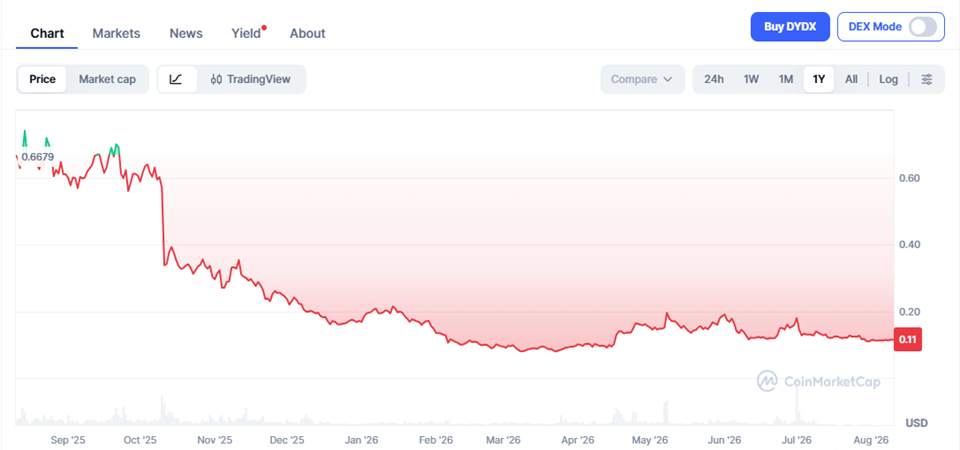
Competition is relentless. Hyperliquid, dYdX, and centralized venues already own trader habits and liquidity. Synthetix’s Ethereum neutrality is an advantage only if execution remains competitive after gas, spreads, and funding.
SNX may interest users of crypto casinos because both sectors attract high-risk crypto liquidity, but audience overlap is not token value. Treat SNX as a speculative bet on measurable fee growth.
The base case is $0.35, with a $0.10 bear case and $0.75 bull case. Perps volume, sUSD stability and buyback data will determine which path is credible.
What is the SNX price outlook for 2030?
A base near $1.60 assumes a durable Ethereum derivatives business. The $5 bull case requires Synthetix to become a major liquidity venue rather than a niche protocol.
Why is SNX so far below its ATH?
The 2021 high reflected DeFi mania and a smaller supply base. Inflation, product fragmentation, sUSD stress and stronger derivatives competitors compressed both demand and valuation.
How do SNX buybacks work?
The 2026 roadmap initially directs trading revenue equally toward SNX and sUSD purchases. Once sUSD is comfortably restored, the stated plan is to direct buybacks solely toward SNX.
Is Synthetix a good investment?
Synthetix has credible technology and a clearer value loop, but it is rebuilding from a weak market position. It suits investors willing to track protocol revenue and accept high smart-contract and competition risk.
Can you use SNX at crypto casinos?
SNX is not a common direct casino deposit asset. Users typically exchange it into a supported coin or stablecoin first. Availability depends on the platform and jurisdiction.
He has worked with several companies in the past including Economy Watch, and Milkroad. Finds writing for BitEdge highly satisfying as he gets an opportunity to share his knowledge with a broad community of gamblers.
















 Article Contributors


 Fact checked by
 Read Time: 6mins
 Published: 28/08/2026 | Updated: 31/08/2026




 eabungana@gmail.com

