














 The Quantum Countdown: Why Bitcoin’s Proposed Fix Could Erase Satoshi’s Fortune
 Article Contributors


 Fact checked by
 Read Time: 2mins
 Published: 16/04/2026 | Updated: 17/04/2026


The 8 Million Bitcoin Vulnerability
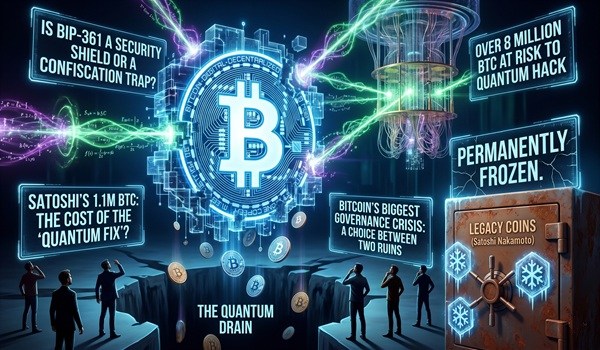
Recent blockchain audits reveal that roughly 8 million BTC (over 34% of the current Bitcoin supply) is stored in addresses with exposed public keys. These holdings are prime targets for future quantum computers, which could theoretically crack the underlying signatures to drain funds.
To mitigate this, BIP-361 suggests a freeze-and-migrate strategy. Under this plan, vulnerable addresses would be locked, requiring owners to move their assets to new, quantum-resistant formats.
However, this transition isn’t just a technical update; it represents a fundamental shift in how Bitcoin handles property rights on-chain.
The Locked Legacy: Satoshi’s Unsaveable Wealth
The question is, what would be the fate of Satoshi? The proposal relies on a recovery system using zero-knowledge proofs tied to modern seed phrases. But there is a major catch: this standard didn’t exist during Bitcoin’s first few years.
Before the industry adopted the BIP-39 seed phrase protocol in 2013, approximately 1.7 million BTC were stored using legacy methods, including the estimated 1.1 million BTC attributed to Satoshi Nakamoto.
Because these wallets lack the necessary cryptographic roots required by the new recovery system, they would be effectively trapped. Hoskinson argues that for these specific coins, there is no mathematical way to prove ownership under the new rules, meaning the creator’s fortune and that of many early adopters would be permanently frozen.
A Hard Fork in Soft Fork Clothing
In addition to the lost coins, there is a philosophical war going on about what the update really means.
- As a soft fork, or a change that works with older versions, developers have shown BIP-361.
- Critics, on the other hand, say this is not the right name. The update would act like a hard fork because it would make existing signature schemes (still being used by participants) invalid.
In the Bitcoin world, a hard fork is often viewed as a nuclear option because it forces every user to upgrade or risk being split from the main network.
Implementing such a change would shatter the long-held narrative that BTC is an immutable, unchangeable protocol.
Governance at the Crossroads
Unlike platforms like Cardano or Polkadot, which use on-chain voting to resolve technical disputes, Bitcoin relies on social consensus.
If no action is taken, the network faces a grim choice by the 2030s: allow quantum attackers to potentially steal 10% of the total supply, or force through a controversial upgrade that could alienate its most foundational holders.
The need to make a decision will only grow stronger as big businesses and even governments start to see Bitcoin as a strategic reserve.
Bitcoin’s new quantum defense proposal, BIP-361, could permanently freeze 1.7 million BTC, including Satoshi Nakamoto’s original coins. Discover why critics call it a hard fork in disguise.


 eabungana@gmail.com

