














 GAO Slams FDIC Over Crypto Oversight Gaps
 Article Contributors


 Fact checked by
 Read Time: 2mins
 Published: 17/06/2026 | Updated: 19/06/2026


Growing Authority Demands Closer Alignment
The watchdog’s concerns are magnified by the FDIC’s expanding role under recent legislative developments. Following the introduction of the GENIUS Act, the agency has taken on broader responsibilities regarding national stablecoin issuers.
This includes evaluating reserve compositions, capital requirements, and liquidity strategies for tokenized instruments operating through commercial bank accounts.
Under current proposals, the cash reserves backing these stablecoins may qualify for federal deposit insurance if held within compliant banking institutions. However, the end-users holding the individual digital tokens do not receive individual federal protection.
This distinction places the FDIC at the center of an evolving debate over how standard banking safeguards should apply to tokenized payments, increasing the urgency for integrated oversight with other regulatory bodies.
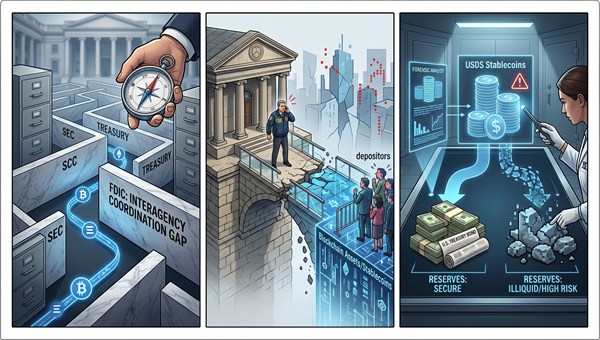
Addressing Cracks in Traditional Bank Supervision
The call for structural change arrives amid lingering questions over the federal response to the banking turbulence of 2023. Landmark collapses of institutions heavily exposed to crypto-asset and technology firms—specifically Silicon Valley Bank, Signature Bank, and Silvergate Bank—have kept regulatory response times under intense scrutiny.
The watchdog suggested that the FDIC could have moved with greater urgency when these entities began displaying critical liquidity and risk-management deficiencies. To address these vulnerabilities, the report reiterated a call for the FDIC to implement a mandatory rotation policy for its designated bank case managers.
Currently, the agency does not enforce a structured rotation schedule, a flaw the federal watchdog notes could compromise supervisory independence and delay decisive, evidence-based intervention when a bank’s financial health begins to deteriorate.
A Shifting Horizon for Digital Asset Policy
This warning coincides with broader, ongoing legislative efforts on Capitol Hill. Lawmakers recently advanced the CLARITY Act through the Senate Banking Committee, a bill designed to formally divide digital asset jurisdiction between standard market watchdogs and establish a dedicated legal framework for dollar-pegged stablecoins.
Concurrently, the FDIC has gradually softened its initial stance on digital asset operations. Policy shifts introduced by agency leadership now allow supervised institutions to participate in certain blockchain activities without seeking prior administrative approval, provided they demonstrate comprehensive risk management.
However, as Congress wrestles with rules regarding customer identification, bank charter protocols, and collateral transparency, the federal accountability office insists that informal agency shifts are not enough.
The watchdog maintains that a permanent, collaborative framework among federal regulators is essential to stop emerging crypto liabilities from bleeding into the broader financial system.


 eabungana@gmail.com

