














 Visa and WeFi Launch On-Chain Banking
 Article Contributors


 Fact checked by
 Read Time: 2mins
 Published: 29/04/2026 | Updated: 30/04/2026


Bridging the Gap with On-Chain Banking
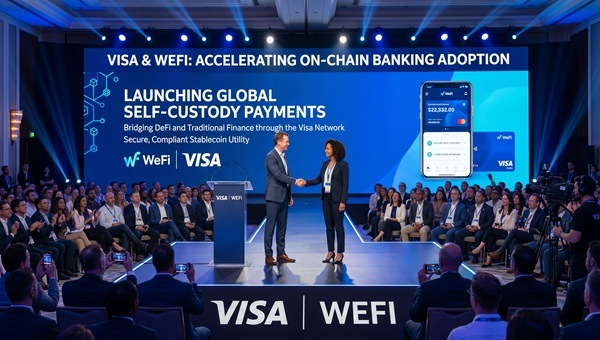
The partnership centers on an “on-chain banking” model that seeks to modernize how individuals interact with their digital wealth. Unlike many existing crypto-linked cards that require users to surrender their assets to a central custodian, the WeFi infrastructure emphasizes self-custody.
By separating the control of assets from the execution of payments, the platform allows users to retain their private keys while remaining connected to regulated payment rails. This hybrid approach effectively transforms a digital wallet into a functional checking account.
Users can maintain a unified balance and spend stablecoins at any merchant within Visa’s network of millions, with conversions to local currency happening instantly in the background. This ensures that the merchant receives familiar fiat currency while the user enjoys the benefits of blockchain-based asset management.
Global Rollout and Personal IBANs
One of the most distinctive features of this initiative is the provision of personal International Bank Account Numbers (IBANs). These allow users to send and receive funds across borders with the same ease as traditional banking, but with the added speed and transparency inherent to blockchain ledgers.
The service is set for a phased deployment, targeting key markets across Europe, Asia, and Latin America. By focusing on these regions, Visa and WeFi aim to provide sophisticated financial tools to both tech-savvy investors and underserved populations who may lack access to traditional banking infrastructure.
The expansion into further markets will be contingent on navigating local regulatory requirements and securing necessary issuing partnerships.
A Focus on Stability and Compliance
At its inception, the collaboration will prioritize regulated stablecoins—digital assets pegged to the value of fiat currencies like the U.S. Dollar. These assets are seen as the ideal bridge for daily commerce due to their price stability.
However, the partners have indicated that other digital assets may be integrated into the ecosystem as the technology matures and regulatory frameworks become more defined.
The initiative also addresses long-standing concerns regarding security and oversight. By utilizing smart contracts and automated monitoring, the platform aims to uphold strict anti-money laundering (AML) standards and sanctions screening in real-time.
This ensures that while users enjoy autonomy over their funds, the ecosystem remains compliant with global financial regulations.
The Shift Toward Financial Maturity
This partnership signals a broader movement within the financial sector, moving away from experimental crypto products and toward integrated, consumer-ready solutions.
For Visa, this is an extension of its ongoing efforts to modernize its payment “plumbing” using stablecoins.
For the crypto industry, it represents a validation of decentralized models, proving they can operate reliably at scale within the world’s most established financial networks.


 eabungana@gmail.com

