















 Article Contributors


 Fact checked by
 Read Time: 7mins
 Published: 24/04/2024 | Updated: 16/11/2026


The basics of basic Blackjack strategy
To play the basic strategy, you should make the move that gives you the highest probability of winning based on your cards and the dealer’s card. The best players memorize the move that should be made in every situation, or you can print out a chart or use a blackjack hand calculator.
🔹 Following the basic strategy, you can reduce the house edge to around 1.5%, depending on the table rules.
However, there are other strategies, such as card counting, that you can play at the same time to cut this edge down to 0.5% and help you increase your expected value (EV). This is for 8 decks, which is the standard for online casinos.
🔹 Some casinos offer a 1-deck game, where playing the best strategies can cut the house edge down to 0.014%.
However, when you add card counting, following a basic strategy can be detrimental to your EV. These moves are called deviations and are the moments when you should not follow basic strategy.
This is a basic strategy chart that you can use when playing BJ.

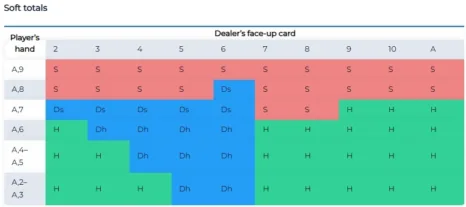
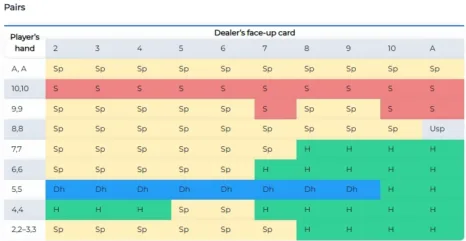
Key:
- S = Stand
- H = Hit
- Dh = Double (if not allowed, then hit)
- Ds = Double (if not allowed, then stand)
- SP = Split
- Uh = Surrender (if not allowed, then hit)
- Us = Surrender (if not allowed, then stand)
- Usp = Surrender (if not allowed, then split)
A live blackjack table from Evolution Gaming, called Power Blackjack, allows you to triple and quadruple down. You should make these moves in place of a double down if available.
Counting cards makes all the difference
If you’re serious about beating the house and walking away with a positive EV, you need to use a counting system with your basic strategy.
When you have the true count of the shoe, you’ll be able to see that the composition of the shoe has changed, and suddenly basic strategy is no longer the most valuable way to play a certain hand. As a result, learning how and when to play these deviations will increase your EV.
🔹 The hi-lo card counting system is one of the most popular thanks to its simplicity. In this card-counting strategy, each card is assigned a value. You then use these values to increase or decrease the running count.
🔹 The running count gives you a better indication of whether there are more high or low cards in the deck, allowing you to make a smarter decision on your next move.
Card values are as follows:
| Card rank: 2, 3, 4, 5, 6 | Count value +1 |
| Card rank: 7, 8, 9 | Count value 0 |
| Card rank: 10, J, Q, K, A | Count value -1 |
At the end of every deck in the shoe, you divide the running count by the number of decks remaining. This doesn’t have to be exact and can be a rough figure, so don’t worry if you’re terrible at math.
🔹For example, if the running count is +6 and there are 4 decks left, you do 6÷4=1.5. Round that up to 2, and this is known as the true count.
The higher the true count, the more you should bet.
Let’s use an example of when this count is useful.
Every blackjack training guide says that insurance is a sucker’s bet, and that’s true, for the most part. The chance of the dealer having a BJ with an Ace up is 31% because 4 out of every 13 cards will be a 10-value card. At a 31% chance, taking insurance is a negative EV bet.
However, if you’re keeping count of the deck composition and the count becomes high, meaning more high cards remain in the deck than small cards, there’s a greater chance of the dealer having a 10-value card and therefore a BJ.
🔹When the count is +4 or higher, it’s better to take insurance.
Learn the Blackjack Deviations
If you’re using the hi-lo card counting system, you should calculate the true count at the end of every round. This gives you a more accurate count on the shoe, allowing you to make better EV plays.
There are hundreds of deviations that you can learn, but there are 18 deviations known as the “Illustrious 18″ that offer you the most bang for your buck. These are 18 times when you should change your basic strategy and make a move based on the count of the deck.
🔹If the running count is lower than the target count, make the move in the “lower” column.
🔹If the count is equal to or higher than the target count, make the move in the “higher” column.
The moves are as follows:
| Insurance | Count: 3 | Lower – Leave | Higher – Take |
| Hand: 16 vs T | Count: 0 | Lower – Hit | Higher – Stand |
| Hand: 15 vs T | Count: 4 | Lower – Hit | Higher – Stand |
| Hand: T-T vs 5 | Count: 5 | Lower – Stand | Higher – Split |
| Hand: T-T vs 6 | Count: 4 | Lower – Stand | Higher – Split |
| Hand: 10 vs T | Count: 4 | Lower – Hit | Higher – Double |
| Hand: 12 vs 3 | Count: 2 | Lower – Hit | Higher – Stand |
| Hand: 12 vs 4 | Count: 3 | Lower – Hit | Higher – Stand |
| Hand: 11 vs A | Count: 1 | Lower – Hit | Higher – Double |
| Hand: 9 vs 2 | Count: 1 | Lower – Hit | Higher – Double |
| Hand: 10 vs A | Count: 4 | Lower – Hit | Higher – Double |
| Hand: 9 vs 7 | Count: 3 | Lower – Hit | Higher – Double |
| Hand: 16 vs 9 | Count: 5 | Lower – Hit | Higher – Stand |
| Hand: 13 vs 2 | Count: -1 | Lower – Hit | Higher – Stand |
| Hand: 12 vs 4 | Count: 0 | Lower – Hit | Higher – Stand |
| Hand: 12 vs 5 | Count: -2 | Lower – Hit | Higher – Stand |
| Hand: 12 vs 6 | Count: -1 | Lower – Hit | Higher – Stand |
| Hand: 13 vs 3 | Count: -2 | Lower – Hit | Higher – Stand |
When there are 2 optional moves available, you should play the hand based on the count.
1️⃣ If you’ve got 16 vs T and the count is 0 or lower, then you should hit. If the count is +1 or above, then you should stand.
2️⃣ If you’ve got 13 vs. a dealer’s 3, you will hit on -2 or lower, but stand should the count be -1 or higher.
Depending on the table rules, the number of decks, and bet spread values, you can increase your EV by 10-40%.
Using basic strategy, card counting, and deviations will give you the best probability against the house. However, many people believe that other variables impact your performance and chances of winning.
Most of these are personal preferences and superstitions. Let’s take a look at a couple.
Are you ready to add deviations to the basic strategy?
Now you’re a deviation pro, and you are ready to head out there and take on the live dealer tables of the best blackjack casinos.
You can also use these deviations on certain computer-generated tables, but do check how many decks the game uses and when the deck gets shuffled.
These strategies do not work if the decks are shuffled after every single hand.


 eabungana@gmail.com

