





 U.S. Security Probe Targets Bitmain’s Bitcoin Mining Equipment
  Article Contributors

 Fact checked by

Bitmain Dominance Spurs US Security Fears
The move lands at a critical moment. Bitcoin mining in the United States has expanded sharply since 2021, concentrating large clusters of computing power near substations and transmission hubs. Regulators now fear that a foreign-designed device installed at scale across power-intensive sites may represent a strategic weak point.
Bitmain’s position in the mining ecosystem is hard to overstate. Industry datasets from Cambridge and independent mining-economics firms show that the company has consistently shipped between 65 and 75 percent of all professional-grade Bitcoin ASICs sold since 2020.
The Antminer S21 and S21 Pro, released in late 2024, set a new standard in efficiency at roughly 17–20 J/TH, enabling miners in Texas, Georgia, Kentucky, North Dakota, and Wyoming to push operating costs lower than international peers.
By 2025, U.S.-based miners controlled roughly 38–42 percent of global hash rate, and much of that capacity depends on Bitmain machines.
Even after China’s 2021 mining ban, Bitmain retained its dominance by relocating assembly lines to Malaysia and expanding logistics networks in Kazakhstan and Singapore while keeping chip design teams in Beijing and Shenzhen.
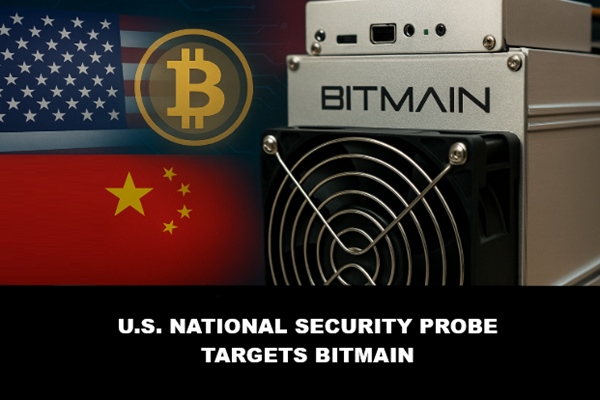
What investigators are evaluating?
The current federal probe revolves around two core risk vectors:
- Firmware control and remote update pathways.
These pathways allow legitimate upgrades but could, in theory, be exploited to issue synchronized instructions to thousands of miners.
- Hidden telemetry or data-exfiltration channels.
Mining facilities in Texas, Washington, Oklahoma, and Ohio sit near substations, high-voltage lines, or military installations. Regulators want to assess whether any outbound communication beyond standard pool protocols exists inside certain hardware configurations.
Homeland Security has already conducted physical inspections at ports and sent selected Bitmain units for teardown analysis at independent labs.
Officials have not accused the company of wrongdoing, but they argue that the presence of any unverified communication capabilities inside imported hardware warrants thorough testing, given China’s 2017 National Intelligence Law.
How exposed are U.S. mining companies?
Publicly listed Bitcoin miners are already preparing for potential supply-chain turbulence, as company disclosures show just how dependent the industry is on Bitmain hardware.
Marathon Digital reports that roughly 60 percent of its active fleet consists of Bitmain machines, while Riot Platforms operates with about 55 percent. CleanSpark’s exposure is even higher, with an estimated 65 to 70 percent of its deployed units sourced from Bitmain’s S19 and S21 series.
Alternative suppliers exist; primarily MicroBT (WhatsMiner) and Canaan (Avalon), but their combined global market share remains near 25–30 percent, and their flagship units typically cost more. If Bitmain imports are slowed or restricted, miners may face 20–35 percent increases in hardware costs over the next two quarters.
Hash rate climbed from 420 EH/s in January to a peak above 680 EH/s in early Q4, partially fueled by new U.S. facilities coming online. A security-driven supply chain shock would echo previous episodes. When China banned domestic mining in 2021, the global hash rate fell nearly 50 percent within three months.
The investigation fits a broader U.S. strategy toward Chinese technology suppliers in strategic sectors. Prior actions against Huawei, Hikvision, and SMIC were grounded in similar concerns: over-reliance on equipment designed in jurisdictions with mandatory state cooperation laws.
Congress is simultaneously debating several mining-related measures, including energy-consumption reporting standards and critical-infrastructure proximity rules.
Bitmain, cautious in tone, stated that it “complies fully with applicable U.S. requirements” and supports transparent review.
The Road Ahead
Many operators have begun stockpiling spare parts to keep existing fleets running longer, while others are actively testing alternative machines from WhatsMiner and Avalon in case Bitmain shipments face prolonged delays.
Several expansion projects have already been paused as companies wait for clearer guidance on import timelines and regulatory direction.
Regulators, meanwhile, are weighing a range of responses.
Measures could remain narrow, focusing on facilities located near critical infrastructure, or could expand to include mandatory firmware verification across all imported mining equipment.
The most severe option, a broad import ban resembling earlier telecom restrictions, remains possible, though not yet signaled as imminent.


 eabungana@gmail.com
