





 FTX’s Caroline Ellison to Exit Federal Custody in 2026
  Article Contributors

 Fact checked by

The saga traces back to November 2022, when FTX, the exchange founded by Sam Bankman-Fried, imploded under the weight of revelations that customer funds had vanished into a black hole of risky bets and hidden loans.
Valued at $32 billion at its zenith, FTX handled billions in daily trades and attracted over a million users globally.
The collapse exposed an $8 billion shortfall, triggering bankruptcy proceedings that listed liabilities between $10 billion and $50 billion, affecting more than 100,000 creditors worldwide.
Crucial Cooperation
Prosecutors later uncovered how Alameda, FTX’s sister hedge fund, had siphoned customer deposits to plug trading losses, a scheme that violated basic financial safeguards and eroded trust across the sector.
Ellison’s involvement ran deep. She joined Alameda in 2018 as a trader, rising to CEO in 2021 after Bankman-Fried stepped back to focus on FTX. Their professional ties are intertwined with a personal relationship, adding layers of complexity to the investigation.
Court documents revealed that Alameda enjoyed special privileges on FTX’s platform, including a secret $65 billion line of credit funded by user assets.
When market turbulence hit in 2022, triggered by a broader crypto downturn where Bitcoin plunged from $69,000 to below $20,000, the facade crumbled. A tweet from rival exchange Binance’s CEO questioning FTX’s solvency sparked a bank run, with $6 billion withdrawn in 72 hours, sealing the exchange’s fate.
Facing the fallout, Ellison chose cooperation over defiance.
In December 2022, before her charges went public, she pleaded guilty to seven felony counts: two of wire fraud, four of conspiracy to commit fraud, and one of money laundering. This decision contrasted sharply with Bankman-Fried’s initial denials.
Her plea deal required full disclosure, and she delivered. During Bankman-Fried’s 2023 trial, Ellison spent three days testifying, detailing directives to fabricate balance sheets that showed Alameda with $10 billion in assets against negligible debts.
She described a frantic effort to mislead lenders like Genesis, which lost $175 million in the mess, and regulators who had overlooked the commingling of funds.
Her candor proved instrumental. Prosecutors credited Ellison’s evidence with securing Bankman-Fried’s conviction on all seven counts, leading to his 25-year sentence in March 2024.
Sentence & Reentry
Other FTX executives followed suit: Gary Wang, the chief technology officer, and Nishad Singh, head of engineering, also cooperated, receiving time served and three years’ probation, respectively. Ellison’s remorse resonated in court; she apologized for the harm inflicted on innocent users, many of whom saw life savings evaporate.
U.S. District Judge Lewis Kaplan acknowledged her “extraordinary cooperation” during sentencing on September 24, 2024, but imposed a 24-month prison term and ordered her to forfeit $11.02 billion—a symbolic figure matching the scale of the fraud, although her personal assets totaled just $28 million.
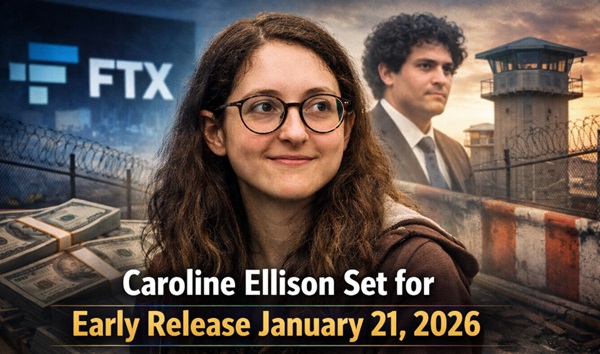
Ellison reported to the Federal Correctional Institution in Danbury, Connecticut, on November 7, 2024, to begin her sentence. After serving roughly 11 months, she transferred to community confinement in New York on October 16, 2025, a step toward reintegration that includes halfway house residency or home detention.
The Bureau of Prisons initially projected her release for February 20, 2026, but recent updates advanced it by nearly a month, attributed to good behavior credits under federal guidelines that allow up to 54 days off per year for model conduct.
Post-release, she faces three years of supervised probation and a 10-year prohibition from roles in cryptocurrency exchanges or as an officer in public companies.
Ongoing Recovery
This development unfolds against a backdrop of partial redemption for FTX’s victims. The bankruptcy estate, under administrator John Ray III, has clawed back assets through sales and recoveries, amassing over $16 billion. Plans announced in 2025 aim to repay creditors 118% to 143% of their claims, a rare outcome in such insolvencies.
Bankman-Fried, meanwhile, appeals his conviction from a California prison, with a potential release not until 2044 if unsuccessful. His recent bid for a presidential pardon from Donald Trump, who returned to office in 2025 and already freed Binance founder Changpeng Zhao, adds intrigue. Critics argue it undermines justice, especially given the $160 million in political donations tied to FTX funds.
Ellison’s impending release signals closure for one player in this drama, but the FTX debacle continues to echo. It exposed vulnerabilities in decentralized finance, where rapid growth outpaced oversight, leading to losses estimated at $10 billion for users. As the market rebounds, with global crypto capitalization exceeding $3 trillion, industry leaders emphasize transparency and audits to prevent repeats.


 eabungana@gmail.com
