





 Iran Accepts Cryptocurrency for Advanced Arms Exports
  Article Contributors

 Fact checked by

Circumventing Sanctions via Digital Assets
The shift reflects Tehran’s long-running effort to circumvent Western financial sanctions and strengthen its access to global revenue.
Traditional banking networks such as SWIFT remain closed to Iranian entities after years of U.S., European Union, and United Kingdom restrictions tied to the country’s nuclear activities and regional security policies.
The crypto payment option is a strategic adaptation to those constraints.
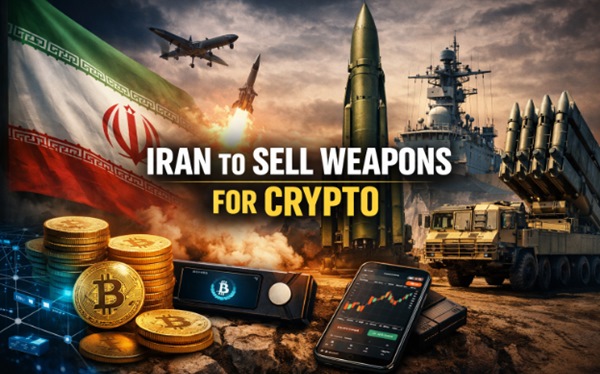
A Digital Catalog of Advanced Weaponry
Established in 1989, Mindex now markets over 3,000 products through a sleek online portal, complete with a virtual chatbot that fields inquiries in multiple languages.
Buyers can browse ballistic missiles like the Emad series, capable of striking targets up to 1,700 kilometers away, alongside Shahed drones that have proven devastating in conflicts such as Russia’s war in Ukraine.
Warships from the Shahid Soleimani class, short-range air defense systems like the Majid, anti-ship cruise missiles, rockets, and small arms round out the catalog.
Prices remain undisclosed on the site, but negotiations allow for inspections in Iran under strict security protocols.
The Rise of “Shadow Banking” Networks
This development builds on Iran’s longstanding use of digital assets to navigate economic isolation. Blockchain analytics firm Chainalysis reported that sanctioned countries, including Iran, received nearly $16 billion in cryptocurrencies in 2024 alone.
The U.S. Treasury, in September 2025, exposed networks involving two Iranians who processed over $100 million in Bitcoin for oil sales between 2023 and 2025.
These “shadow banking” operations have funded everything from energy exports to military procurements, with Iran ranking 18th globally in major arms exports that year, according to the Stockholm International Peace Research Institute.
Mindex claims ties to clients in 35 countries, though specifics remain veiled. Potential buyers must agree to terms on weapon usage, particularly in wars against other nations, but these clauses are open to negotiation.
The agency’s FAQ dismisses sanctions worries outright, assuring that contracts will proceed without delay. This confidence reflects Iran’s broader strategy of resilience, honed through decades of pressure.
Global Security and Regulatory Implications
Recall how Tehran supplied drones to Russia amid the Ukraine invasion, deals that drew fresh U.S. penalties and highlighted the limits of traditional enforcement.
Yet the implications ripple far beyond Tehran’s borders. For the crypto market, this validates digital assets as tools for real-world evasion, potentially inviting stricter regulations. The Financial Action Task Force has long warned about misuse by rogue states, and this could accelerate calls for enhanced tracking under frameworks like Europe’s MiCA.
Exchanges might face tougher know-your-customer requirements, while institutional investors hesitate amid geopolitical risks. Bitcoin, hovering near $89,000 in early 2026, could see volatility if regulators crack down on wallets linked to such trades.
On the security front, the offer exacerbates proliferation concerns. Weapons like the Shahed drones have already altered battlefields, empowering non-state actors in the Middle East and beyond. With UN sanctions reimposed in 2025 over Iran’s nuclear program, following the collapse of diplomatic talks with Britain, France, and Germany, the timing feels deliberate.
Western officials fear this could arm adversaries in hotspots from Yemen to Venezuela, where Iran has historical ties. The U.S. Treasury’s Office of Foreign Assets Control has ramped up designations, blacklisting entities tied to these networks, but crypto’s pseudonymity complicates tracing.
Critics argue this exposes the double-edged sword of decentralization. While proponents hail it as financial inclusion for oppressed economies, the move aligns with a trend among sanctioned nations; Russia and North Korea have similarly explored crypto for illicit activities, drawing bipartisan scrutiny in Washington.
Economically, the stakes are high. Iran’s arms industry, bolstered by domestic innovation, fills voids left by Russia’s diverted exports due to its ongoing conflict. If successful, this could generate hundreds of millions in revenue, bolstering Tehran’s foreign reserves, strained by oil export curbs. Yet counterparties risk secondary sanctions, which could bar them from U.S. markets and trigger asset freezes.
As global finance evolves, Iran’s gambit underscores a pivotal shift. Digital currencies, once niche, now underpin state strategies, challenging the post-World War II order. Whether this sparks a regulatory backlash or normalizes crypto in international trade remains uncertain, but one thing is clear: the fusion of warfare and blockchain demands vigilant oversight from policymakers and investors alike.


 eabungana@gmail.com
