





 Pakistan Signs Stablecoin Deal With Trump-Linked Firm
  Article Contributors

 Fact checked by

Modernizing Remittances Through Digital Architecture
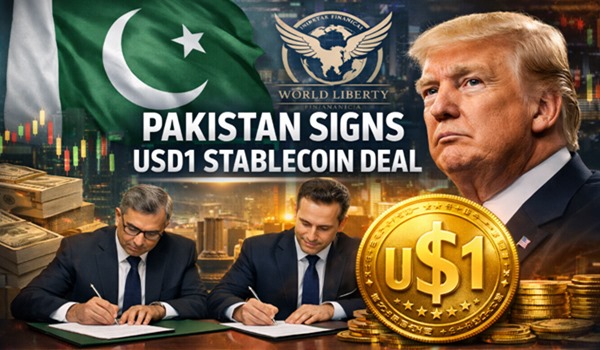
Finance Minister Muhammad Aurangzeb and Zach Witkoff, co-founder and CEO of World Liberty, signed a Memorandum of Understanding (MoU) in Islamabad under the auspices of the Pakistan Virtual Asset Regulatory Authority (PVARA).
- This agreement initiates technical discussions on integrating USD 1 into the country’s emerging digital payment system, particularly for remittances and international settlements.
Pakistan’s interest in stablecoins like USD1 arises from ongoing challenges in cross-border payments. Remittances from overseas workers are a vital source of foreign exchange for Pakistan, amounting to more than $30 billion in recent years. However, traditional channels often involve high fees and slow settlement times.
- The infrastructure provided by stablecoins has the potential to lower these costs while enhancing the speed and transparency of international money transfers.
Experts believe this could significantly benefit Pakistani households that depend on remittance income.
The Memorandum of Understanding (MoU) does not require immediate issuance or deployment but establishes a framework for regulated engagement with the project.
Technical Design and Institutional Adoption of USD1
USD1 is a stablecoin specifically designed to maintain a 1:1 peg to the U.S. dollar. It is currently active on several major blockchain networks, including Ethereum and Binance Smart Chain.
- The token is backed by traditional fiat reserves such as U.S. Treasury bills and cash deposits, which help support its dollar peg.
This collateral structure aligns USD1 with established stablecoins in the industry, as opposed to relying on algorithmic models that have historically faced instability.
World Liberty Financial, launched in late 2024, has actively sought to integrate its products into broader financial systems.
In 2025, for instance, USD1 was reportedly utilized by a state-backed investor from Abu Dhabi in a $2 billion equity transaction involving Binance.
This deal underscored the growing institutional interest in stablecoins as settlement assets.
Navigating Regulatory Evolution and Political Sensitivities
The agreement with Pakistan comes at a time when global markets are experiencing regulatory changes. In the United States, federal policy updates in 2025 have established clearer pathways for the use of regulated stablecoins within financial infrastructure.
These changes have lowered barriers for projects like World Liberty to explore integration with foreign central banks. Pakistan’s agreement shows a similar openness among emerging economies to investigate how stablecoins could support local digital currency initiatives.
The central bank of Pakistan has also announced plans to pilot its own digital currency and is in the process of finalizing legislation to regulate virtual assets.
Officials from the Finance Ministry and regulatory bodies have emphasized that any involvement with stablecoins will closely adhere to regulatory safeguards aimed at protecting monetary stability and preventing illicit financial activities.
Economic Benefits and the Regional Outlook
However, the connection between this project and the Trump family brings political scrutiny to the financial assessment. World Liberty Financial has strong ties to Donald Trump and his business interests.
Supporters view the firm’s initiatives as innovative advancements in digital finance, while critics express concerns about potential conflicts of interest and governance transparency where public policy intersects with private digital asset ventures.
The memorandum of understanding (MoU) with Pakistan is carefully framed as a non-binding technical collaboration rather than a formal adoption of a foreign digital currency.
Economists note that stablecoins could offer Pakistan tangible benefits if integrated responsibly.
- Lower transaction costs, faster clearing times, and more direct access to U.S. dollar-linked instruments could deepen financial inclusion for underserved segments of the population.
- Regulators will need to build robust oversight frameworks to mitigate systemic risks, such as liquidity stresses or dependency on offshore reserve holdings.
Pakistan’s central bank governor has previously signaled that digital payments modernization is a priority, but underscored that safeguards remain paramount.
Regional peers are monitoring closely.
- Countries in Asia and Africa are investigating how stablecoins could integrate into their payment systems.
- El Salvador’s early adoption of Bitcoin sparked a global discussion on how nations are approaching digital assets.
- Pakistan’s agreement, valued at USD 1, demonstrates a more cautious exploration of digital currency within a regulated framework, rather than a complete replacement of its traditional monetary system.
The technical discussions launched by the Pakistan–World Liberty MoU are expected to unfold over the coming months. Regulators and technology partners will assess compliance mechanisms, interoperability with existing payment rails, and risk management protocols.
- Observers say the initiative could become a benchmark for how emerging markets engage with private stablecoin infrastructure under state oversight.
As regulators and markets digest the implications, Pakistan’s engagement with USD1 illustrates how digital assets are transitioning from speculative phenomena to potentially strategic elements of national financial architectures.
Whether this partnership leads to tangible deployment remains to be seen, but it has already catalyzed global dialogue on the role of stablecoins in mainstream finance.



 eabungana@gmail.com
