














 Pi Network Upgrade Sparks Optimism
 Article Contributors


 Fact checked by
 Read Time: 2mins
 Published: 17/04/2026 | Updated: 17/04/2026


Technological Evolution: The Road to Protocol 22
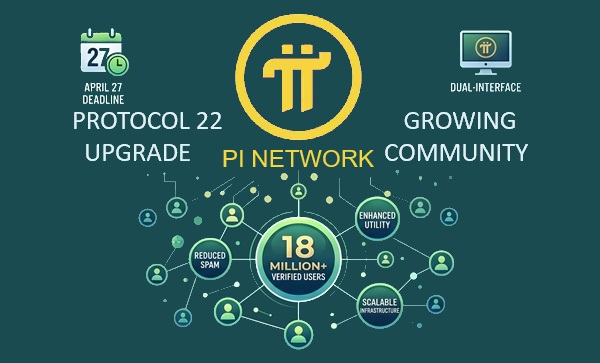
Following the successful deployment of Protocol 21 earlier this month, the Pi Core Team has confirmed that the next major milestone, Protocol 22, is scheduled for April 27.
This update is designed to bridge the gap toward a more robust mainnet environment. One of the standout features of this version is the introduction of a dual-interface system.
This new architecture will allow the community to access a desktop-based application alongside the standard node interface, enabling users to manage their balances and interact with ecosystem features directly from their computers.
Furthermore, the upgrade initiates a phased rollout for node operators. Participants can now begin installing core blockchain components to assist with network validation. However, this participation remains contingent on mandatory KYC compliance and a selection process based on node reliability.
This shift is widely viewed as a precursor to the V23 update, which is expected to finally unlock full smart contract capabilities for decentralized application developers.
Historical Look-Back: The LightChain AI Milestone
Reflecting on the network’s progress over the past year, it is hard to ignore the momentum that began building during the 2025 integration with LightChain AI.
That collaboration served as a pivotal moment for the ecosystem, as it introduced advanced AI-driven verification and scalability solutions that paved the way for the high-density user verification we see today.
By successfully merging LightChain’s decentralized intelligence with the Pi protocol, the developers were able to streamline the transition toward an Open Mainnet, proving that the network could handle complex data processing without sacrificing its core mobile-first philosophy.
This retrospective look highlights how far the infrastructure has come, evolving from those early AI experiments into the sophisticated Protocol 22 framework currently being deployed.
Price Momentum and Technical Breakout
The market has responded favorably to these developmental strides. On April 17, the price of Pi surged by roughly 8%, climbing to a three-week peak of approximately $0.182. Technical analysts have pointed to a clear breakout from a falling wedge pattern on the daily charts—a formation typically associated with a bullish reversal.
Current indicators reinforce this positive sentiment. The Chaikin Money Flow has trended upward, signaling a steady influx of capital as traders position themselves ahead of the mainnet transition.
While immediate resistance is anticipated around the $0.204 mark, the overall structure suggests that the previous bearish cycle is losing its grip. However, market experts remain cautious, noting that a dip below the $0.163 support level could stall the current rally.
Growing User Base and Network Trust
Beyond the technical updates, the network’s fundamental strength is evidenced by its rapidly expanding user base. The project recently celebrated a milestone of over 18 million verified users.
The Core Team emphasizes that these are not merely registrations but verified individuals, a distinction they claim reduces spam and enhances the reliability of future utility-driven transactions.
As the network moves away from its experimental roots and toward a functional blockchain, the focus is shifting toward real-world applications.
With the potential for decentralized finance (DeFi) integrations on the horizon, the coming weeks will be critical in determining whether Pi can sustain this upward trajectory and fulfill its long-standing roadmap promises.


 eabungana@gmail.com

