





 Euro-Pegged Stablecoin Consortium by European Banks
  Article Contributors

 Fact checked by

A Powerhouse Consortium and Regulatory Foundation
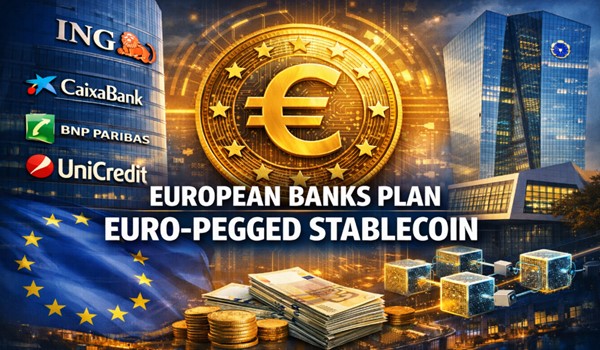
The euro-pegged stablecoin initiative brings together a roster of seasoned European lenders: CaixaBank, ING, UniCredit, Banca Sella, KBC, Danske Bank, DekaBank, SEB, and Raiffeisen Bank International.
BNP Paribas became the tenth member upon joining in early December 2025, expanding the consortium’s collective balance-sheet heft and reach across Europe’s financial markets.
Unlike earlier exploratory projects, this effort has now advanced beyond planning. Qivalis has applied for an electronic money institution license with the Dutch Central Bank and is structured to operate under the European Union’s comprehensive Markets in Crypto Assets Regulation, known as MiCAR.
Passing the MiCAR compliance threshold is widely viewed as essential for any regulated stablecoin issuer in Europe.
Strategic Leadership and Market Evolution
Qivalis will initially focus on crypto market use cases such as trading and near-instant settlement. Over time, executives said they aim to broaden the token’s role into programmable payments, cross-border settlement, and integration with existing banking services.
The consortium has appointed Jan-Oliver Sell, former head of Coinbase Germany, as CEO and Sir Howard Davies, once chairman of the UK’s Financial Services Authority and NatWest Group, as chair of the supervisory board, giving the project leadership with deep regulatory and digital finance experience.
The move by these banks is part of a broader trend within Europe’s financial sector to embrace digital assets under strict regulatory guardrails. In recent years, institutions such as Société Générale’s SG-Forge division have already issued euro-denominated tokens, though on a far smaller scale than what Qivalis aims to achieve.
According to industry data, SG-Forge’s euro-pegged coin circulation stood around €68 million recently, signaling that market demand for regulated digital money exists but remains limited compared with global counterparts.
The MiCAR Framework and Institutional Trust
Regulatory context matters. MiCAR consolidated Europe’s approach to digital financial assets, setting out clear licensing requirements, transparency standards, and investor protections.
Stablecoins issued under MiCAR must maintain full reserves, subject themselves to regulatory supervision, and adhere to strict operational governance—an environment that proponents argue fosters trust among institutional users and retail participants alike.
Europe’s push into regulated stablecoins comes amid concerns that private, largely dollar-linked tokens could siphon liquidity out of traditional banking systems and complicate monetary policy.
Institutions such as the European Central Bank have underscored the need for oversight, highlighting that unregulated digital money can pose systemic risks if it grows unchecked.
Qivalis aims to offer an alternative anchored in regulated banking structures, leveraging the consortium’s pooled expertise and capital to provide fully reserved digital euros.
According to Qivalis’s mission statement, its stablecoin will be “100 percent backed by reserves held in euros and high-quality liquid assets held by regulated custodians,” a commitment aimed at smoothing regulatory review and bolstering confidence in the token’s integrity before and after launch.
Future Outlook: Settlement Efficiency and Adoption
Europe’s largest banks have also cited strategic imperatives beyond mere innovation. A euro-denominated stablecoin has the potential to reduce costs and settlement times for cross-border payments, a long-standing pain point in global finance.
For corporate treasurers and wholesale clients, on-chain payments could cut days off settlement cycles and lower foreign exchange friction by enabling near-instant transactions around the clock.
Still, challenges lie ahead.
- Qivalis must satisfy regulators that it can safely manage reserves, comply with anti-money-laundering standards, and scale technology without compromising system stability.
- Market participants also note that euro stablecoins currently represent a small fraction of the total stablecoin market, where dollar-linked tokens dominate.
Broader adoption will require compelling use cases that justify banks and corporate clients migrating portions of liquidity onto blockchain rails.
Despite these hurdles, the consortium’s formation signals a shift in traditional banking attitudes toward digital currencies. Where European banks once viewed crypto assets with caution, many now see regulated stablecoins as an opportunity to extend their core payment and settlement businesses into blockchain-native environments.
This represents a major evolution in how legacy players engage with digital finance.
As Europe’s regulated stablecoin infrastructure continues to mature, Qivalis’s planned 2026 launch will be closely watched by regulators, payment firms, and global financial markets. Success could position the bloc as a credible alternative to dollar-centric tokens and reinforce the euro’s role in digital finance


 eabungana@gmail.com
