





 Crypto Regulation’s Turning Point: Inside the SEC-CFTC Harmonization Push
  Article Contributors

 Fact checked by

From Enforcement to Alignment
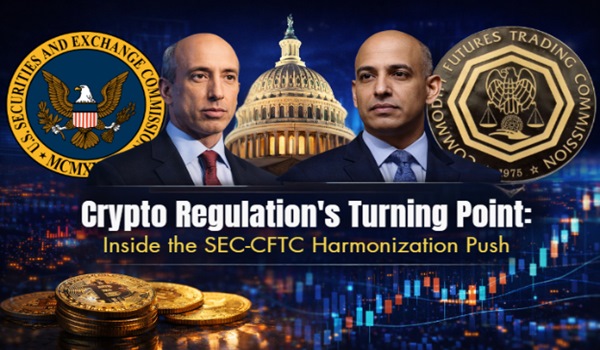
Senior officials from the Securities and Exchange Commission and the Commodity Futures Trading Commission convened for a joint forum on harmonizing crypto regulation, an event that carried significance far beyond its formal title.
The appearance marked a shift in tone from years of jurisdictional friction and enforcement-driven policymaking toward something markets have repeatedly asked for but rarely received: coordinated regulatory clarity.
That shift matters because, for much of the past decade, crypto regulation in the United States arrived primarily through lawsuits, investigations, and settlement announcements.
The SEC built its approach around enforcement actions against token issuers and major trading platforms, often arguing that digital assets were unregistered securities subject to federal disclosure laws.
The CFTC, operating under a different mandate, focused on fraud, manipulation, and misconduct in crypto-linked futures, swaps, and derivatives markets.
Those actions shaped behavior, but they also created uncertainty.
- Firms struggled to determine which rules applied to which assets.
- Compliance obligations overlapped, sometimes conflicted, and evolved through court rulings rather than clear rulebooks.
- Industry participants warned that the lack of consistent standards discouraged investment and pushed innovation offshore, even as crypto markets grew into a multi-trillion-dollar global sector.
The January meeting acknowledged those tensions openly. Regulators framed the discussion as part of a broader effort, known as Project Crypto, to coordinate oversight without abandoning statutory responsibilities.
The goal, officials said, is not to dilute enforcement but to align supervision across markets that no longer fit neatly into legacy regulatory boxes.
Closing the Infrastructure Gap
That structural challenge sits at the center of the harmonization push. Traditional financial oversight divides responsibilities across trading, clearing, custody, and risk management. Crypto markets routinely collapse those functions into single platforms that operate continuously and across borders.
Fragmented oversight has persisted largely because regulatory boundaries were designed for earlier generations of financial infrastructure, not for digitally native markets where assets, services, and technologies converge.
Regulators argued that maintaining separate, siloed approaches has produced gaps and inefficiencies. A platform might face one set of requirements for spot trading, another for derivatives exposure, and yet another for custody, even when those activities are tightly integrated.
Harmonization, in this context, is being presented as a practical response to modern market structure rather than a philosophical shift.
The Push for Unified Classification
A key element under discussion is the development of a shared framework for classifying digital assets. Jurisdictional disputes over whether tokens are securities or commodities have fueled years of litigation and uncertainty.
Officials said a more consistent taxonomy, grounded in economic function rather than labels, could reduce disputes and give firms clearer guidance on compliance expectations.
The timing of the initiative is notable. Congressional efforts to legislate comprehensive crypto rules have advanced unevenly. Several bills aimed at clarifying regulatory authority and establishing guardrails for stablecoins moved forward in early 2026, but political disagreements have slowed final passage.
A White House meeting earlier this month failed to resolve core differences, leaving regulators to act within existing mandates.
Regulatory Coordination Amidst Legislative Delay
That legislative uncertainty has elevated the importance of inter-agency coordination. In recent months, the SEC and CFTC have issued joint statements clarifying aspects of spot crypto trading and convened shared industry roundtables on market structure and custody risks.
While incremental, those steps contrast sharply with years in which the agencies largely pursued parallel, and sometimes competing, approaches.
The CFTC’s evolving posture has also drawn attention. Under Chairman Michael Selig, the agency has revisited rules governing event contracts and prediction markets tied to real-world outcomes, areas where crypto technology intersects with traditional derivatives.
Rather than relying solely on enforcement, the CFTC has signaled a willingness to define clearer parameters under which such products may operate.
What remains unresolved is how far coordination can extend without new legislation. Regulators have discussed formal agreements covering data sharing, joint examinations, and synchronized rulemaking timelines. If implemented, such measures would represent a significant shift from years of agency rivalry toward a more unified supervisory model.
For now, the January forum stands as a marker of change. After a decade in which crypto regulation advanced largely through enforcement actions and court battles, U.S. regulators are attempting to construct a coherent framework that reflects how digital markets actually function.
Whether that effort delivers lasting clarity will shape not only the future of crypto in the United States but the country’s ability to compete in the next phase of global financial innovation.



 eabungana@gmail.com
