





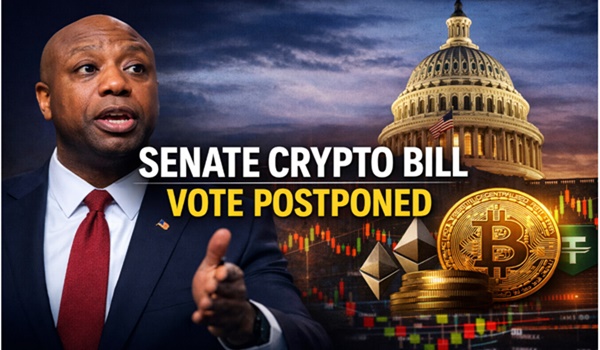
 Senate Crypto Bill Vote Postponed After Industry Opposition and Political Friction
  Article Contributors

 Fact checked by

Industry Pushback Halts Legislative Momentum
Senate Banking Committee Chairman Tim Scott (R-S.C.) described the postponement as a temporary pause to build bipartisan consensus, saying lawmakers and stakeholders are “working in good faith” toward a revised text. The committee is expected to reconvene once negotiations incorporate broader industry input.
The bill sought to divide regulatory authority between the Securities and Exchange Commission (SEC) and the Commodity Futures Trading Commission (CFTC) and to provide clarity on when crypto tokens qualify as securities rather than commodities. It also addressed stablecoin regulation, oversight of decentralized finance, and more explicit consumer protections.
Armstrong’s staunch rejection centered on what he described as unacceptable trade-offs in the draft legislation. Key criticisms included provisions that would:
- effectively prohibit tokenized equities, a fast-emerging asset class
- impose strict data and compliance requirements on decentralized finance, potentially eroding user privacy
- undermine the CFTC’s intended oversight role
- eliminate many kinds of stablecoin reward programs that exchange platforms currently offer
In a post on X (formerly Twitter), Armstrong wrote that “We’d rather have no bill than a bad bill,” framing his stance as a principled rejection of rules that could lock in structural disadvantages for crypto innovators.
Market Volatility Follows Regulatory Uncertainty
The legislative hiccup did not remain confined to Capitol Hill. Financial markets tied to digital assets quickly reflected the heightened uncertainty. Bitcoin, which had briefly approached $97,000 earlier in the week, slipped below $96,000 following the news, while ether and other major tokens edged lower.
Equity markets with crypto exposure also reacted. Coinbase Global Inc. stock fell sharply, ranking among the weaker performers in the S&P 500 in the immediate aftermath of the announcement. Robinhood and Marathon Digital Holdings (MARA) saw share prices decline as traders reassessed regulatory risk in the wake of the delay.
Bitedge analysts noted that the reaction reflects broader investor caution ahead of major legislative inflection points. Markets had priced in expectations that a stable regulatory regime would provide clearer paths for institutional investment and product innovation. Instead, the postponement has extended a period of regulatory ambiguity that has persisted for years.
A Narrowing Window for Bipartisan Consensus
Lawmakers across the aisle acknowledge the narrow window available to finalize crypto legislation. The Senate Agriculture Committee, which must also approve the bill before it can reach the floor, has similarly delayed its sessions.
Debate over the bill’s content has split lines not only between Republicans and Democrats but within the crypto industry itself. Some executives argue that a unified framework could eventually spur competition and protect investors, while others warn that poorly drafted rules may entrench legacy financial interests at the expense of innovation.
Senator Cynthia Lummis (R-Wyo.) publicly expressed disappointment with the opposition but maintained that feedback will be vital to producing a durable and workable law. A senior White House crypto adviser also encouraged stakeholders to use this period to iron out differences and avoid future disruptions.
Market watchers now face a recalibrated timeline. The Senate Banking Committee may resume discussion once updated language is drafted and consensus grows around key sticking points, which could take weeks. Some observers caution that if progress does not materialize before early February, the bill risks being effectively shelved as election-year politics consume Washington’s legislative bandwidth.
For the crypto industry, the episode illustrates the challenge of securing federal regulatory clarity amid competing interests: innovation versus traditional finance, consumer protection versus market freedom, and bipartisan legislative strategy versus commercial lobbying.
The Broader Context
This pause in U.S. crypto policymaking contrasts with regulatory actions in Europe and parts of Asia, where digital asset frameworks have made incremental advances. Investors and companies with global operations are watching closely, balancing hopes of domestic clarity against the risk of falling behind international competitors.
The delayed vote marks a significant inflection point in the effort to legislate digital assets. Whether it ultimately leads to a stronger bill, protracted negotiations, or increased regulatory uncertainty remains a defining question for the year ahead.


 eabungana@gmail.com
